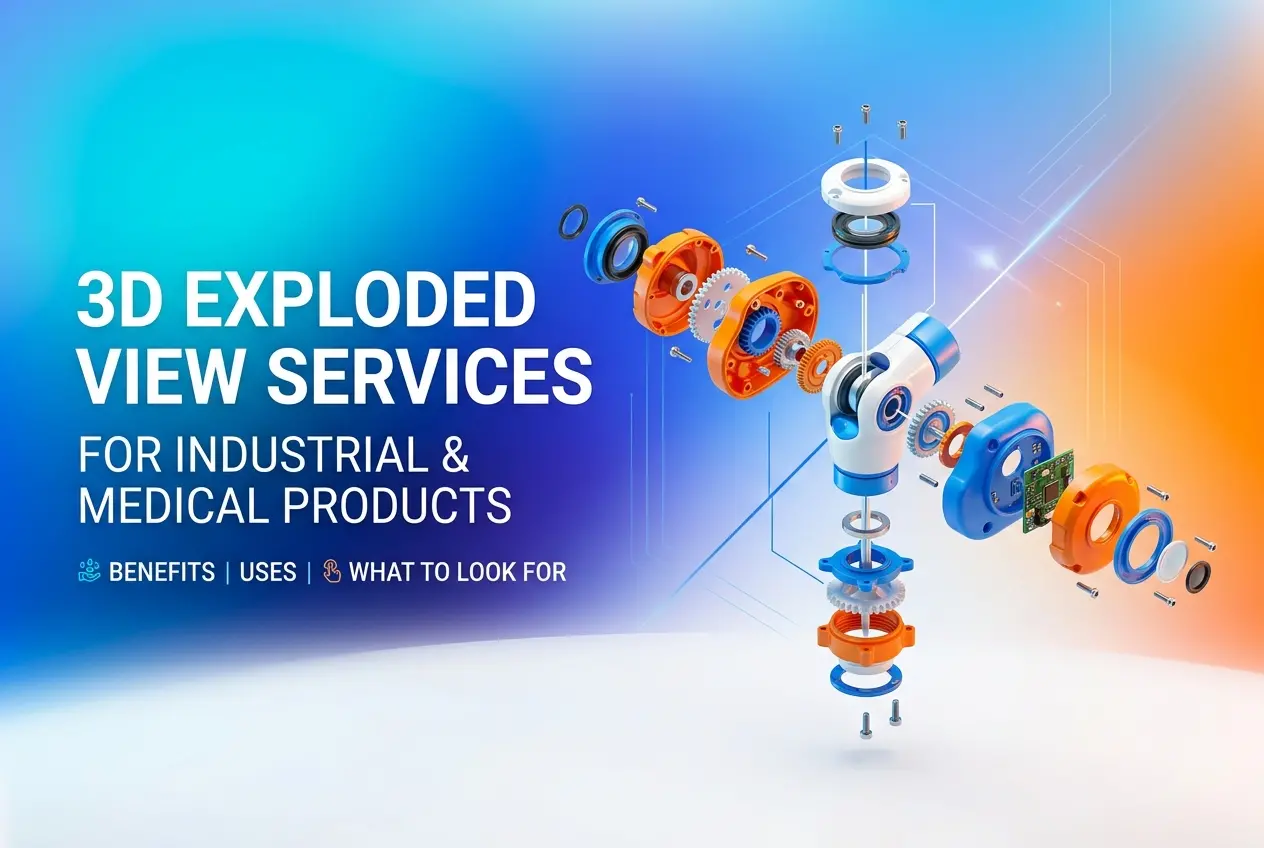
When a product has layers — circuit boards tucked inside plastic housings, mechanical assemblies with interlocking parts, medical devices with components that a buyer or reviewer will never physically touch — a standard 3D render only tells half the story. That’s exactly where 3D Exploded View Services for Industrial and Medical Products: Benefits, Uses and What to Look For becomes a real conversation worth having. An exploded view takes a product apart visually, floating each component in space along a logical axis so the viewer can understand what’s inside, how it connects, and why the design works the way it does. It’s one of the most technically demanding and genuinely useful outputs a 3D studio can produce.
We’ve been producing exploded views here at 360render.com for a range of clients across medical technology, consumer electronics, and industrial equipment. Two projects that stand out are for Xandar-Kardian and Lexound — both companies came to us wanting to show the internal electronics of their devices cleanly, without the mess of a physical teardown or the cost of custom photography. The exploded views did that job perfectly, floating each internal layer — PCBs, antennas, battery modules, sensor arrays — in a way that looked precise and intentional. Their teams specifically called out the exploded views as the assets they liked most from the entire project. That reaction isn’t unusual. When clients see a clean exploded view for the first time, it often becomes the hero asset of their whole communication strategy.
This post breaks down what exploded views actually involve technically, where they’re most useful, what makes a good one versus a mediocre one, and what you should look for when hiring a studio to produce them.
What Is a 3D Exploded View and How Is It Built?
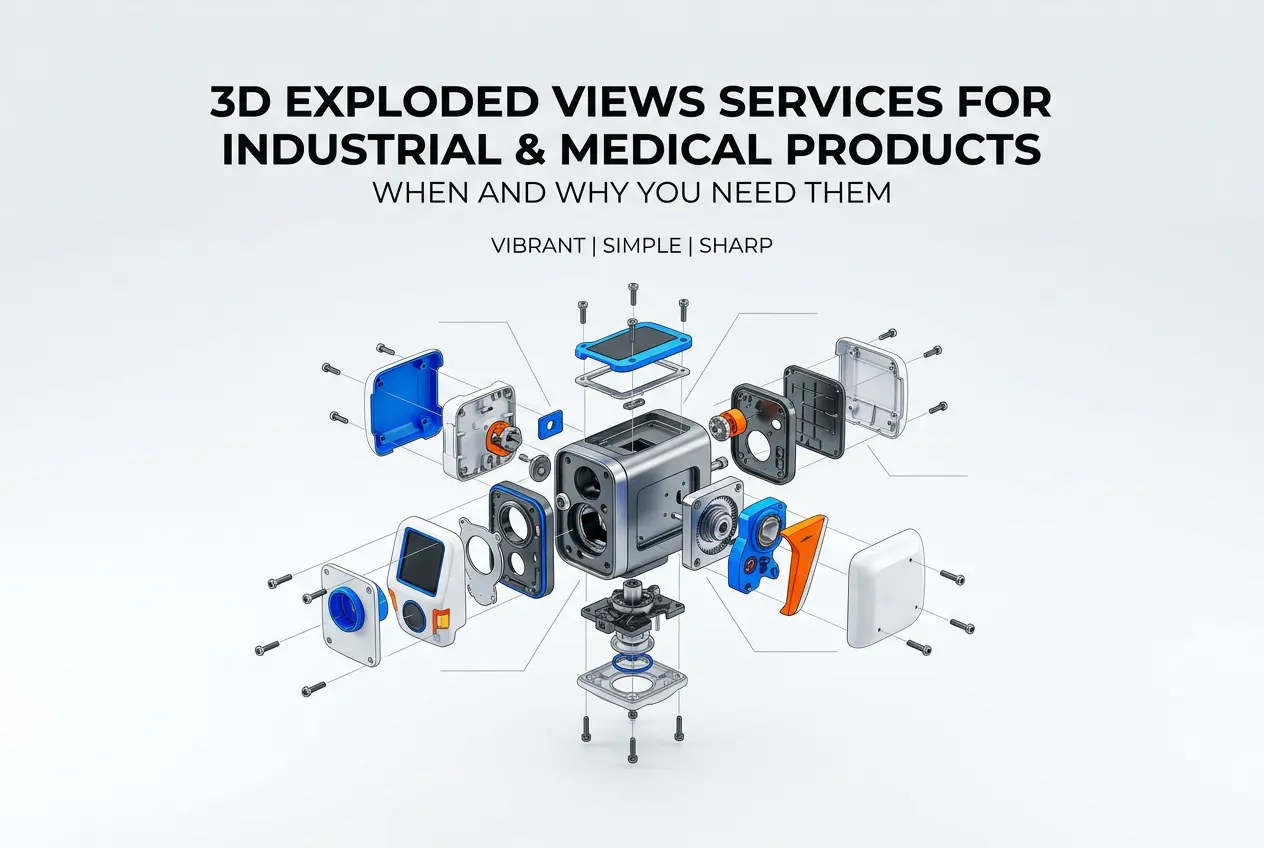
An exploded view is a 3D rendering where the components of a product are spatially separated along a defined axis — usually vertical, horizontal, or along the product’s primary assembly direction — so each part is clearly identifiable and the assembly logic is readable at a glance. Think of it like pausing an assembly animation at the perfect moment.
The process starts with geometry. You either work from CAD files provided by the client — STEP, IGES, SolidWorks, or similar formats — or you build the model from scratch using reference drawings, physical samples, or technical documentation. Industrial and medical products almost always have CAD data, which is a genuine advantage because the geometry is accurate to real-world tolerances. This matters a lot when you’re showing mechanical fits or electronic components, where the relative size and position of parts carries real information.
Once the geometry is prepared, each component is assigned materials and shaders — which is where a lot of studios cut corners. Plastics have subsurface scattering characteristics. Metal components reflect differently depending on finish (brushed, anodized, raw). Circuit boards have their own complex material behavior: solder mask colors, copper trace reflectivity, silkscreen printing on component labels. Getting these right is the difference between a render that looks like a product and one that looks like a toy.
The actual explosion is then set up by offsetting components along defined vectors. Good studios do this with intention — the explosion should follow the product’s natural assembly sequence, not just randomly push parts apart. Annotations, dimension lines, or component callouts are often added as a post-production layer, either in the 3D environment or in compositing software like After Effects or Photoshop.
Why 3D Exploded View Services for Industrial and Medical Products Matter More Than You Think
Physical photography of internal components is expensive, slow, and destructive. You either need to sacrifice a production unit or work with an engineering prototype that may not represent final materials. You need specialized macro photography equipment and lighting setups. You need someone who understands both photography and the product well enough to make the internals look intentional rather than chaotic.
A 3D exploded view sidesteps all of that. Once the model is built, you can render it from any angle, at any resolution, with any background, for any use case — white background for technical documentation, dark gradient for marketing, in-context environment for trade show materials. You get full control over what’s visible and what isn’t. If a component isn’t final yet, you can render a placeholder or exclude it from the explosion. If the client changes the color of a housing part, you update the material shader and re-render — no new photography needed.
For medical products specifically, exploded views often serve regulatory and compliance functions. Device manufacturers need to communicate assembly sequences to manufacturing partners, service technicians, and sometimes regulatory bodies. A well-structured 3D exploded view can replace or supplement technical drawings in ways that are faster to understand for non-engineering audiences. For industrial products — machinery, tools, enclosures, fluid handling systems — exploded views are standard in service manuals, training materials, and distributor sales kits.
Key Use Cases Across Industries

Medical Devices and Wearables
This is one of our most active categories. Medical device companies increasingly need to communicate their technology to investors, procurement teams, and clinical partners who aren’t engineers. Showing a wearable health monitor’s internal stack — sensor module, battery, antenna, processing board, housing layers — in a clean exploded view tells a story of engineering quality faster than any spec sheet. For Xandar-Kardian, their radar-based occupancy sensing device has internal electronics that are genuinely sophisticated, and the exploded view let that sophistication speak for itself visually without requiring the viewer to understand the underlying radar technology.
Consumer Electronics and Audio Products
Lexound, an audio brand, had a similar need. The internal construction of their audio hardware — driver assemblies, acoustic chambers, electronic components — represents real engineering investment. Photographs of internal components rarely do this justice. The exploded view let each internal element float cleanly in space, properly lit, with materials that accurately reflected the component type. When you’re selling to audiophiles or professional buyers, showing what’s inside in this way builds confidence in a way that marketing copy alone cannot.
Industrial Equipment and Mechanical Assemblies
For mechanical products — pumps, actuators, enclosures, tooling systems — exploded views are almost a requirement for technical sales. Distributors need to show end customers what they’re buying at a component level. Maintenance teams need visual reference. Training programs use exploded views as the foundation of assembly and disassembly instruction. The 3D version is better than traditional technical illustration because it looks real, carries material and finish information, and can be updated as product versions change.
E-Commerce and Product Marketing
This is a growing area. Direct-to-consumer brands selling technically complex products — smart home devices, personal care electronics, power tools — are using exploded views to justify price points and communicate engineering quality to buyers who would otherwise just see a closed box. In that context, the exploded view functions as both a technical asset and a trust-building visual.
What Separates a Good Exploded View from a Mediocre One
The most common failure mode we see in exploded views produced by less experienced studios is what I’d call random explosion — parts are just pushed apart without logic, so the viewer can’t tell how the product actually goes together. The explosion vector should follow the real assembly sequence. If a product assembles top-down, the explosion should pull apart top-down. If there are sub-assemblies within the product, those should group and separate as a unit before breaking apart internally.
Material quality is the second big differentiator. Circuit boards in particular are often rendered with flat green or blue shaders that look completely wrong. Real PCBs have a specific surface texture, component topography, and reflectivity that requires actual shader work to get right. Same with medical-grade plastics — they often have a specific sheen that differs from consumer-grade ABS, and getting that wrong makes the product look cheaper than it is.
Lighting is the third factor. An exploded view needs even, descriptive lighting that reveals form across all components simultaneously. If you light it dramatically for a hero marketing shot, some components will fall into shadow and lose their detail. The best exploded views use a combination of studio lighting and ambient fill that keeps everything readable while still looking polished.
Finally, annotation and labeling. If the exploded view is meant to function as technical documentation, the callouts need to be legible at the intended output size, positioned logically relative to their components, and consistent in style. This is often a collaboration between the 3D studio and the client’s technical or marketing team, and it takes an extra pass of work that some studios don’t budget for properly.
What to Look For When Choosing a Studio
Ask to see previous exploded view work — not just product renders. Exploded views are a specific skill set. A studio that’s great at architectural visualization may not have the technical product modeling background to handle a medical device assembly correctly.
Check whether they can work from CAD files directly. For industrial and medical products, this is usually non-negotiable. Building geometry from scratch when CAD exists wastes time and introduces inaccuracy. A studio that works fluently with STEP files and understands how to clean CAD geometry for rendering will save you weeks.
Ask about their material library and whether they have experience with electronics, medical-grade materials, and engineered plastics. Generic material shaders are a red flag. Specificity in materials means specificity in understanding the product category.
Finally, ask how they handle revision cycles. Exploded views often require back-and-forth on explosion spacing, component visibility, and annotation positioning. A studio with a clear revision process and realistic turnaround times for technical renders is worth more than one with a flashy portfolio but poor project communication.
Conclusion
Exploded views aren’t just a visual novelty — they’re a serious communication tool for any product where the inside matters as much as the outside. For medical devices, consumer electronics, and industrial equipment, a well-executed exploded view can replace physical teardowns, support technical documentation, strengthen investor decks, and give sales teams something genuinely useful to show. The work is technical, it requires real understanding of both 3D production and product engineering, and when it’s done well, clients almost always say it’s the asset they use most.
If you’re working on a product that has internal complexity worth showing, we’d be glad to talk through what an exploded view project would involve. Get in touch with our team at 360render.com and let’s figure out the right approach for your product.
Frequently Asked Questions
What are 3D exploded view services and how do they differ from standard product renderings?
3D exploded view services create digitally separated illustrations that show how individual components of a product fit together, unlike standard renderings that display the finished assembly as a whole. These visuals pull apart each part along a logical axis, making internal structures, assembly sequences, and part relationships immediately clear to viewers. They are especially valuable for complex industrial machinery and medical devices where understanding component interaction is critical for training, sales, or documentation purposes.
What industries benefit most from professional 3D exploded view services?
Industrial manufacturing, medical device companies, aerospace, automotive, and consumer electronics sectors gain the most value from 3D exploded view services due to the mechanical complexity of their products. Medical device manufacturers use them for regulatory submissions, surgeon training, and patient education, while industrial companies rely on them for maintenance manuals and assembly instructions. Any business selling or documenting multi-component products can reduce errors, support costs, and miscommunication by investing in high-quality exploded view visuals.
How are 3D exploded views used in medical device marketing and regulatory documentation?
Medical device companies use 3D exploded views in FDA and CE regulatory submissions to clearly illustrate product construction, materials, and component relationships without requiring physical prototypes. In marketing, these visuals help clinicians and procurement officers quickly understand a device’s unique design features and quality of engineering during the purchasing decision process. They also appear in IFU documents, surgical technique guides, and trade show materials to communicate complex product details with precision and visual clarity.
What should I look for when choosing a 3D exploded view service provider for industrial products?
Look for a provider with demonstrated experience in your specific industry, as industrial and medical products require knowledge of mechanical assemblies, tolerances, and component hierarchy to create accurate and useful exploded views. Review their portfolio for technical accuracy, visual consistency, and ability to handle complex multi-part assemblies with hundreds of components. Also evaluate whether they can work directly from CAD files, their turnaround time, revision policies, and whether deliverables include editable source files for future updates.
How much do professional 3D exploded view services typically cost and what factors affect pricing?
Professional 3D exploded view services generally range from a few hundred dollars for simple consumer products to several thousand dollars for complex industrial or medical assemblies with many components and detailed callouts. Key pricing factors include the number of individual parts, availability of existing CAD data, level of photorealistic detail required, number of views or angles needed, and whether the project includes annotated part numbers or interactive digital output. Investing in quality upfront typically reduces costs associated with product returns, assembly errors, and customer support inquiries over the product lifecycle.