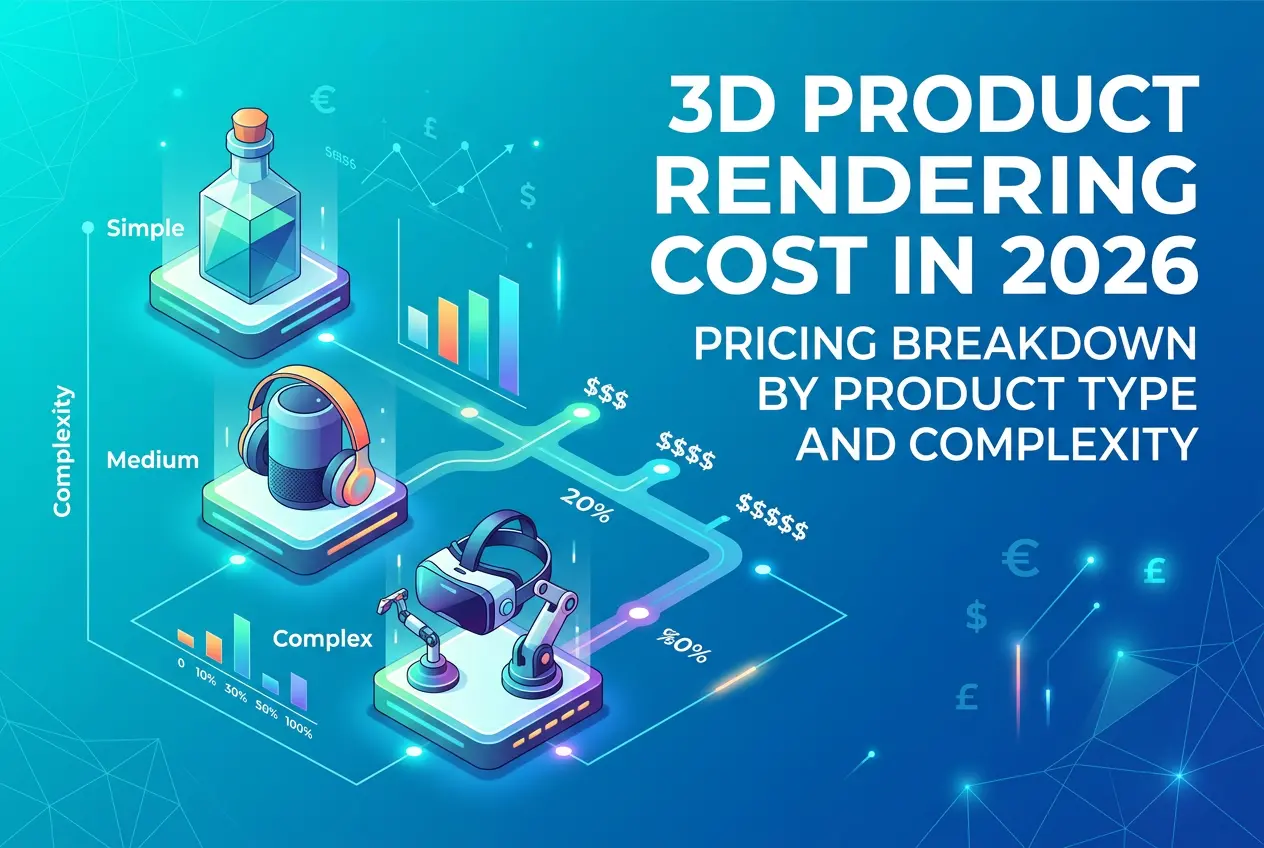
Every time a brand asks us about 3D product rendering, the second question out of their mouth — right after “how long does it take?” — is “what’s it going to cost?” That’s a completely fair question, and honestly, the industry has done a poor job of answering it clearly. Pricing pages either show vague ranges that mean nothing, or they quote a single number without explaining what drives it up or down. So let me break down the actual 3D Product Rendering Cost in 2026: Pricing Breakdown by Product Type and Complexity in plain terms, from someone who prices these projects every week.
The short answer is: it depends. But I know you’re tired of hearing that, so let me give you the long answer — the one that actually helps you budget.
What Actually Drives 3D Product Rendering Cost
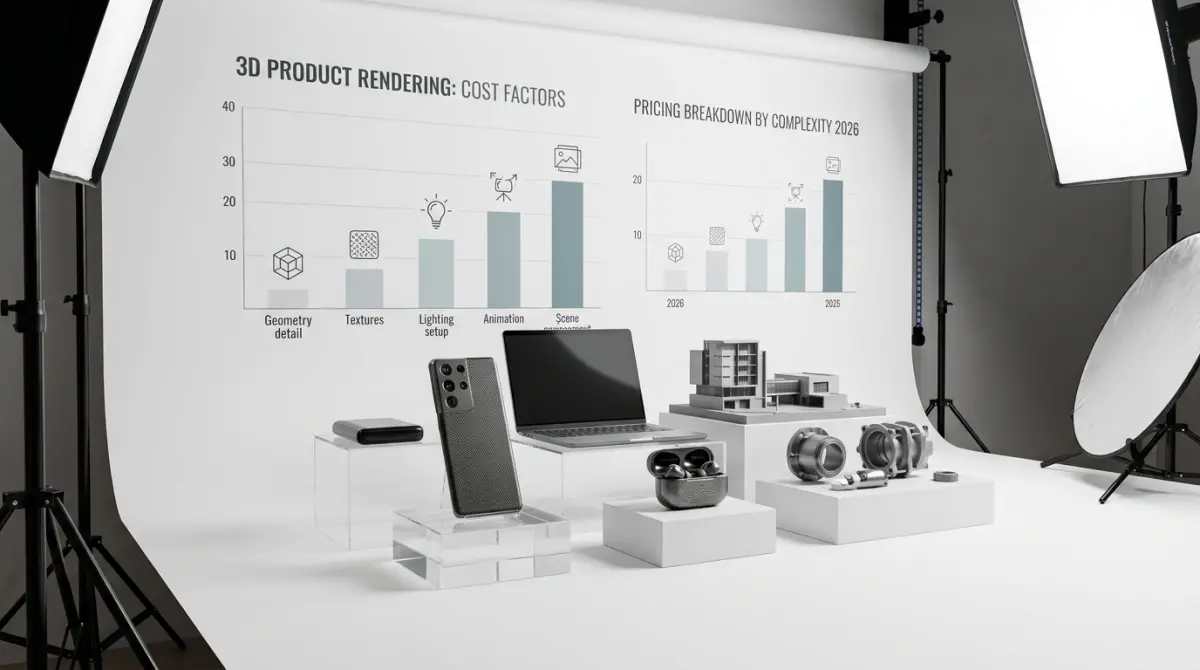
Before we get into product-specific numbers, you need to understand the core factors that move the price needle. Complexity is the biggest one, but it’s a word that gets thrown around loosely. In our studio, complexity means the number of parts, the surface diversity, the level of photorealistic detail required, and how much reference material you can give us to work with.
Here’s what we look at when quoting a job:
Geometry Complexity
A flat-faced product like a book, a box, or a basic tile is geometrically simple. A power drill, a wristwatch, or an athletic shoe is not. Products with lots of moving parts, curved surfaces, stitching, woven textures, or intricate mechanical details require significantly more modeling time. More modeling time means higher cost. There’s no way around that.
Material and Surface Complexity
A product with one matte finish is easy to shade. A product that has brushed stainless steel, a rubber grip, a transparent polycarbonate window, and a printed logo panel — that’s four separate material workflows. Every realistic material requires its own setup: the right roughness maps, reflection behavior, subsurface scattering for certain plastics and skin-toned products, and careful light interaction testing. Surface complexity is often underestimated by clients who think it’s just a “texture thing.”
Number of Views and Scene Setups
Each angle is a render. A single hero shot on a white background is one render. A lifestyle scene from three camera angles with two color variants is six renders at minimum. Volume adds up fast, and this is the most direct way clients can control their own budget.
Lifestyle vs. Studio Rendering
A product floating on a white background with a simple shadow is a studio render. A product placed in a believable interior or outdoor environment — a coffee table, a kitchen counter, a fashion flat-lay — is a lifestyle render. Lifestyle rendering requires either building or purchasing environment assets, setting up lighting that matches the real world, and significantly more compositing work. It costs more because it’s more work, full stop.
3D Product Rendering Cost in 2026: Pricing Breakdown by Product Type and Complexity
Let me walk through the most common product categories we handle and give you a realistic sense of what pricing looks like.
Simple Consumer Goods (Packaging, Bottles, Boxes, Canisters)
These are the bread-and-butter products of e-commerce rendering. A single cosmetic bottle, a supplement container, a flat-pack box — these have predictable geometry and usually just one or two materials. For a clean studio render with a white or gradient background, basic packaging falls at the lower end of the pricing spectrum. Add a few extra angles, and you’re looking at modest increments per view. When brands need multiple SKUs — say, a product line of ten bottle sizes in four colorways — volume pricing usually kicks in and the per-unit cost drops.
Electronics and Consumer Tech
This is where pricing jumps. A smartphone, a wireless speaker, a laptop, or a set of earbuds involves tight tolerances, fine surface transitions, and materials that absolutely have to look right. Brushed aluminum that reads as plastic kills the product’s premium appeal instantly. We spend a lot of time on reflective and specular behavior for tech products. Expect mid-to-upper range pricing for standalone hero shots, and higher still for full 360-degree turntables or interactive renders.
Furniture and Home Décor
Furniture is interesting because the geometry can be relatively straightforward — a chair or a dining table isn’t mechanically complex — but materials are demanding. Wood grain that looks photorealistic, fabric with accurate weave and drape, leather with correct highlights and pore-level texture. Lighting in furniture renders is also more involved because you’re often building a partial room environment to sell the product in context. Our team regularly handles 3D product rendering for furniture clients who want both isolated studio shots and styled room scenes, and the room scenes typically cost notably more per image.
Apparel, Footwear, and Soft Goods
This is one of the most technically demanding categories. Fabric simulation, stitching, sole textures on shoes, lace patterns, print accuracy on athletic wear — it’s a lot. CGI apparel has improved enormously over the past few years, but getting it to look genuinely convincing still requires specialized workflows. Pricing here is typically higher than hard-surface products of comparable “size” because the technical requirements are different.
Industrial and B2B Products
Machinery, tools, components, and equipment often need technical accuracy above all else. A client might need a render of a hydraulic valve assembly that shows internal cross-sections, or a medical device where every surface finish needs to match a specific specification. These renders sometimes require us to work directly from CAD files, which is an additional step in the pipeline. Exploded views and cut-away renders for marketing or documentation materials fall here too, and they require careful structural planning before any rendering happens.
What Clients Get Wrong When Budgeting for Product Renders
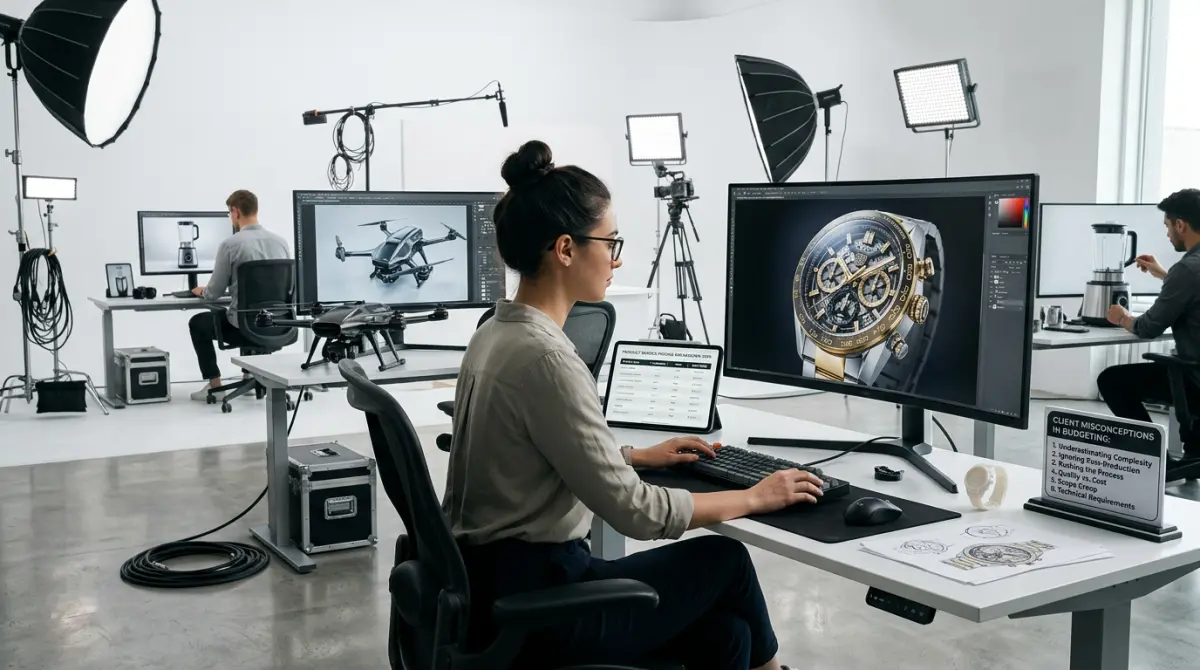
In our experience, the most common budgeting mistake is treating renders like photography — quoting for a single shot and then being surprised by the cost of additional angles, color variants, or scene changes. 3D rendering has high upfront costs and low marginal costs. The expensive part is building the model and setting up the scene. Once that’s done, an additional camera angle is relatively inexpensive. This means your budget planning should front-load toward the setup phase, not try to minimize it.
The second mistake is under-specifying at the brief stage. A client who says “I need a product render of my blender” and then — after we’ve built the model — says “oh, it also has this translucent container and this chrome detail we forgot to mention” creates rework that wasn’t scoped. Be exhaustive in your brief. Send every reference photo you have. Send the physical product if possible. Send the technical drawings if they exist. The more we know upfront, the more accurately we can price, and the fewer surprises you get.
Third: clients sometimes assume that a faster turnaround is free. Rush work compresses timelines, which means either overtime for our artists or reprioritizing other client work. Rush fees are standard across the industry for good reason.
Packaged Pricing vs. Custom Quotes
Some studios — including us at certain volume levels — offer packaged pricing for standardized product types. A “basic e-commerce package” for simple packaging might cover a set number of views at a fixed price. These packages work well when the product genuinely fits a simple profile.
For anything beyond the standard, a custom quote is the only honest approach. We’d rather spend twenty minutes understanding your product and give you an accurate number than hand you a package price that either undershoots your expectations or overcharges for complexity you don’t have.
If you want an accurate picture of product rendering pricing for your specific project, the fastest route is always a direct conversation with a studio that has handled your product category before.
Getting the Most Value From Your Rendering Budget
A few practical notes from our side of the desk. Consolidate your renders into a single production sprint rather than drip-feeding single images over months — it keeps setup costs low and often qualifies for volume pricing. Plan your variants early; switching a color in post is easier than building a new material setup. And invest in high-quality reference material. A product we can study in detail — real product photos, spec sheets, Pantone codes — renders faster and more accurately than one we’re guessing at.
If you’re working in e-commerce and need consistent backgrounds, angles, and styling across a catalog, standardizing your shot list before production starts saves significant time and cost. We’ve built full catalog workflows for clients where the per-image cost dropped considerably just because the scope was well-defined from day one.
Ready to Get a Real Quote?
Understanding 3D product rendering cost in 2026 is as much about knowing your product’s complexity as it is about comparing studio rates. The right rendering partner will ask you smart questions before quoting — and that process itself tells you a lot about the quality of work you’ll get.
If you’re ready to discuss your project in specifics, reach out to our team at 360render.com. We’ll give you a clear, itemized quote based on what your project actually needs — not a generic price pulled from a rate card.
Frequently Asked Questions
How much does 3D product rendering cost in 2026 for a simple product like a bottle or box?
For simple products with basic geometry and minimal detail, 3D product rendering in 2026 typically costs between $150 and $500 per image when working with a professional studio. Freelance 3D artists may charge as little as $75 to $250 per render for straightforward items like bottles, boxes, or basic consumer goods. The final price depends on turnaround time, number of revisions, and whether the 3D model needs to be built from scratch or already exists.
What factors most affect the price of 3D product rendering in 2026?
The main cost drivers for 3D product rendering include product complexity, number of materials and textures, level of photorealism required, and whether lifestyle or scene environments need to be created around the product. Additional factors like rush delivery, number of viewing angles, post-production retouching, and animation requirements can significantly increase the base price. Products with intricate mechanical parts, transparent materials like glass, or highly reflective surfaces such as jewelry require more rendering time and technical skill, pushing costs higher.
Is hiring a 3D rendering agency more expensive than using a freelancer for product visualization in 2026?
Yes, 3D rendering agencies typically charge 40 to 100 percent more than freelancers, with agency pricing for product renders ranging from $300 to over $2,000 per image depending on complexity and deliverables. However, agencies offer advantages like dedicated project management, faster turnaround through team workflows, and more consistent quality control across large product catalogs. For brands needing dozens of SKUs rendered at once, agency pricing often includes volume discounts that can make the overall cost per image more competitive.
How much does a full 3D product rendering package for an e-commerce catalog cost in 2026?
A complete e-commerce rendering package in 2026, which typically includes multiple angles, a white background hero shot, and one or two lifestyle scenes per product, generally ranges from $800 to $3,500 per product depending on complexity. For brands with large catalogs of 50 or more products, bulk pricing can reduce per-product costs by 20 to 40 percent when working with studios that specialize in high-volume CGI production. This investment often pays off quickly since 3D renders eliminate the need for physical samples, studio rentals, photographers, and shipping logistics.
How does 3D product rendering pricing compare for jewelry versus furniture in 2026?
Jewelry rendering is among the most expensive product categories in 2026, with single high-quality images costing between $400 and $1,500 due to the complexity of rendering metals, gemstone light refraction, and microscopic surface details. Furniture rendering tends to fall in a mid-range cost bracket of $300 to $900 per image, as it requires realistic fabric or wood textures and often needs full room scene setups to provide context. Both categories are more expensive than simple packaged goods but deliver strong ROI because realistic renders directly influence purchasing decisions for high-consideration products.