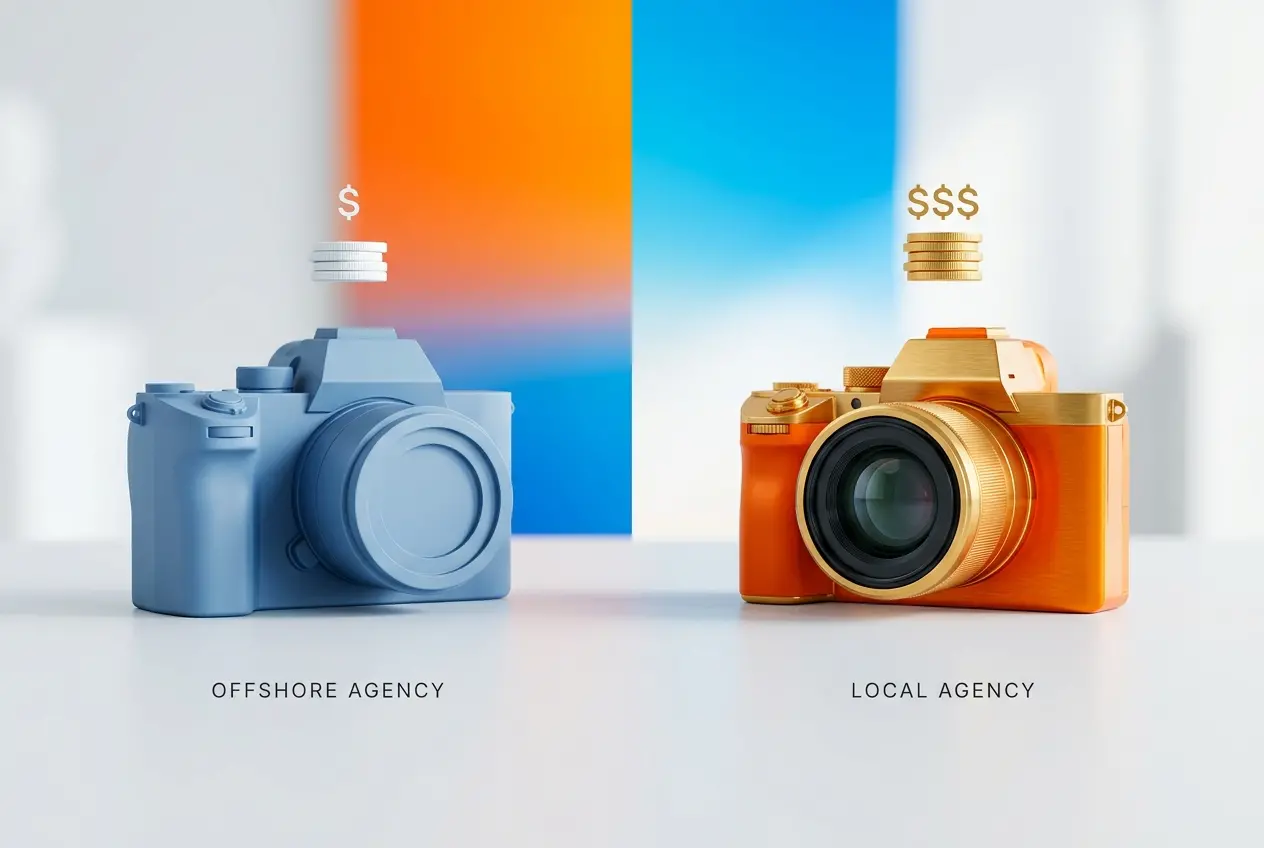
Every product seller, brand manager, or architect who’s shopped around for 3D rendering has asked some version of the same question: why does one agency quote three times what another one does for what seems like the same deliverable? The question behind Offshore vs Local 3D Product Rendering Agency: What the Price Difference Actually Buys You is genuinely worth answering — not with marketing talk, but with a straightforward breakdown of what’s actually happening on both sides of that price gap. I run a studio based in India that serves clients across the US, UK, Australia, and Europe. So I sit in an interesting position: technically “offshore” to most of our clients, but operating at a level of technical output that competes directly with top local studios in those markets. That gap between price and quality isn’t what most people assume it to be.
The common assumption is simple: local costs more because of higher wages and overheads, offshore costs less because labour is cheaper. That’s partially true. But it misses the more important question — what does the price difference actually reflect in terms of output quality, communication reliability, revision cycles, and final usability of the renders? Those are the things that cost you money downstream if you get them wrong.
The Real Components of a Rendering Quote
Before comparing offshore versus local, it helps to understand what a rendering quote actually contains. Most clients see a final number and assume it’s just “hours × rate.” In reality, a professional rendering project involves software licensing costs (V-Ray, Corona, KeyShot, 3ds Max, Cinema 4D — none of these are free), hardware amortisation (a proper rendering workstation or farm isn’t cheap), asset libraries for materials and environments, and the time of someone who actually knows what they’re doing. That last part is the one that varies most wildly between agencies.
A local agency in London or New York carries all of those costs plus significantly higher studio rent, employee salaries benchmarked to local living costs, and business overheads that are just structurally more expensive in those cities. An offshore agency in India, Eastern Europe, or Southeast Asia carries the same software and hardware costs but with dramatically lower operational overhead. That’s the legitimate source of the price difference. What it does not mean is that the technical skill is automatically lower — and this is where most buyers get confused.
What You’re Actually Paying for With a Premium Local Agency
There are real things a higher-priced local agency can offer that justify their rate — and it’s worth being honest about what those are rather than dismissing them.
Proximity and Real-Time Collaboration
If you’re a product design firm that needs to sit in a room with your renderer, mark up prints together, and iterate in real time over a few hours, a local studio makes that possible. For high-stakes product launches where the creative direction is still evolving and decisions happen face-to-face, proximity has real value. You can walk someone through a physical prototype. You can point at a material swatch. That tactile collaboration is something time zones and video calls can’t fully replicate, even with excellent communication.
Account Management and Creative Direction
Premium local agencies often bundle in dedicated account management, creative direction, and sometimes even art direction for the overall campaign. You’re not just buying renders — you’re buying a creative partner who understands your brand, attends your meetings, and takes responsibility for creative consistency across a whole project. That kind of service has a cost, and it’s legitimate.
Legal and Contractual Comfort
Some enterprise clients, particularly in regulated industries, feel more comfortable with agencies operating under the same legal jurisdiction. IP ownership, NDAs, and contracts are all governed by the same law, which makes dispute resolution clearer. This matters more in some industries than others, but it’s a real factor for certain procurement departments.
Offshore vs Local 3D Product Rendering Agency: Where the Value Actually Lives

Here’s where I want to be direct. The technical output of a well-run offshore studio — proper lighting, physically accurate materials, production-ready resolution, clean geometry — is indistinguishable from the output of a local studio at double the price. The renderer doesn’t know what country it’s in. V-Ray renders photons the same way in Mumbai as it does in Manchester. The quality of the final image is determined by the artist’s skill, the quality of the brief, and the revision process — not the studio’s postcode.
We produce 3D product renders for clients in the furniture, consumer electronics, cosmetics, and industrial equipment sectors. The deliverables go directly to Amazon listings, product catalogues, and brand websites. Buyers in those markets don’t know or care where the render was made — they care whether it’s accurate, photorealistic, and usable. That’s the right criteria.
Where offshore agencies genuinely fall short — and I’m including poorly run ones in my own region here — is in communication reliability, revision management, and brief comprehension. A cheap offshore render mill that processes hundreds of jobs simultaneously often has thin communication, templated outputs, and minimal interest in understanding your product beyond the reference images you send. That’s not an offshore problem specifically — it’s a volume-over-quality problem. You see the same issue with some local freelancers too.
| Factor | Premium Local Agency | Quality Offshore Agency | Budget Offshore Mill |
|---|---|---|---|
| Render Quality (technical) | High | High | Variable / Low |
| Creative Direction | Strong | Moderate | Minimal |
| Communication | Excellent | Good (async) | Poor |
| Revision Handling | Thorough | Thorough | Limited |
| Turnaround Speed | Moderate | Fast (timezone advantage) | Unpredictable |
| Cost | High | Moderate | Low |
| IP / Legal Clarity | High | Good (with proper contracts) | Risk |
What Clients Actually Get Wrong When Choosing
The most common mistake isn’t choosing offshore over local or vice versa — it’s choosing on price alone without evaluating the portfolio for technical competency. A render portfolio tells you almost everything. Look at whether the materials read correctly. Does the plastic look like plastic or does it look like painted metal? Do the shadows have the right softness for the light source shown? Is the geometry clean at the edges? These are things a working artist notices immediately. If the portfolio passes that test, the geography stops mattering.
The second mistake is underestimating how much communication quality affects the final result. A poorly communicated brief produces bad renders everywhere — locally and offshore. The agencies that charge more, whether local or offshore, often charge partly for the time spent actually understanding what you need before a single polygon is moved. That briefing process is not overhead. It’s the thing that prevents three rounds of revisions that could have been one.
A client came to us after working with two different local agencies in their home market. The renders were technically fine but kept missing the brand feel — the lighting was too clinical, the styling didn’t match their product aesthetic. The problem wasn’t geography or price. It was that neither agency had taken time to understand the brand. We spent the first conversation asking about their competitors, their target demographic, and what emotional response they wanted from someone viewing the image. That investment in understanding paid off in the output. That conversation costs time. Time is what you’re paying for.
The Timezone Factor: Underrated in Both Directions

Timezone differences get cited as a negative for offshore work, but for many product companies, they’re actually an advantage. If you send a brief at 5pm in New York, a studio in India picks it up at the start of their working day and can have progress to you before your next morning starts. That’s an overnight turnaround structure that’s genuinely useful for companies managing tight production schedules. It requires good async communication discipline — clear briefs, documented feedback, structured revision notes — but when that’s in place, the time difference accelerates work rather than delaying it.
For 360-degree product renders and animation projects where rendering itself takes overnight compute time anyway, the timezone advantage is especially pronounced. The render farm runs while both teams sleep and results are ready for review the next morning in the client’s timezone.
When Local Is Genuinely Worth the Premium
To be fair about this: there are scenarios where a local premium is worth paying. If your project requires physical set visits, on-location photography coordination alongside 3D work, or integrated CGI and live photography direction, a local agency that can physically be on set has real advantages. Similarly, if your brand’s creative direction is in flux and you need highly iterative, in-person creative workshops to develop the visual language, paying for proximity makes sense. And for enterprise clients with strict vendor compliance requirements, the operational simplicity of a same-jurisdiction contract is sometimes worth the cost difference on its own.
But for the majority of product rendering briefs — e-commerce imagery, catalogue renders, lifestyle shots for product visualisation, architectural product context shots — the deliverable is a digital file. Digital files cross borders instantly. The argument for paying a local premium for those projects is mostly inertia, not logic.
How to Evaluate Any Agency, Regardless of Location
Ask for portfolio work in your specific product category. Rendering a piece of furniture is a different technical challenge from rendering a transparent cosmetic bottle or a machined metal component. Make sure they’ve done your type of product before. Ask about their revision process — how many rounds are included, how feedback is documented, who your point of contact is. Ask what software they use and why. A studio that can explain their material and lighting pipeline understands their craft. One that just says “we use industry-standard software” probably doesn’t want you to look too closely.
Check whether they ask you smart questions before quoting. A good agency will want to know your end use (web, print, packaging), your product file format, whether you have brand guidelines, what competitors’ imagery looks like. If they quote you immediately without asking any of that, they’re treating your project as a commodity job.
The Offshore vs Local 3D Product Rendering Agency: What the Price Difference Actually Buys You question ultimately comes down to this: you’re paying for skill, communication, and process — not a postcode. Geography influences price through operational costs, but it doesn’t determine quality. Find the agency that asks the right questions, shows relevant portfolio work, and treats your project as specific rather than generic. That agency will serve you well whether they’re down the street or ten time zones away.
If you’re ready to talk through a project and see whether our approach fits what you need, get in touch with our team — we’re straightforward about what we can do, how we work, and what it costs.
Frequently Asked Questions
Why is offshore 3D product rendering so much cheaper than local agencies?
Offshore 3D rendering agencies operate in countries with significantly lower labor costs, overhead expenses, and cost of living, allowing them to charge 40-80% less than local studios. However, this price difference doesn't always reflect a gap in software or technical capability, since both offshore and local agencies often use the same industry-standard tools like Cinema 4D, KeyShot, or V-Ray. The real cost difference lies in communication infrastructure, revision turnaround times, and the level of strategic creative consultation included in the service.
What do you actually get when you pay more for a local 3D product rendering agency?
Local agencies typically offer real-time collaboration, faster revision cycles, and a deeper understanding of your target market's cultural aesthetics and consumer expectations. You're also paying for account management, brand strategy alignment, and the ability to hold in-person briefings that reduce costly miscommunications. Many local studios also carry liability insurance, NDAs tailored to local law, and dedicated project managers who protect your intellectual property more reliably.
Is offshore 3D rendering good enough for high-end product launches or e-commerce?
Offshore rendering can absolutely meet professional quality standards for e-commerce platforms like Amazon or Shopify, especially for straightforward product shots with clear briefs and reference images. For high-stakes launches involving complex brand storytelling, lifestyle scenes, or tight campaign deadlines, the communication lag and potential revision delays with offshore teams can introduce risk that outweighs the cost savings. The safest approach is to vet offshore agencies through portfolio reviews and paid test projects before committing to full campaign production.
How does time zone difference affect working with an offshore 3D rendering agency?
A significant time zone gap, such as working with an agency 8-12 hours ahead or behind, means feedback cycles that take hours locally can stretch to a full business day offshore. This can double or triple your total project timeline if your campaign requires multiple rounds of revisions or real-time creative decisions. Some offshore agencies mitigate this by assigning shift workers or project managers who overlap with your business hours, but it's critical to confirm this before signing any contract.
When does it make financial sense to choose a local 3D product rendering agency over an offshore one?
Choosing a local agency makes the most financial sense when your project involves tight deadlines, complex brand guidelines, or requires ongoing collaboration with your internal marketing or design team. It also pays off when the cost of a single costly revision error, a missed launch window, or a brand inconsistency far exceeds the premium you'd pay for local expertise and accountability. For businesses with standardized, repeatable rendering needs and well-documented briefs, offshore agencies offer a compelling ROI, but for brand-critical work the communication reliability of a local partner often justifies the higher investment.