360 Renderings for Real Estate: How Virtual Tours Are Replacing Traditional Photography
The way buyers discover and fall in love with properties has changed dramatically over the last few years. If you’ve been following real estate marketing trends, you’ve probably noticed that 360 renderings for real estate: how virtual tours are replacing traditional photography is more than just an industry talking point — it’s a visible shift in how listings actually perform. Buyers expect more. They want to walk through a space before they ever set foot inside it. And static photos, no matter how well-staged or beautifully lit, simply can’t deliver that experience anymore.
Think about it from a buyer’s perspective. You’re scrolling through dozens of listings on a Saturday morning, coffee in hand. One property has twelve flat photos shot with a wide-angle lens. Another lets you spin around the kitchen, peek into the master bathroom, and stroll down the hallway — all from your phone. Which one holds your attention? Which one do you call your agent about? The answer is obvious, and real estate professionals are catching on fast.
This isn’t just a trend driven by technology for its own sake. There are real, measurable reasons why agencies, developers, and solo agents are replacing traditional photography workflows with immersive 360-degree content. In this post, we’re going to walk through exactly why that shift is happening, what the practical benefits look like, and how you can take advantage of it for your own properties.
Why Traditional Real Estate Photography Is Showing Its Limits
Traditional photography had a solid run. A skilled photographer with good lighting and composition can absolutely make a property look appealing. But it has a fundamental ceiling. A photo shows you one angle, frozen in time, with zero interactivity. Buyers have learned to read between the lines — they know a well-placed couch hides a weird corner, and a wide-angle shot makes a small room look twice its actual size.
That skepticism is a real problem for sellers. When buyers arrive at a showing and the space doesn’t match their mental image from the listing photos, trust erodes immediately. It’s one of the most common complaints from buyers and agents alike. The mismatch between expectation and reality slows down the sales cycle and increases buyer hesitation.
There’s also the issue of distance. International buyers, out-of-state relocators, and remote investors simply cannot visit every property in person before making decisions. Traditional photography forces them to either make a trip or take a leap of faith based on incomplete visual information. Neither option is ideal. This is precisely where immersive 360-degree content steps in and fills the gap in a meaningful way.
What Makes 360 Renderings Different From Standard Virtual Tours
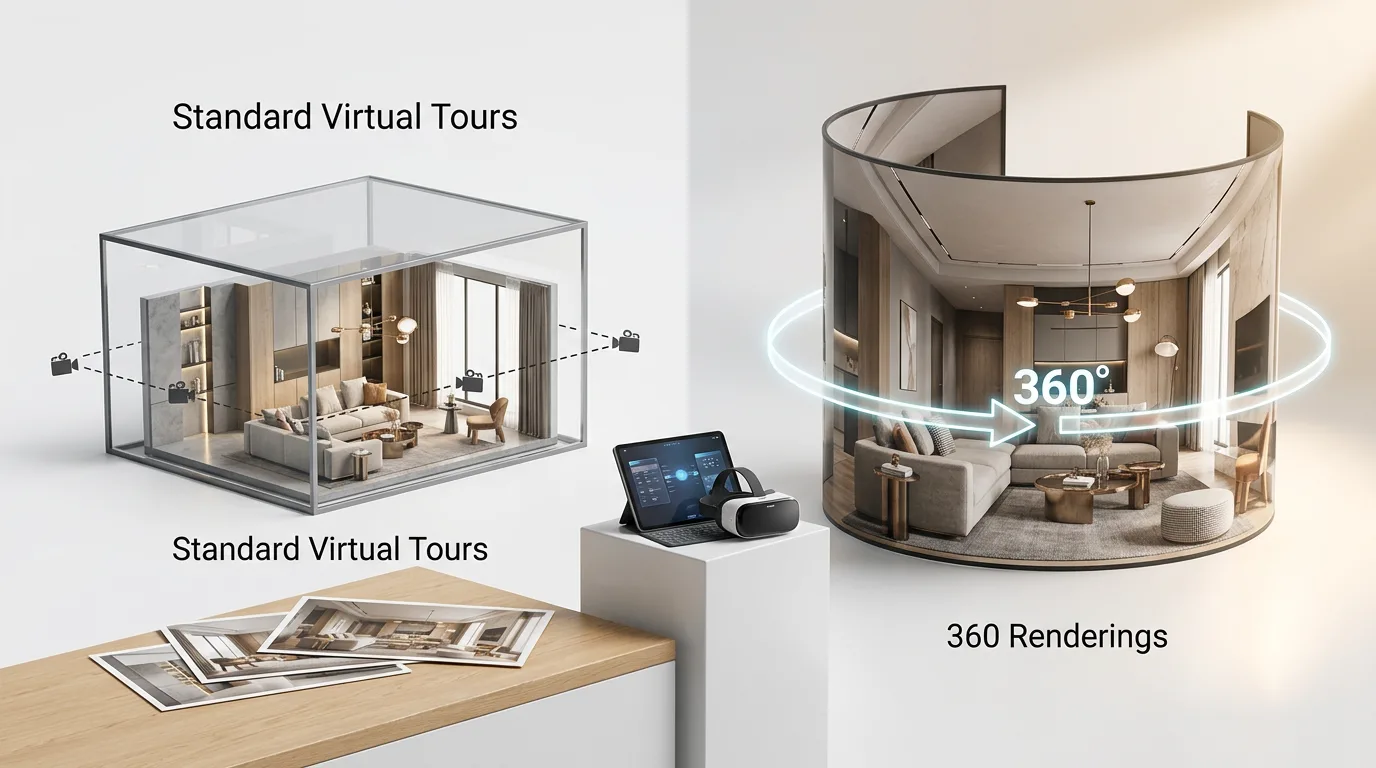
You might be wondering — aren’t virtual tours just a slideshow of photos stitched together? Not exactly. There’s an important distinction between a basic virtual tour and a true 360-degree rendering. Standard virtual tours using photography are limited by what exists. If a property is under construction, or you want to show a space fully furnished before a single piece of furniture has been ordered, photography can’t help you.
A 360 rendering is built from scratch using 3D modeling software. This means you can create a fully interactive, photorealistic walk-through of a space that doesn’t physically exist yet. New developments, off-plan apartments, renovations — all of it can be visualized and marketed before the first brick is laid. That’s a capability traditional photography will never have.
For developers especially, this is a massive advantage. You’re not waiting for construction to complete before launching your marketing campaign. You can start generating interest, collecting leads, and even closing pre-sales using a 360 rendering that gives buyers a genuine sense of the finished product. The quality of modern 3D rendering is such that many buyers genuinely cannot tell the difference between a rendered image and a real photograph — and the interactivity of a 360 view makes the experience even more convincing.
The Real Business Case: How Immersive Content Drives Sales
Let’s talk numbers for a moment, because this is where the conversation gets very practical for developers and agents. Properties listed with interactive 360-degree content consistently see higher engagement metrics. More time spent on a listing page. More return visits. More inquiries per listing. The correlation between immersive content and buyer engagement isn’t subtle — it’s significant.
There’s also a qualification effect. When a buyer has already virtually walked through a property and they’re still interested, they’re a much more serious prospect than someone who clicked through a few photos. Their expectations have been set accurately. They know roughly how the light falls in the living room at mid-morning. They’ve already decided they like the layout. In-person showings become more focused, more productive, and much more likely to result in an offer.
For luxury real estate and commercial properties, the impact is even more pronounced. High-value buyers in those markets often operate internationally or have extremely limited time. A real estate rendering that allows a Hong Kong-based investor to tour a Manhattan penthouse from their office before booking a flight is not a nice-to-have — it’s a competitive necessity. Agencies that offer this capability win listings that others don’t even get considered for.
360 Renderings for Real Estate: How Virtual Tours Are Replacing Traditional Photography in New Developments
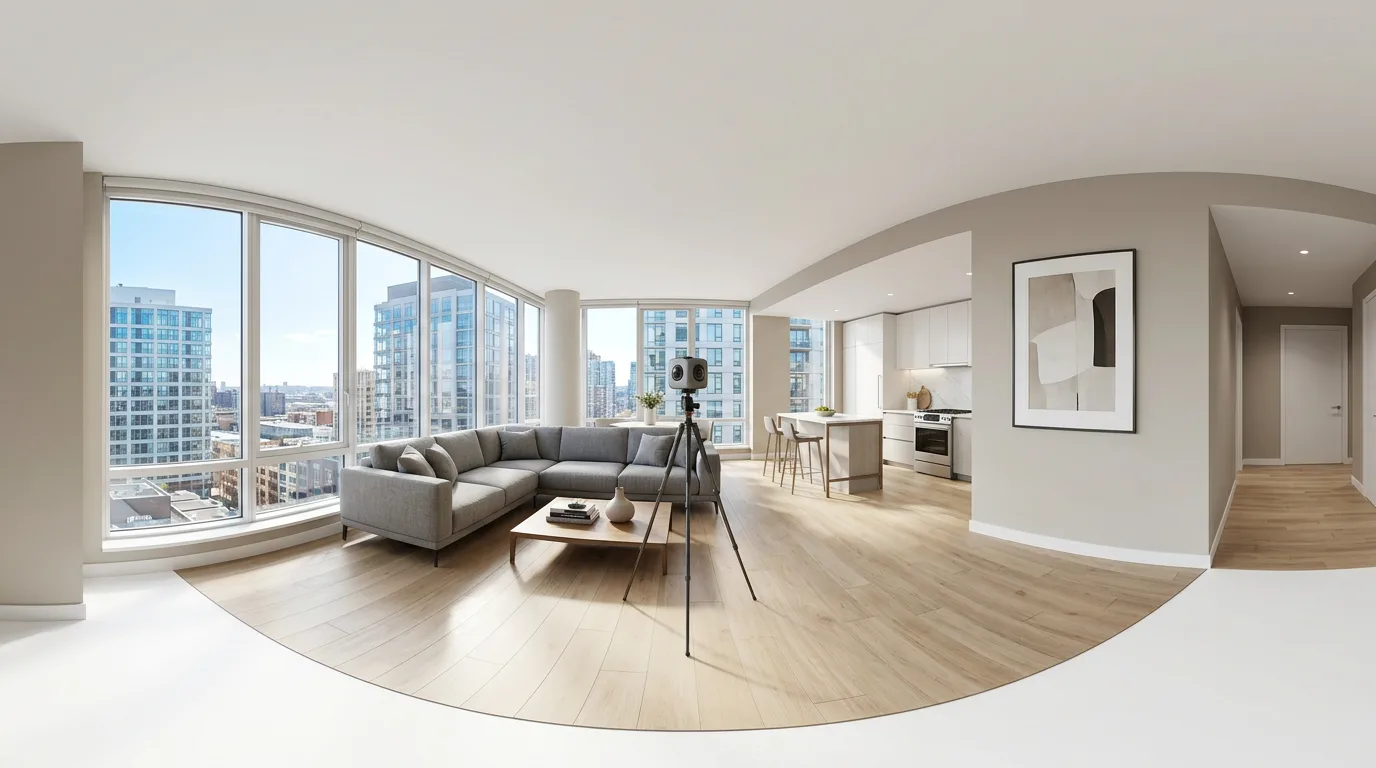
New development marketing is perhaps the area where this shift is most visible and most impactful. Pre-construction sales have always been challenging because you’re asking buyers to commit to something that only exists on paper. Traditional marketing tools — floor plans, artist impressions, brochures — help to a degree, but they’re passive. A buyer can look at them, but they can’t experience the space.
A fully rendered 360-degree virtual tour changes that dynamic entirely. When a buyer can put on a VR headset or simply open a browser and walk through a photorealistic version of the apartment they’re considering purchasing, the psychological barrier to commitment drops significantly. They feel like they know the space. They’ve already imagined their furniture in it. They’ve decided which room will be the home office. That level of emotional connection is what drives purchase decisions.
Developers who invest in high-quality architectural rendering for their pre-sales campaigns consistently report shorter selling timelines and stronger early sales momentum. The upfront investment in visualization pays for itself many times over when you’re moving units faster and at better price points because buyers are confident rather than hesitant.
Interior Staging Without the Physical Staging Costs
Here’s another practical angle worth considering. Physical staging is expensive. Renting furniture, hiring a staging company, transporting everything to the property — costs add up quickly, especially if you’re managing multiple units in a development. And then you have to coordinate photography shoots around the staging schedule, which adds another layer of logistical complexity.
Virtual staging through 3D rendering eliminates most of that friction. You can furnish a space digitally with any style, any furniture collection, any color scheme — and produce both still images and a 360-degree interactive tour from the same rendering. Want to show the same apartment configured as a family home and as a minimalist bachelor pad? That’s just a matter of switching the 3D model assets. The flexibility is genuinely impressive and the cost comparison is favorable at almost any scale.
Accessibility and Reach: Marketing That Never Sleeps
Traditional photography-based listings are passive. They sit there and wait for someone to look at them. A 360 virtual tour is still passive in the sense that it lives online, but it’s actively engaging once someone finds it. Time zones don’t matter. A buyer in London looking at a property in Miami at 2am their time gets the same full experience as someone walking through in person during business hours.
This around-the-clock accessibility is particularly valuable for developers and agents working with international or investor markets. Your marketing works while you sleep. Buyers self-qualify through the virtual tour experience, and by the time they contact you, they’ve already done most of the discovery work on their own. That makes your sales conversations more efficient and more productive.
Practical Tips for Using 360 Renderings Effectively in Real Estate Marketing
If you’re considering adding 360-degree virtual tours to your marketing toolkit, here are some practical guidelines that will help you get the most out of the investment.
Start with a clear brief. The quality of a 360 rendering depends heavily on the quality of information provided to the team creating it. Floor plans, material specifications, furniture preferences, lighting direction — the more detail you can provide upfront, the more accurate and compelling the final result will be. Vague briefs produce vague results.
Think about the buyer journey. A 360 tour isn’t just a technical deliverable — it’s a marketing experience. Think about where you want to guide a buyer’s attention. What are the hero moments in the property? The view from the living room? The master suite? Plan the tour starting points and flow with those highlights in mind.
Integrate with your existing channels. A 360 rendering works best when it’s embedded directly on your property listing page, shared on social media as short-form clips, and included in email campaigns to your buyer database. The more touchpoints you create around the virtual tour, the more mileage you get from the production investment.
Use it for internal approvals too. Developers often find that 360 renderings are just as useful for internal design reviews and stakeholder presentations as they are for buyer marketing. Walking a board through a virtual version of the finished development is far more effective than presenting PDF floor plans.
Combine with still renders. A exterior rendering paired with an interior 360 tour gives buyers a complete picture — they understand the building from the outside and the experience inside. Using both formats together tends to produce stronger engagement than either alone.
Conclusion: The Future of Real Estate Marketing Is Already Here
The shift described in 360 renderings for real estate: how virtual tours are replacing traditional photography isn’t on the horizon — it’s already well underway. Buyers expect more from listings. Developers need marketing tools that work before construction completes. Agents need ways to stand out in crowded markets. Immersive 360-degree content addresses all of those needs simultaneously, and it does so at a scale and quality level that was unimaginable even five years ago.
Traditional photography will still have a place in real estate marketing. But as a standalone tool, its limitations are increasingly obvious. The agencies and developers who are winning right now are the ones who have expanded their visual marketing toolkit to include the kind of immersive, interactive content that today’s buyers genuinely respond to.
If you’re ready to see what 360 rendering can do for your properties — whether you’re marketing a single luxury listing or an entire new development — the team at 360render.com would love to talk through your project. Get in touch with us today and let’s figure out the right approach for your specific goals. The difference between a listing that sits and one that sells is often a matter of how well buyers can picture themselves inside it.
Frequently Asked Questions
What is the difference between 360 renderings and traditional real estate photography?
Traditional real estate photography captures existing spaces using physical cameras, meaning the property must already be built or staged before photos can be taken. 360 renderings, by contrast, are computer-generated images that create fully immersive, photorealistic virtual environments of a property that may not yet exist. This allows developers and agents to market off-plan or under-construction properties with the same visual impact as a completed home.
How much do 360 virtual tour renderings cost compared to traditional real estate photography?
Traditional real estate photography typically costs between $150 and $500 per session depending on the property size and photographer, while 360 renderings can range from $1,500 to $10,000 or more depending on complexity and level of detail. However, renderings eliminate costs associated with staging, travel, and reshoots caused by weather or construction delays. For large-scale developments with multiple units, the cost-per-unit often becomes more competitive than repeated photography sessions.
Can 360 real estate renderings replace physical showings and open houses?
While 360 virtual tours cannot fully replicate the sensory experience of walking through a physical space, they have proven highly effective at replacing initial in-person showings by allowing buyers to explore properties remotely at any time. Studies show that listings with virtual tours receive up to 87% more views than those with standard photos, significantly reducing the number of unqualified showings. For international buyers, investors, or relocating clients, 360 renderings can serve as the primary decision-making tool without requiring a physical visit.
What software or technology is used to create 360 renderings for real estate?
Professional 360 real estate renderings are typically created using 3D modeling and rendering software such as 3ds Max, Cinema 4D, or Blender, combined with rendering engines like V-Ray, Corona, or Unreal Engine for photorealistic output. These tools allow artists to build accurate architectural models, apply realistic materials and lighting, and export interactive 360-degree panoramas viewable on web browsers or VR headsets. Some platforms like Matterport are also used to convert physical spaces into navigable 3D virtual tours using specialized scanning cameras.
Are 360 virtual tour renderings effective for selling luxury or off-plan real estate?
Yes, 360 renderings are especially powerful in the luxury and off-plan real estate markets, where buyers expect premium presentation and properties may not yet be physically accessible. High-end renderings can showcase custom finishes, furniture arrangements, and architectural details with a level of polish and control that standard photography cannot achieve for incomplete properties. Many luxury developers report faster pre-sales and higher buyer confidence when using immersive 360 virtual tours as part of their marketing strategy.
Also read: 360 Virtual Rendering for Real Estate: Benefits of 360 Renderings for Developers and Architects