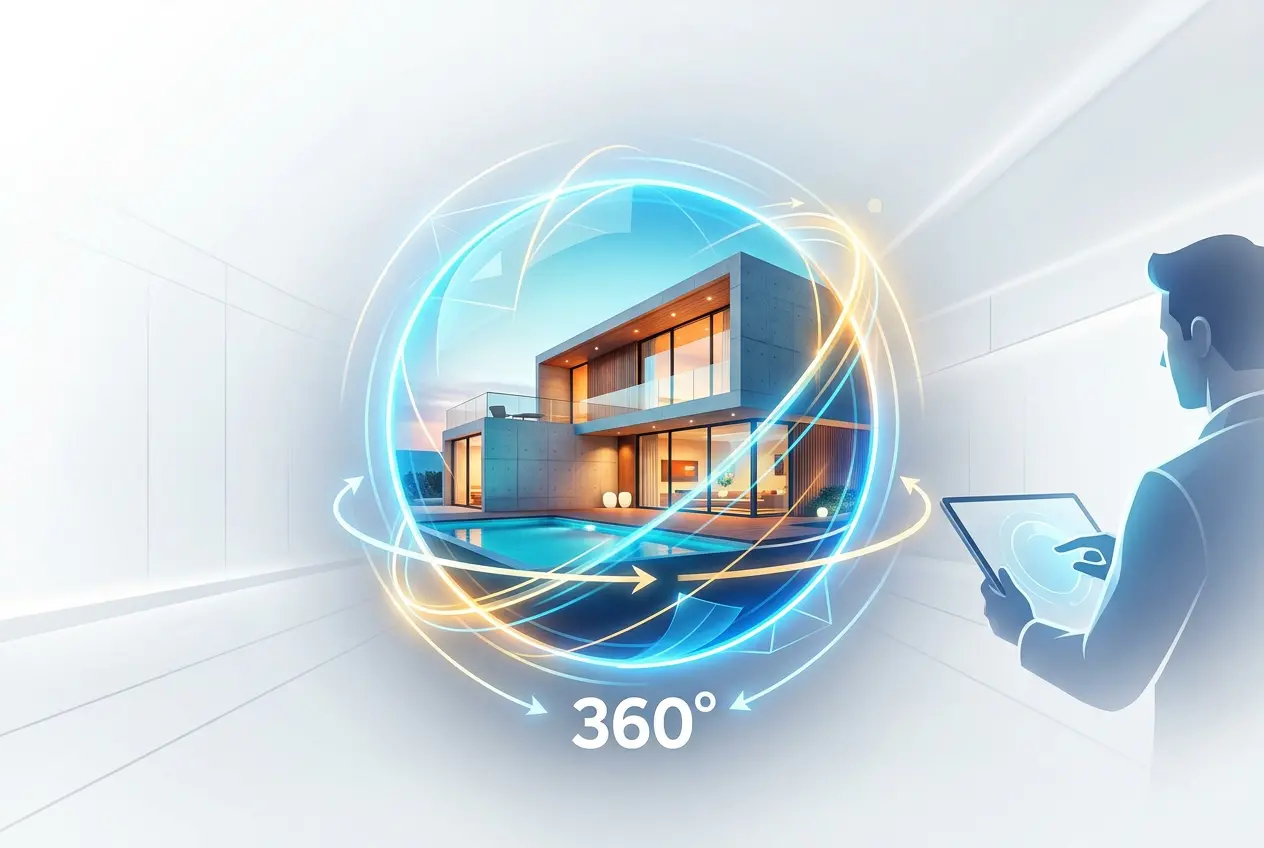
When developers and architects first started asking us about 360 virtual rendering for real estate, the conversation was usually around one simple problem: how do you sell or approve something that doesn’t exist yet? That question sits at the core of why 360 virtual rendering for real estate: benefits of 360 renderings for developers and architects has become one of the most practically useful discussions in the industry right now. It’s not about flashy technology for its own sake. It’s about solving real problems — financing approvals, buyer confidence, design validation — with tools that actually work. And after producing hundreds of these interactive experiences for residential towers, villa communities, commercial developments, and mixed-use projects, we’ve built a clear picture of where the value lies and where people waste their budget.
A standard static render is a photograph of a moment. Beautiful, yes, but fixed. A 360 render hands the viewer a pair of eyes and says, “look around.” You can scan the ceiling, check the view from the window, turn toward the kitchen, look down at the flooring. For a buyer sitting in another country evaluating an off-plan apartment, or for a planning authority reviewing a proposed building’s interior spatial quality, that difference in experience is enormous. The spatial comprehension you get from a 360 is genuinely closer to standing inside the space than anything a static image can provide.
In our studio, we treat 360 renders not as a premium add-on but as a core deliverable for any project where spatial storytelling matters. Let’s break down exactly why, and how developers and architects can use them most effectively.
What Exactly Is a 360 Virtual Render?
A 360 render — sometimes called a panoramic render or an equirectangular render — is a full spherical image captured from a single point in a 3D scene. When you open it in a viewer (on a website, in a VR headset, or even just on a phone by tilting it around), you can look in any direction from that fixed point. You’re not navigating through a space the way you would in a real-time walkthrough. You’re planted at one spot, but you have complete visual freedom around you.
The production pipeline is similar to standard architectural rendering. We build or receive the 3D model, apply materials and lighting, set up the camera at a strategic point in the space — usually standing height in the center of a room, or at a key viewpoint on a balcony — and then render the full sphere. The output is typically an equirectangular image that gets embedded into a viewer. Multiple 360 renders linked together with clickable hotspots become a virtual tour, which is where this format really earns its place in real estate marketing and design review workflows.
360 Virtual Rendering for Real Estate: Benefits of 360 Renderings for Developers and Architects
Off-Plan Sales and Buyer Confidence
This is the use case we encounter most often. A developer has floor plans, a 3D model in some stage of completion, and a sales launch date approaching. Buyers are being asked to commit to apartments that won’t be delivered for two or three years. The challenge is experiential: a floor plan tells you the dimensions, a static render shows you one curated angle, but neither gives the buyer a genuine sense of being inside the apartment.
A set of linked 360 renders changes that. When a prospective buyer can stand virtually in the living room, turn to see the open kitchen behind them, then rotate toward the full-height windows overlooking the city, they’re processing the space emotionally — the same way they would on a physical site visit. That emotional processing is what drives purchasing decisions. We’ve consistently seen that developers who invest in 360 virtual tours for their sales centers spend less time on the floor explaining layouts and more time closing.
Design Review and Client Approvals
For architects, 360 renders serve a completely different but equally important purpose. Presenting a design to a client — whether that’s a private homeowner, a hotel chain, or a government body — requires the client to understand the spatial proposal. Most clients are not trained to read drawings or interpret static renders accurately. They’ll look at a beautifully lit perspective image and miss the fact that the corridor feels narrow, or that the reception area has an awkward relationship to the entrance.
Drop a client into a 360 render of that reception area and they’ll immediately notice the spatial proportions. We’ve had architects come back to us saying a 360 review session with their client caught feedback in an hour that would have taken three rounds of physical revisions to surface otherwise. That’s not a small thing when construction costs are involved. Catching a design issue at the 3D stage is always faster and cheaper than catching it on site.
Planning and Regulatory Submissions
Planning authorities and review committees are increasingly familiar with 3D visualisation. 360 renders add a layer of spatial transparency to submissions that static images can’t match. When a planning committee can virtually stand inside a proposed public space, a retail atrium, or a residential lobby, they’re evaluating the design with far more accuracy. This matters especially for projects where the quality of interior public spaces is part of the approval criteria.
Remote and International Clients
A significant portion of real estate investment — particularly in markets like Dubai, Singapore, London, and across India’s major metro cities — comes from buyers who are physically elsewhere. Getting them to a sales center is not always practical. A 360 virtual tour embedded on a project website, or shared through a simple link, lets that buyer experience the apartment from their phone in Frankfurt or their laptop in Toronto. No VR headset required, no travel, no waiting for a show apartment to be built.
We’ve produced 360 tours for developers specifically for this remote audience, and the brief is always the same: make it feel real enough that someone thousands of kilometers away feels confident enough to proceed. That’s a high bar, and it’s why the quality of the 3D model, the lighting, and the material accuracy in the render matters so much.
What Goes Into a High-Quality 360 Render
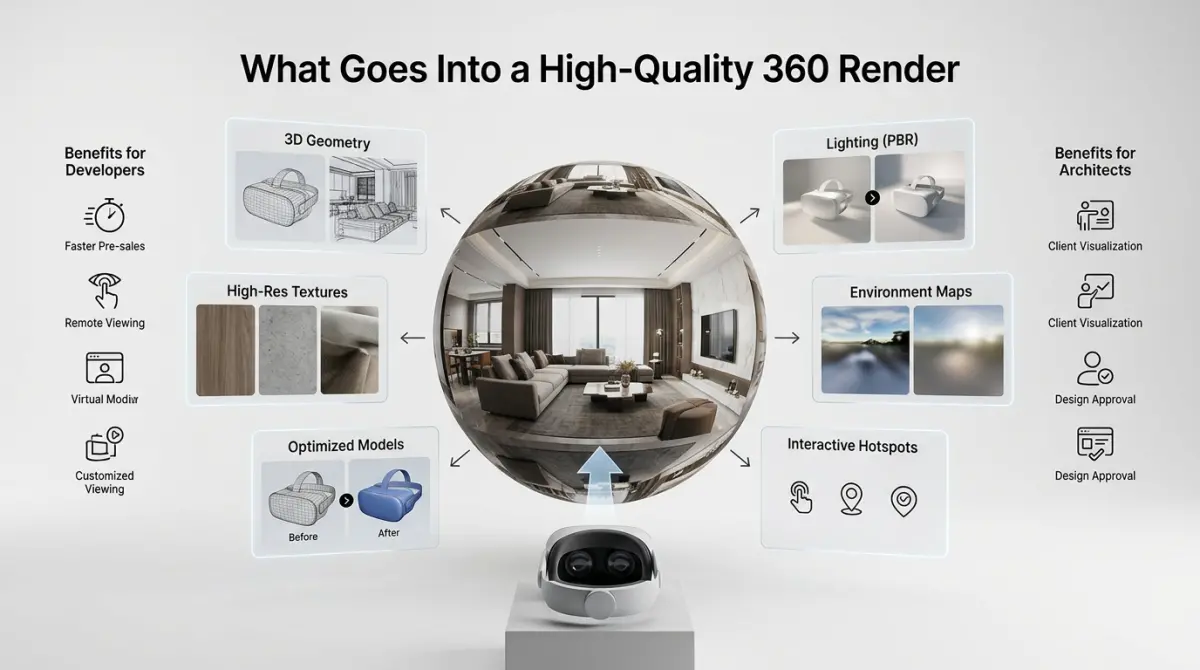
The technical side of 360 rendering is worth understanding because it directly affects what you get. A 360 render has to look convincing in every direction — not just the hero angle. That means the ceiling, the floor, the corners, the back wall behind you — all of it has to be finished to the same standard. In a static render, an artist can focus light and composition attention on the primary view. In a 360, there’s nowhere to hide.
Lighting is particularly demanding. We use a combination of HDRI environment lighting, artificial light sources, and bounced light to achieve a result that looks natural from every angle. The render resolution for a 360 also needs to be significantly higher than a standard render — because as the viewer zooms into a particular section of the panorama, that region needs to hold up at close inspection. Typically we render at very high resolutions to ensure that quality holds when someone is actually using the tour on screen.
Materials need to be physically accurate. Reflections in a 360 are visible from many angles simultaneously, so a poorly set-up reflective surface — a marble floor, a glass partition, polished metal — will look wrong in a way that immediately breaks the sense of realism.
Common Mistakes Clients Make With 360 Renders
The most frequent mistake is commissioning 360 renders from a model that isn’t ready. We receive project files where walls are missing, furniture is placeholder geometry, or the lighting setup doesn’t exist yet. Fixing an incomplete model to 360-ready standard takes time that clients often haven’t accounted for in their schedule or budget.
Second mistake: too few viewpoints. A single 360 render of the living area doesn’t constitute a virtual tour. Buyers and reviewers want to see the master bedroom, the bathroom, the kitchen, the balcony, the lobby, the view from the roof terrace. Planning the hotspot navigation between these points before production begins — not after — is something we always discuss with developers at the briefing stage.
Third: ignoring the viewing platform. A beautifully produced 360 tour that lives in a clunky or mobile-unfriendly viewer loses most of its impact. The file delivery format and the hosting environment are part of the deliverable, not an afterthought. At 360render.com, we factor in how the tour will actually be experienced by the end user, not just how it looks in our own preview.
How Architects Specifically Benefit
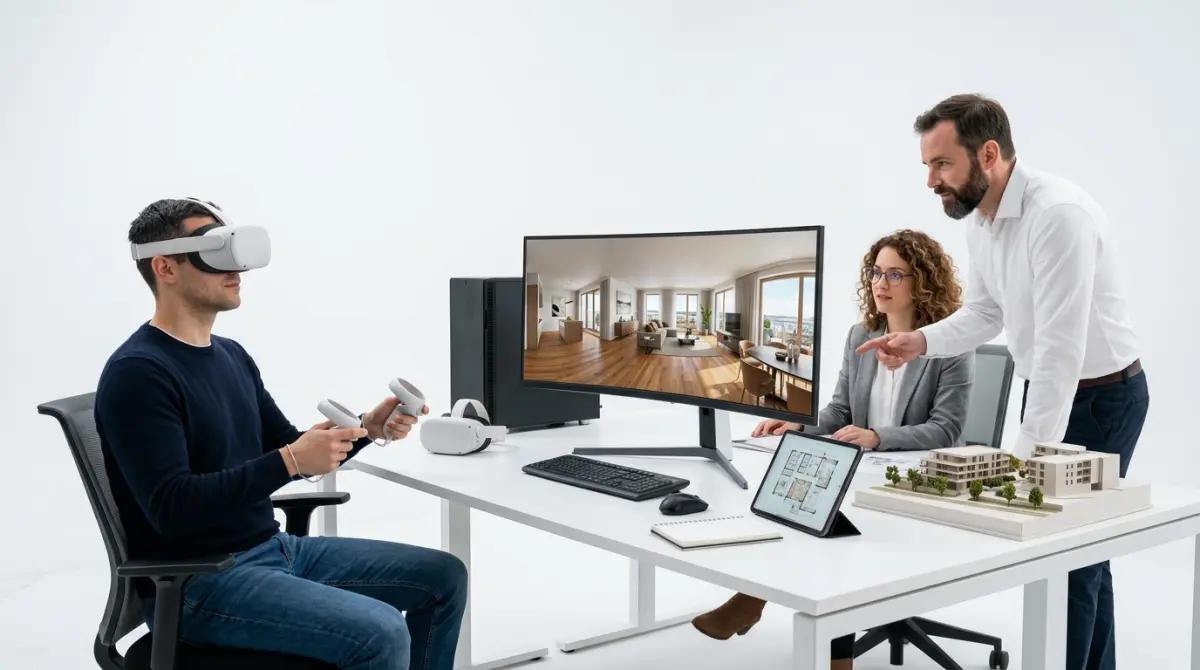
Architects get a different set of benefits than developers. For an architect, a 360 render is a design communication tool. It helps a client understand spatial intent before anything is committed to construction. It helps an architect explain why a particular ceiling height matters, why the positioning of a staircase creates a specific experiential sequence, why natural light enters a room the way it does at a certain time of day.
When paired with proper architectural rendering services, 360 virtual tours become part of the architect’s standard presentation toolkit — especially for design-forward practices working on residential, hospitality, or cultural projects where spatial experience is the core value proposition. We’ve found that architects who regularly use 360 renders in client presentations tend to get faster sign-offs, fewer late-stage design changes, and clients who are genuinely more engaged with the process.
Making the Investment Work
The cost of a 360 render set — or a full virtual tour — varies depending on the complexity of the 3D model, the number of viewpoints, the level of detail required, and the delivery format. It is not the cheapest line item in a project’s marketing budget. But it needs to be evaluated against what it replaces or accelerates: show apartment construction, travel costs for remote buyers, rounds of revision triggered by misunderstood static renders, delays in planning approvals.
When you frame the investment that way, the calculus usually becomes straightforward. One less round of client revisions on a large residential project, or one additional overseas buyer converted through a virtual tour, typically more than covers the cost of producing the tour itself.
If you’re a developer or architect evaluating whether 360 virtual renders belong in your next project, the honest answer is: for any project where spatial experience is being sold, approved, or reviewed by someone who can’t visit the physical space, they probably do. The question is just how to produce them properly.
Reach out to our team at 360render.com to discuss your project requirements. We work with developers and architects across residential, commercial, and hospitality sectors, and we’re happy to scope out exactly what a 360 virtual tour would involve for your specific brief.
Frequently Asked Questions
What is 360 virtual rendering in real estate and how does it work?
360 virtual rendering in real estate is a computer-generated visualization technique that creates fully immersive, photorealistic environments allowing viewers to explore a property from every angle before it is built. Using specialized 3D modeling software, architects and developers provide design files that are transformed into interactive panoramic experiences viewable on desktops, mobile devices, or VR headsets. The result is a seamless walkthrough of an unbuilt space that mimics the experience of physically standing inside the finished property.
What are the main benefits of 360 virtual renderings for real estate developers?
360 virtual renderings allow developers to market and pre-sell properties before construction begins, significantly reducing financial risk and accelerating sales cycles. They also help secure investor confidence by presenting a compelling, realistic vision of the project without requiring a physical model or completed unit. Additionally, developers can use these renderings to identify design flaws early, saving costly change orders during construction.
How do 360 renderings help architects improve their design process?
360 renderings give architects the ability to virtually walk through their designs and evaluate spatial relationships, lighting, and material choices in a way that flat 2D drawings simply cannot provide. This immersive perspective makes it easier to spot design inconsistencies, adjust proportions, and refine aesthetic decisions before construction documents are finalized. Clients also gain a clearer understanding of the architect's vision, leading to faster approvals and fewer revision cycles.
How much do 360 virtual renderings cost for real estate projects?
The cost of 360 virtual renderings for real estate projects typically ranges from $500 to $5,000 or more per scene, depending on the complexity of the space, level of detail required, and the experience of the rendering studio. Large-scale developments such as luxury condominiums or commercial complexes may invest $10,000 to $50,000 for comprehensive interactive tours covering multiple units and amenity spaces. Despite the upfront investment, many developers report a strong return through accelerated pre-sales and reduced marketing expenses.
What is the difference between a 360 virtual rendering and a virtual tour of an existing property?
A 360 virtual rendering is a computer-generated image created entirely from architectural plans and design files, used to visualize properties that have not yet been built. A virtual tour of an existing property, by contrast, is produced using 360-degree photography or scanning technology to capture a space that already exists in the physical world. The key distinction is that renderings offer complete creative control over materials, lighting, and furnishings, while virtual tours document a real, finished environment.