
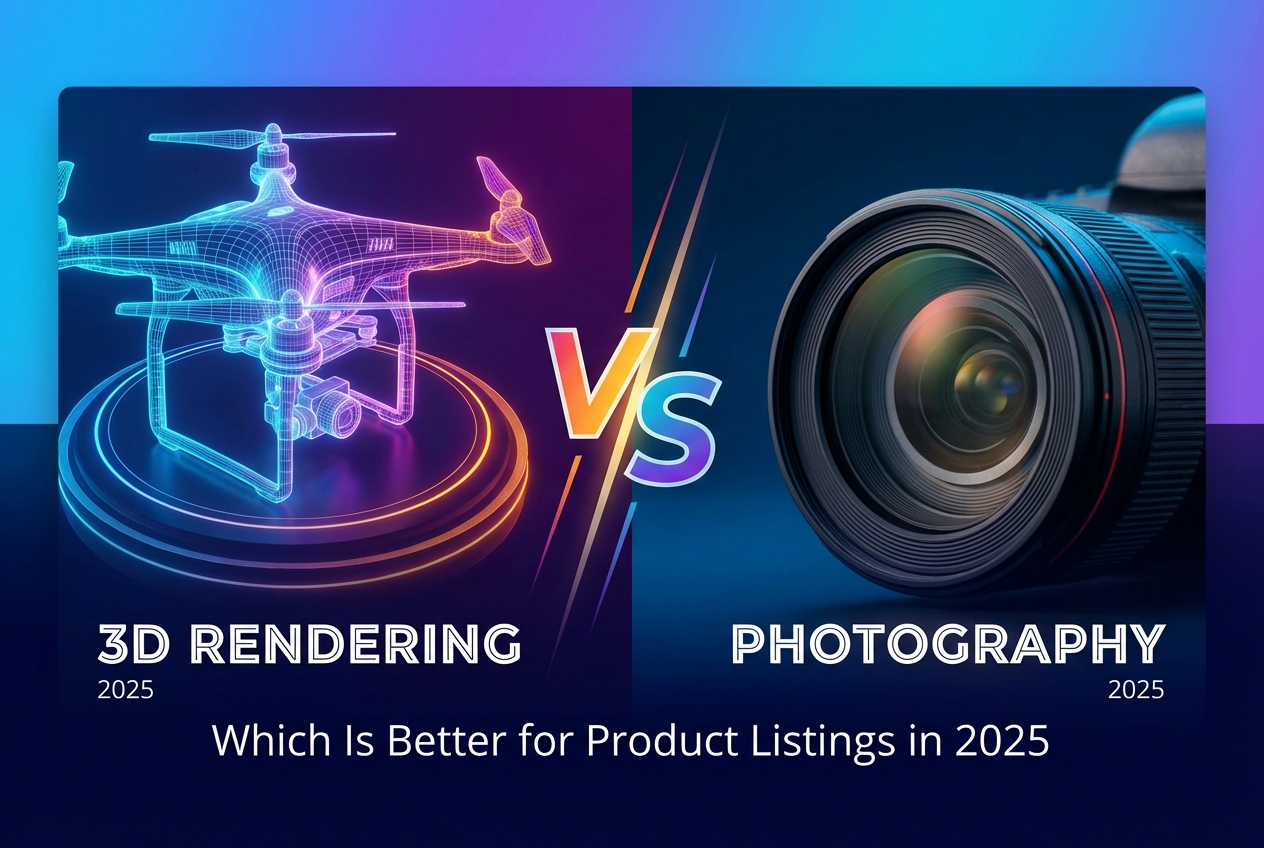
3D Rendering vs Photography for Product Listings: Why the Choice Matters More Than Ever in 2025
If you’re selling products online in 2025, the way you present them visually can make or break a sale. Shoppers can’t pick things up, turn them over, or feel the texture — so your product images carry an enormous amount of weight. That’s why more and more brands are asking a very practical question: when it comes to 3D rendering vs photography for product listings, which approach actually delivers better results? It’s not a trivial decision. Both approaches have real costs, real advantages, and real limitations that will affect your workflow, your budget, and ultimately your conversion rates.
The honest answer isn’t as simple as “one is better than the other.” It depends on what you’re selling, how often your catalog changes, what markets you’re targeting, and how much creative control you need. That said, the gap between the two options has shifted considerably over the past few years. 3D rendering technology has matured to the point where photorealistic CGI images are nearly indistinguishable from studio photography — sometimes better, because they can show angles and environments that would be physically impossible or prohibitively expensive to shoot.
In this post, we’re going to break down both options honestly. We’ll look at cost, quality, flexibility, turnaround time, and use cases. By the end, you should have a clear enough picture to make the right call for your business — or at least know which questions to ask.
3D Rendering vs Photography: Understanding the Core Difference
Before comparing them, it helps to understand what each process actually involves.
Traditional product photography means booking a photographer, renting or building a set, sourcing props, arranging lighting, and either shipping physical samples to the studio or shooting on location. The photographer captures real light interacting with a real object. Post-production editing cleans things up, but the foundation is always a photograph of something tangible.
3D product rendering works the other way around. A 3D artist builds a digital model of your product — often from CAD files, technical drawings, or reference photos — and then creates a virtual environment around it. Lighting, materials, textures, shadows, and reflections are all simulated with specialized software. The final output is a rendered image that looks like a photograph but was generated entirely on a computer.
Both methods produce static images, lifestyle shots, and even video content. The key difference is that one requires a physical product and a physical set, while the other exists entirely in a digital pipeline. That distinction has enormous practical implications, which we’ll get into now.
Cost Comparison: Which Option Actually Saves Money?
This is usually the first thing people want to know, and it’s where the comparison gets interesting.
A professional product photography shoot involves multiple line items: photographer fees, studio rental, lighting equipment, props and set dressing, model fees if needed, retouching and editing, and the cost of producing and shipping physical samples. For a small catalog of say 10 to 20 products, you might be looking at anywhere from $2,000 to $10,000 or more depending on the complexity and your location. Each time you want to update a color variant, change a material, or show a product in a different context, you’re potentially booking another shoot.
3D rendering has a higher upfront cost per asset when you’re just getting started — building a detailed 3D model takes time. But once that model exists, generating additional color variants, changing finishes, swapping backgrounds, or producing entirely new lifestyle scenes is much cheaper and faster. You’re essentially paying once to build the asset, then reusing it many times over. For businesses with large product catalogs or frequent product updates, this scalability is hard to beat.
There’s also the hidden cost of product samples to consider. For new product launches, you may not even have a finished product ready when you need marketing images. With 3D rendering, you can produce high-quality visuals before the product ever goes into production — which is a significant advantage for pre-launch campaigns and crowdfunding projects.
Quality and Realism: Can CGI Really Match a Camera?
Five years ago, you could usually tell the difference between a rendered product image and a real photograph if you looked closely. Today, that line has blurred to the point where most consumers can’t tell — and in some cases, 3D rendering actually produces cleaner, more controlled results than photography.
Modern rendering engines like V-Ray, Arnold, and Blender’s Cycles can simulate physically accurate light behavior, including complex reflections on metallic surfaces, translucency in glass or plastic, and soft shadows in natural environments. When done well, the results are stunning. Luxury brands in the furniture, automotive, and jewelry sectors have been using CGI imagery for years precisely because it gives them complete control over every visual element.
That said, photography still has advantages in certain situations. For products with highly organic or irregular textures — handmade ceramics, raw food, natural fabrics — real photography often captures nuance that’s difficult and expensive to replicate in CGI. There’s also the question of authenticity. Some brands deliberately lean into the “real photo” aesthetic because it signals transparency and builds trust with certain audiences.
The honest takeaway: for most manufactured products — electronics, furniture, apparel, footwear, cosmetics, hardware — 3D rendering can match or exceed photography quality while offering more flexibility. For artisan, organic, or food products, photography may still win on authenticity.
Speed and Flexibility: Where 3D Rendering Has a Clear Advantage
One of the biggest practical advantages of 3D rendering is how it handles change. In e-commerce, product listings are never static. Colors get added, packaging gets updated, seasonal variations are introduced, and marketing teams constantly want fresh angles and lifestyle contexts.
With traditional photography, every one of those changes means another shoot — more scheduling, more logistics, more cost. With 3D rendering, many of those changes can be made directly in the existing scene file. Want to show your sofa in five different fabric colors? That’s a texture swap, not five separate shoots. Want to show your kitchen appliance in a modern loft versus a rustic farmhouse kitchen? That’s a background environment change, not two location shoots.
Turnaround times vary depending on the complexity of the project, but for straightforward product visuals with an existing model, many studios can deliver updated renders within a few days. That kind of speed matters when you’re managing seasonal campaigns or responding to market trends quickly.
There’s also the question of international markets. If you sell in regions where lifestyle photography needs to reflect local aesthetics, 3D rendering lets you adapt the same product into different contexts without any additional shooting. That flexibility has real commercial value.
When to Choose Photography Over 3D Rendering
We’ve made a strong case for CGI, but photography isn’t going away. Here’s when it genuinely makes more sense:
- You have complex organic textures: Food photography, fresh flowers, handmade goods — products where natural irregularity is part of the appeal are still usually better served by a camera.
- You need real human interaction: Lifestyle shots featuring actual people in authentic settings can be harder to replicate convincingly in CGI, especially if the human element is central to the image.
- You have a small, stable catalog: If you sell five products that never change, the ongoing scalability benefits of 3D rendering matter less. A one-time photography investment might be perfectly sufficient.
- Your brand identity leans into authenticity: Some brands — particularly in wellness, artisan food, or sustainable fashion — deliberately use unpolished, natural photography as part of their brand voice. CGI might feel too “perfect” for that audience.
- You need it fast with no existing assets: If you need images in 24 hours and you already have the product in hand, a skilled photographer might be faster than building a 3D model from scratch.
Practical Tips for Getting the Most Out of Either Approach
If You’re Going with 3D Rendering
Start with good source files. The quality of your 3D model depends heavily on the reference material provided. CAD files are ideal. If those aren’t available, high-resolution photos from multiple angles, technical drawings, and physical measurements all help the artist build a more accurate model. The better your inputs, the better your outputs.
Think in systems, not individual images. One of the biggest mistakes brands make is commissioning 3D renders one image at a time. Instead, think about your full visual library upfront — how many angles you need, which color variants to cover, what lifestyle environments make sense for your audience. Building everything in one pass from a single 3D model is far more efficient and cost-effective than going back repeatedly for additions.
Brief your rendering studio clearly on intended use. Images destined for Amazon product listings have different technical requirements than those going on a printed catalog or a hero banner on your website. Resolution, aspect ratio, background color (white vs. lifestyle), and file format all vary. A good 3D rendering studio will ask these questions — but it helps to know the answers before the project starts.
If You’re Sticking with Photography
Invest in proper art direction. The biggest differentiator between mediocre product photography and great product photography is usually planning, not equipment. A clear brief that covers the mood, color palette, props, and reference images will save enormous amounts of time on set and in post-production.
Build a relationship with your photographer. A photographer who understands your brand and has shot your products before will consistently produce better results than someone new who needs to learn your aesthetic every time. If photography is your long-term strategy, treat your photographer as a creative partner, not a vendor you swap out for the cheapest quote.
Consider a hybrid approach. Many brands are discovering that the most practical strategy isn’t “all CGI” or “all photography” — it’s a smart combination of both. Photography for hero lifestyle images featuring people. 3D rendering for product variants, catalog images, configurators, and international market adaptations. This hybrid model often delivers the best balance of authenticity and scalability.
The Verdict for 2025: Where Should You Put Your Budget?
The conversation around 3D rendering vs photography for product listings has shifted significantly over the past few years. CGI is no longer a niche option for big brands with enormous budgets — it’s an accessible, practical solution for businesses of all sizes, and the quality ceiling has risen dramatically.
For most e-commerce brands selling manufactured goods — furniture, electronics, cosmetics, sporting goods, fashion accessories — 3D rendering now offers a compelling combination of quality, flexibility, and long-term cost efficiency that traditional photography struggles to match at scale. The ability to generate unlimited variants from a single model, visualize products before they exist, and adapt assets quickly for different markets and contexts is genuinely valuable.
That said, photography still earns its place for organic products, human-centric lifestyle imagery, and brands where a natural, unpolished aesthetic is core to the identity. The smart play for most growing brands is to evaluate where each approach serves them best and build a strategy that uses both where appropriate.
If you’re unsure which approach fits your catalog, or you’re ready to explore what high-quality 3D rendering could do for your product listings, the team at 360render.com is ready to help. We work with e-commerce brands, manufacturers, and retailers to create product visuals that convert. Get in touch with us today to talk through your project — no hard sell, just a practical conversation about what makes sense for your business.
“`
Frequently Asked Questions
Is 3D rendering cheaper than product photography for e-commerce listings in 2025?
3D rendering has become increasingly cost-competitive with traditional photography, especially for businesses with large product catalogs or frequent variations in color, size, and style. While the upfront investment in 3D modeling can range from $50 to $500 per product, it eliminates recurring costs like studio rentals, photographers, and physical samples. Over time, brands managing dozens of SKUs typically find 3D rendering delivers a lower cost-per-image than traditional photography.
Which produces more realistic product images in 2025, 3D rendering or photography?
High-quality 3D rendering in 2025 has reached photorealistic levels that are virtually indistinguishable from actual photography, thanks to advancements in ray tracing, AI-enhanced texturing, and rendering software like KeyShot and Blender. However, photography still holds a slight edge for capturing organic textures, fabric details, and subtle imperfections that reassure buyers of authenticity. The best choice depends on your product type, with hard goods like electronics and furniture favoring rendering and soft goods like clothing often still benefiting from photography.
Does using 3D rendered images instead of photos hurt conversion rates on Amazon or Shopify?
Studies and seller reports from 2024 to 2025 indicate that high-quality 3D rendered images perform equally to or better than traditional photos on platforms like Amazon and Shopify, particularly when lifestyle scenes and multiple angles are included. Rendering allows for perfect lighting, ideal angles, and unlimited scene variations that can increase click-through and conversion rates. The key factor is image quality rather than production method, meaning poorly executed renders will hurt conversions just as much as low-quality photos.
How long does it take to create 3D rendered product images compared to scheduling a professional photo shoot?
A professional product photo shoot typically requires days to weeks of lead time for scheduling, shipping physical samples, studio setup, shooting, and post-processing editing. In contrast, once a 3D model is created, rendering additional variants, angles, or scene changes can be completed within hours to a couple of days. This speed advantage makes 3D rendering especially valuable for product launches, seasonal campaigns, and businesses that frequently update their catalog.
Should startups and small businesses choose 3D rendering or photography for their first product listings in 2025?
For startups launching with a limited budget and a small number of hero products, professional photography often remains the more practical starting point because it requires no specialized software knowledge and delivers proven, authentic results quickly. However, small businesses with scalable product lines, multiple variants, or plans for international markets may find early investment in 3D assets more cost-effective long-term. A hybrid approach, using photography for hero images and rendering for variant and lifestyle imagery, is increasingly popular among growing brands in 2025.
Also read: How to Outsource 3d Rendering – 5 Steps | 360 Render
1 comment