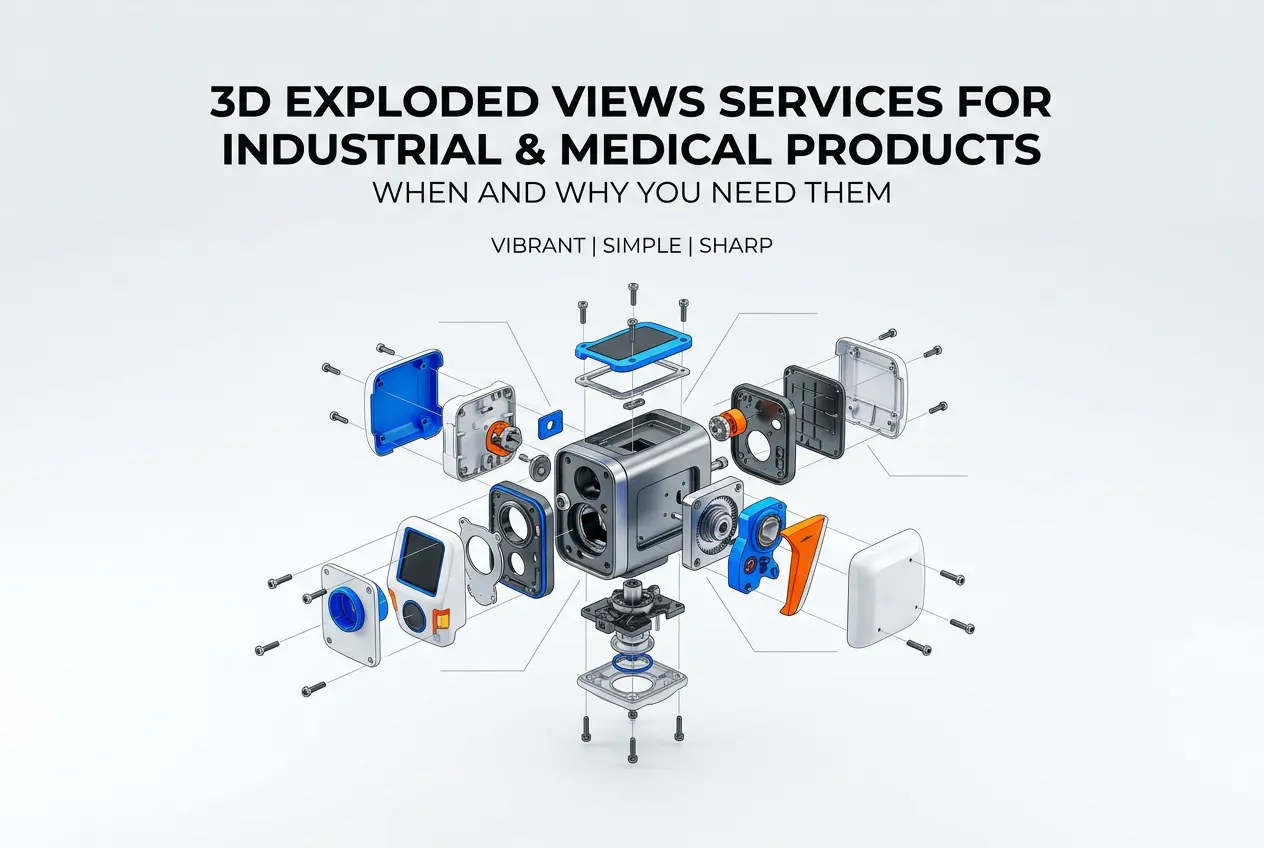
There’s a specific moment in almost every industrial or medical product project where a flat photo or even a polished product render just doesn’t do the job. The product looks great, but no one can understand how it works, how it assembles, or why every component matters. That’s exactly where 3D Exploded Views Services for Industrial and Medical Products come in — and once you’ve used them properly, you’ll wonder how you ever explained a complex product without one. Whether you’re a surgeon trying to understand a new implant system, an engineer reviewing a mechanical assembly, or a product manager preparing a device launch, an exploded view does something that words, arrows, and even videos struggle to do: it shows the entire anatomy of a product in one clear, organized visual.
In our studio at 360render.com, we’ve worked on exploded views across a genuinely wide range of products — from dental implant systems and medical devices to consumer hardware like a collapsible thermos cup and 3D printer extruder assemblies. Each project taught us something about what makes an exploded view actually useful versus merely decorative. And yes, there’s a big difference. A technically accurate exploded view that’s also visually well-composed is a powerful communication tool. A poorly planned one just creates confusion. This post breaks down when you need one, why it matters, and what separates a useful exploded view from a pretty mess.
What Is a 3D Exploded View and How Is It Different From a Regular Render?
A regular 3D product render shows your product assembled and looking its best — accurate materials, lighting, angles, maybe some lifestyle context. An exploded view does something structurally different: it pulls the components apart along a logical axis or set of axes, showing each part clearly separated from the others while still maintaining their spatial relationship. You can see what connects to what, what goes in first, what sits inside what.
The key word is logical. The explosion isn’t random. Parts usually separate along the assembly axis — think of a bolt pulling straight out from a hole, or a cap lifting cleanly off a cylinder. In more complex assemblies, components explode in multiple directions, but the artist needs to ensure nothing visually overlaps in a confusing way. This is where 3D exploded views are technically superior to traditional 2D technical drawings: you’re working in three-dimensional space, so you can choose the exact viewing angle that makes the assembly most legible.
From a workflow standpoint, we build these from CAD data, engineered 3D models, or sometimes from reference images combined with our own modeled geometry. The fidelity of the source data matters a lot — which we’ll cover shortly.
3D Exploded Views Services for Industrial and Medical Products: The Core Use Cases
Medical Device and Implant Systems
This is probably where we’ve done our most specialized work. Dental and orthopedic implant systems are inherently complex — there are multiple precision components that must be understood clearly by surgeons, distributors, and training staff. We created an exploded view showing exactly how an implant assembles on the jaw in an All-on-4 system. The challenge there was communicating sequential assembly in a single still image: which component comes first, how the abutment interfaces with the implant body, how the final prosthetic locks in. Done well, that single image replaces several paragraphs of written instructions.
We also built exploded views for an implant stability tool, showing how the device interacts with the implant during a procedure. For a non-surgeon audience — think sales reps or procurement teams — this type of visual bridges the gap between clinical knowledge and commercial understanding. Similarly, we created an exploded breakdown of how an angulated guide pin is used to set the correct angle for implants and abutments. Angulation is a spatial concept that’s genuinely hard to describe in text, but when you see the guide pin relationship rendered clearly with components pulled apart along their respective axes, it clicks immediately.
We’ve also done exploded views for multiple Xandar Kardian medical devices — a company working in radar-based healthcare monitoring. Their products have layered PCB and enclosure assemblies that needed to be communicated clearly to distributors and integration partners. In that context, the exploded view isn’t for surgery — it’s for technical sales, integration documentation, and investor materials.
Industrial Products and Consumer Hardware
Industrial applications have their own set of requirements. A client brought us a collapsible thermos cup — a product with a clever collapsing mechanism that was genuinely hard to understand from marketing photos alone. The exploded view showed each layer of the collapsing structure, the lid seal assembly, and how the base locked in place. For an e-commerce context, this kind of visual directly answers the question a customer has before buying: “How does this actually work?”
We did an exploded view of a door hinge assembly — something that sounds simple but has more components than most people realize, especially for heavy-duty hinges with internal tensioning mechanisms. And we broke down a 3D printer’s extruder assembly, which is a genuinely complex mechanical system with heat blocks, nozzles, thermistors, cooling components, and drive gears all packed into a small space. For a product like that, an exploded view is almost essential documentation — both for the end user trying to maintain or modify their printer, and for the manufacturer explaining their design choices.
We also created what I’d call an artistic exploded view of a surgical toolkit used to determine implant spacing. This one was as much about aesthetics as function — the components were arranged with deliberate spacing and a clean background so it could work as both technical documentation and a high-end product visual for a medical catalog.
When Do You Actually Need One?

Not every product needs an exploded view. A solid perfume bottle or a simple phone case doesn’t have assembly complexity worth illustrating. But here are the situations where it becomes genuinely necessary:
- Multi-component assemblies: If your product has more than a handful of parts that connect or nest together, an exploded view helps any audience — technical or not — understand the structure.
- Surgical or procedural training: Any device used in a clinical setting benefits from clear assembly and usage visuals. Text and arrows on a 2D diagram don’t carry the same weight as a properly built 3D exploded view.
- Technical sales and distribution: When your sales team is explaining a product to distributors, procurement officers, or technical evaluators who aren’t product engineers, exploded views handle the education layer so the conversation can focus on fit and value.
- Patent and regulatory submissions: Some submissions require clear visual documentation of component relationships. A 3D exploded view is cleaner and more precise than most hand-drafted alternatives.
- User manuals and assembly guides: If your product requires assembly by the end user, an exploded view with part callouts is a far better instruction tool than photographs of real parts, which often have poor contrast and confusing backgrounds.
- Investor decks and product launches: When you’re presenting a new product, showing the engineering depth through an exploded view signals quality and complexity in a way a surface render cannot.
What Actually Makes a Good Exploded View — Technically Speaking
We’ve reviewed exploded views done by other studios and, honestly, we’ve seen the full range. Here’s what separates a useful one from a confusing one:
Explosion direction logic. Parts need to move along sensible vectors. If a screw threads into a horizontal hole, it should explode horizontally. If components stack vertically, they should pull apart vertically. Crossing explosion paths is a common mistake — two parts exploding in the same direction when they assemble from different sides creates visual overlap and confusion.
Spacing and scale. The distance between exploded components needs to be visually proportional. Too close and the parts merge visually. Too far and the relationship between them becomes unclear. We typically do test renders at multiple spacing levels before locking in the final composition.
View angle selection. This is probably the most underappreciated decision in the whole process. The camera angle determines which parts are legible and which hide behind others. We usually render multiple angle options and let the client weigh in, because sometimes what makes mechanical sense doesn’t match what their audience will actually understand most easily.
Materials and rendering quality. A flat, unshaded exploded view works fine in a CAD program but looks cold and clinical for commercial use. We render exploded views with the same material quality we’d use for a hero product shot — accurate metals, plastics, rubbers, and surface finishes. The exploded view for the Xandar Kardian devices, for instance, had specific enclosure materials and PCB coloring that needed to look right for their branding.
Labels and callouts. Depending on use case, some exploded views need part names, numbers, or arrows pointing to key interfaces. These are usually added in post as a separate layer so the client can use the clean render for one purpose and the annotated version for documentation.
Common Mistakes Clients Make When Requesting Exploded Views

The most common issue we run into is clients providing incomplete CAD data or physical samples with no underlying 3D model. An exploded view requires accurate internal geometry — you can’t fake the internal components of an implant or a mechanical assembly. If the model doesn’t exist yet, we can build it, but that needs to be scoped into the project timeline and budget from the start.
The second issue is treating the exploded view as an afterthought. It’s often the last thing requested after all the hero renders are done, and clients sometimes underestimate how much modeling or technical setup it requires. In our experience, the best results happen when the exploded view is planned alongside the other renders — same scene, same lighting setup, same camera logic — so everything feels visually cohesive.
Third: expecting a single static view to do all jobs. For a product like an All-on-4 implant system, one exploded view shows the components. A second might show the assembly sequence. A third might isolate just the abutment connection. These are different visuals with different purposes, and trying to cram all that information into one image usually produces something that tries to say everything and ends up saying nothing clearly.
Getting Started With 3D Exploded Views for Your Product
If you’re working on a medical device, industrial tool, or any multi-component product and you’re struggling to communicate how it works — visually, clearly, and at a level that works for both technical and non-technical audiences — a properly built exploded view is probably the right solution. It’s a specific skill set that sits at the intersection of 3D modeling precision, spatial logic, and visual design. Getting all three right is what produces an exploded view that actually works in the field.
We’ve built these for dental implant systems, medical monitoring devices, mechanical hardware, and consumer products — and each one reinforced the same principle: the more complex and precise the product, the more an exploded view earns its place in your asset library. If you have a product that needs this kind of treatment, get in touch with us and we’ll assess what it actually takes to do it right for your specific use case.
Frequently Asked Questions
What are 3D exploded view services and how do they differ from standard product renderings?
3D exploded view services create technical illustrations that show all individual components of a product spatially separated along an axis, revealing how each part fits together in assembly. Unlike standard product renderings that display a finished product externally, exploded views expose internal structures, component relationships, and assembly sequences in a single clear visual. This makes them especially valuable for complex industrial machinery or medical devices where understanding part interaction is critical.
When should industrial manufacturers invest in 3D exploded view illustrations for their products?
Industrial manufacturers should invest in 3D exploded views when launching new machinery, updating technical manuals, training assembly teams, or supporting after-sales service with accurate spare parts identification. They are particularly essential when products contain numerous sub-components that are difficult to describe through written instructions or flat 2D diagrams alone. Early integration during the product design phase can also reduce costly assembly errors and improve communication between engineering and production teams.
Why are 3D exploded views especially important for medical device documentation and compliance?
Medical device manufacturers are often required by regulatory bodies such as the FDA and ISO standards to provide clear, precise technical documentation that demonstrates device assembly, functionality, and component traceability. 3D exploded views satisfy these requirements by visually mapping every component with labeled part numbers, ensuring that documentation is unambiguous for auditors, healthcare professionals, and service technicians. Accurate visual documentation also reduces the risk of misassembly, which is a critical safety concern in medical applications.
How much do professional 3D exploded view services typically cost for industrial or medical products?
The cost of professional 3D exploded view services varies widely depending on product complexity, number of components, level of detail required, and the format of source files provided, ranging from a few hundred dollars for simple parts to several thousand for complex assemblies. Medical and industrial products with intricate internal mechanisms, tight tolerances, or regulatory documentation requirements tend to fall at the higher end of the pricing spectrum. Providing accurate CAD files upfront can significantly reduce production time and lower overall project costs.
What file formats and source materials are needed to create accurate 3D exploded view illustrations?
Professional 3D exploded view artists typically work best with native CAD files in formats such as STEP, IGES, SolidWorks, or CATIA, as these contain precise geometry and component structure data needed for accurate decomposition. If CAD files are unavailable, detailed 2D engineering drawings, physical product samples, or high-resolution photographs can be used as reference, though this may increase production time and cost. Providing a complete bill of materials alongside source files helps ensure every component is correctly identified and labeled in the final illustration.
Also read: 3D Exploded View Services for Industrial and Medical Products: Benefits, Uses and What to Look For