Imagine you have just finished setting up the perfect 3D scene. The lighting is pristine, the materials are highly detailed, and your camera angles are locked in. You hit the “render” button, sit back, and wait. Then, your computer gives you the dreaded estimated time: 72 hours remaining. If you are a 3D artist or a business waiting on a marketing campaign, that kind of delay is incredibly frustrating—and often unacceptable.
Whether you are working on intricate 3D product rendering services or massive architectural visualizations, rendering is undeniably the most computationally heavy part of the 3D pipeline. A single workstation, no matter how souped-up and powerful, will almost always struggle to process high-resolution images or complex animations in a short amount of time. The math required to calculate light bounces, shadows, reflections, and refractions is simply too much for one machine to handle quickly.
This is exactly where a render farm comes into play. If you have ever wondered how major Hollywood studios and top-tier visualization agencies like 360 Render manage to output photorealistic visuals in record time, the secret lies in these massive computing powerhouses. Let’s dive into what a render farm is, how it works behind the scenes, and why it is an absolute game-changer for modern 3D workflows.
What is a Render Farm and How Does it Work?
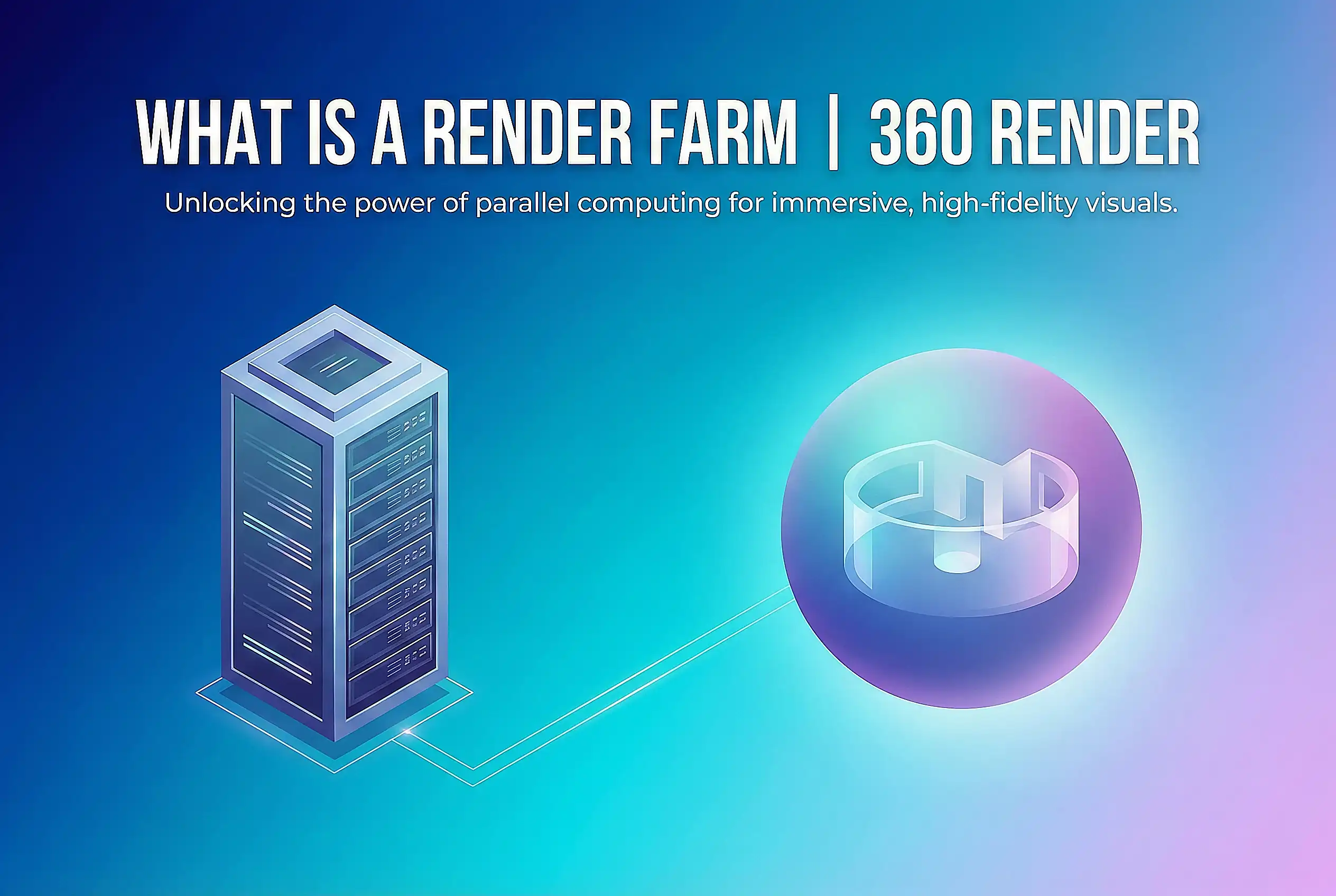
At its core, a render farm is a cluster of high-performance computers—often referred to as “nodes”—that are connected via a local network or the internet to render 3D images and animations collaboratively. Instead of relying on a single CPU or GPU to do all the heavy lifting, a render farm distributes the workload across dozens, hundreds, or even thousands of processors simultaneously.
Think of it like painting a massive mural. If one artist tries to paint the whole wall, it might take them a month. But if you hire 100 skilled artists and assign each of them a small, specific square of the wall, the entire mural can be finished in a matter of hours.
In a render farm setup, a “manager” or “controller” software takes your 3D project file and breaks it down. If you are rendering a 360 product spin rotational animation that consists of 300 frames, the manager will send frame 1 to Node A, frame 2 to Node B, frame 3 to Node C, and so on. If you are rendering a single, massive high-resolution still image, the software will split that single image into tiny squares (called “buckets” or “tiles”) and have different computers calculate different sections at the same time.
The Biggest Benefits of Using a Render Farm
Using a render farm isn’t just a luxury; for many professionals, it is an absolute necessity. Here are the main reasons why 3D artists and agencies rely on them:
1. Unmatched Speed and Efficiency
The most obvious benefit is speed. A rendering job that might lock up your personal computer for a week can easily be completed by a render farm in a few hours or even minutes. This rapid turnaround is crucial for meeting tight client deadlines, especially in fast-paced industries like e-commerce and real estate.
2. Freeing Up Your Workstation
When your computer is rendering, it is essentially useless for anything else. The CPU and RAM are maxed out, meaning you can’t continue modeling, texturing, or working on other projects. By sending your heavy scenes—like detailed medical equipment 3D renders—to a farm, your local machine is instantly freed up, allowing you to keep working and stay productive.
3. Handling Extreme Complexity
As technology advances, client expectations rise. Today’s renders require 4K or even 8K resolutions, insanely high polygon counts, and complex volumetric lighting. Handling massive CAD data for an exploded view 3D render or a massive architectural masterplan simply requires more RAM and VRAM than a standard desktop can provide.
Cloud Render Farms vs. Local Render Farms
When we talk about render farms, they generally fall into two categories: local and cloud-based.
Local Render Farms: These are physical servers built and maintained in-house by a studio. While they offer complete control and don’t require internet bandwidth to transfer massive files, they come with astronomical upfront hardware costs, high electricity bills, and require dedicated IT staff to maintain. They are usually reserved for massive animation studios.
Cloud Render Farms: This is the modern solution for most freelancers and agencies. Cloud render farms allow you to upload your packaged 3D scene to remote servers over the internet and rent computing power on a pay-as-you-go basis. They are incredibly scalable; you can rent 10 nodes or 1,000 nodes depending on your budget and deadline. Furthermore, reputable commercial rendering services prioritize IP protection, quality, and reliability, ensuring your unreleased product designs are kept strictly confidential.
Practical Examples: When Should You Use a Render Farm?
Not every project requires a render farm. A simple, low-resolution mockup can easily be handled locally. However, here are some practical examples of when a render farm becomes indispensable:
- High-Resolution E-commerce Visuals: If you are creating a suite of Amazon product renderings, you need crisp, high-resolution images. Rendering multiple angles, color variations, and close-ups for an entire product catalog is a perfect job for a farm.
- Immersive Virtual Experiences: Creating 360 virtual tours and panoramas requires rendering spherical images at massive resolutions (often 8K or higher) so that the user can zoom in without losing clarity. A render farm chews through these massive files with ease.
- Complex Architectural Animations: A 60-second fly-through of a commercial exterior rendering at 30 frames per second equals 1,800 individual frames. If each frame takes 30 minutes locally, that’s over a month of non-stop rendering. A render farm can do it overnight.
- Lifestyle Scenes: Creating a lifestyle 3D product render in a virtual space often involves complex lighting setups, soft shadows, and high-resolution textures for background props. Offloading this ensures the final image is noise-free and photorealistic.
Practical Tips for Optimizing Your 3D Scenes Before Farm Rendering
Before you upload your files to a render farm, it is crucial to optimize your scene. Since you are often paying for cloud rendering by the hour or by the node, an unoptimized scene can cost you unnecessary time and money. Here are a few practical tips:
- Optimize Geometry and Textures: Don’t use an 8K texture for a tiny background prop that the camera barely sees. Similarly, use proxies for repetitive, heavy geometry. For example, if you are working on residential exterior rendering, use proxies for the grass and trees to keep the file size manageable.
- Always Do Test Renders Locally: Never send a final, high-resolution animation to a render farm without doing a low-resolution test first. Render a few scattered frames (e.g., frame 1, frame 50, frame 100) locally to ensure the lighting, textures, and camera movements are exactly as you want them.
- Check Your File Paths: When you send a project to a remote server, the server needs all your texture files, HDRIs, and proxies. Make sure you properly “pack” or “archive” your scene so that no assets are left behind on your local hard drive, which would result in missing textures (the dreaded pink or black materials) in the final render.
Conclusion
In the fast-paced world of digital visualization, time is money. A render farm bridges the gap between your creative vision and the technical limitations of standard computer hardware. By harnessing the power of hundreds of processors simultaneously, you can deliver breathtaking, photorealistic visuals to your clients without the agonizing wait times.
At 360 Render, we understand that quality and speed go hand in hand. That is why our 3D rendering process leverages state-of-the-art computing power to ensure your projects—from simple studio shots to complex architectural animations—are delivered flawlessly and on schedule. We handle the heavy lifting so you can focus on what matters most: growing your business and showcasing your products in the best possible light.
If you are ready to bring your ideas to life with stunning 3D visuals without the wait, contact us today!