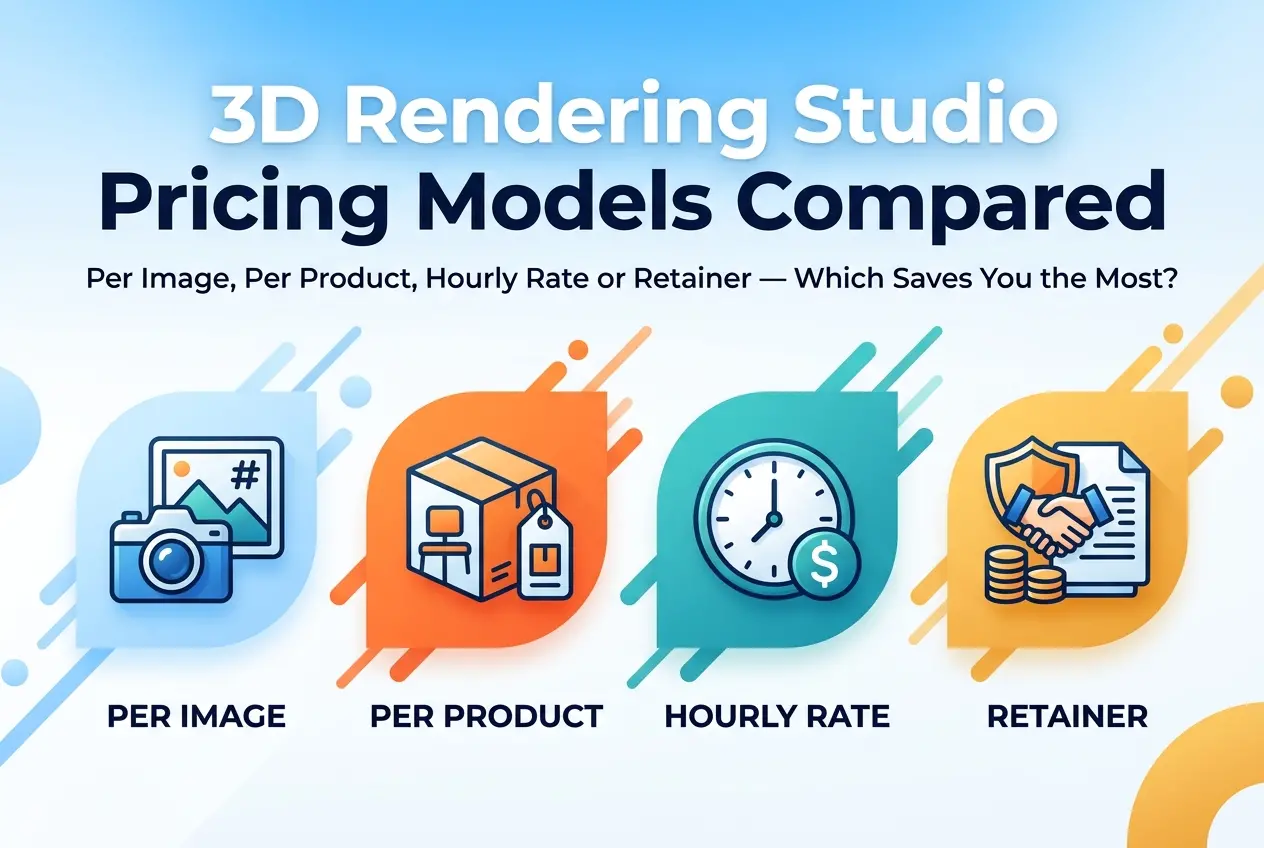
Every client who asks us for a quote eventually asks the same thing: “Is per-image pricing cheaper, or should I just hire you by the hour?” It’s a fair question, and the honest answer is that it depends on what you’re buying. This guide, 3D Rendering Studio Pricing Models Compared: Per Image, Per Product, Hourly Rate or Retainer — Which Saves You the Most?, breaks down how each model works from inside a studio, where each one protects you, and where each one quietly costs you more than you expected.
Pricing models aren’t just billing preferences. They decide who carries the risk. If the studio carries it, you pay a premium for certainty. If you carry it, you get lower headline rates but an open-ended bill. Once you see it that way, picking the right model gets much easier.
Below, I’ll walk through the four common structures, show what drives cost inside each one, and share what we’ve seen clients get wrong.
Per Image Pricing: Predictable, but Scope Matters
Per-image pricing is the most common model for architectural and interior visualization. You get a fixed fee for each final still, usually with a set number of revision rounds included. It’s simple to budget and easy to compare between studios.
What most clients miss is that “per image” hides a lot of variables. A simple bedroom with furniture from a catalogue is a very different job from an exterior of a mixed-use building with landscaping, vehicles, people and dusk lighting. Both are one image. The studio’s quote should reflect:
- Model complexity: whether we build from CAD and drawings or start from a sketch
- Asset needs: custom furniture or facade details versus library assets
- Lighting and camera: daylight, night, or golden hour, interior or aerial
- Resolution and output: print-size files cost more render time than web images
- Revision rounds: how many are included and what counts as a revision versus a change of scope
Per-image works best when the brief is clear and the design is frozen. It works badly when the design is still shifting, because every change to the building after modeling begins is technically out of scope. Good studios will tell you that upfront. Weak ones will let it slide until the invoice arrives.
Where per-image saves you money
Once the 3D model exists, additional views of the same scene are far cheaper than the first. A studio that builds a living room for one hero shot can often deliver a second angle at a fraction of the cost. If you need a package of four or five views of the same project, ask for a bundled rate rather than pricing each one in isolation.
Per Product Pricing: Built for Catalogues and E-commerce
Per-product pricing is the standard for e-commerce sellers and manufacturers. Instead of paying per image, you pay a fixed fee per SKU that includes a defined set of outputs, say a white-background hero, two or three angles, and perhaps a lifestyle scene.
The logic is efficient. The expensive part of product visualization is building an accurate model: matching materials, bevels, stitching, finishes and proportions. Once that’s done, rendering extra angles or colorways costs relatively little. So a per-product rate reflects the modeling effort and bundles the outputs.
If you sell variants (same chair in eight fabrics, for example), this model is where the savings are largest. The geometry is built once, and materials are swapped. We’d encourage anyone with a growing catalogue to look at our 3D product rendering services with variants in mind rather than treating each colorway as a new job.
The catch
Per-product pricing assumes reasonably clean source material. If you send a blurry phone photo and a rough dimension, the studio has to guess, and revision loops multiply. Send CAD files, technical drawings, material samples or high-resolution reference photos, and the fixed price tends to stay fixed.
Hourly Rate: Flexible, but Hard to Forecast

Hourly billing makes sense when the scope can’t be defined in advance. Think of early design exploration, ongoing modifications to an existing scene, or technical troubleshooting on a messy file someone else built. You pay for the time spent, and you can steer the work as it develops.
The risk is obvious: you don’t know the final cost until the work is done. Hourly also rewards slow work in a way that fixed pricing doesn’t, because a studio on a fixed fee has every reason to be efficient. That’s not an accusation. Plenty of studios bill hourly with total honesty. But the incentives are worth understanding.
If you go hourly, protect yourself with three things: a cap or estimate that requires approval before it’s exceeded, regular time reports, and a clear definition of what’s being worked on each week. Hourly works well with a client who communicates quickly and makes decisions fast. It works poorly with a committee that takes two weeks to answer an email.
Retainer Pricing: Best for Ongoing Volume
A retainer reserves studio capacity for a set period, usually monthly. You pay a recurring fee in exchange for priority scheduling, a consistent team, and a pool of hours or deliverables you can draw from.
Retainers make sense for developers with a pipeline of projects, furniture brands launching collections throughout the year, and architecture firms that need visuals for every competition and client pitch. The studio learns your standards, your material libraries, your preferred camera style. Briefing time shrinks, and output becomes more consistent from one job to the next.
The downside is paying for capacity you don’t use. If your workload is lumpy, with a flood of work in spring and silence in summer, a retainer can cost more than buying per image. Ask whether unused hours roll over, and what happens when you need more than the retainer covers.
3D Rendering Studio Pricing Models Compared: Which Actually Saves You the Most?

Here’s the short version of how the four models stack up:
| Model | Best for | Main risk | Who carries the risk |
|---|---|---|---|
| Per image | Single projects with a frozen design | Scope creep and change fees | Shared |
| Per product | Catalogues, variants, e-commerce | Poor source material causing revisions | Studio, mostly |
| Hourly | Undefined or evolving scope | Unpredictable total cost | Client |
| Retainer | Ongoing, steady volume | Paying for unused capacity | Client |
No single model wins everywhere. The cheapest option is the one that matches how predictable your work actually is. Defined scope and finished designs favor fixed pricing. Fluid scope favors hourly. Constant volume favors retainers. Many of our long-term clients use a hybrid: a per-image or per-product rate for standard deliverables, plus hourly billing for out-of-scope changes.
What Clients Get Wrong
After years of quoting jobs, the same mistakes keep showing up.
Comparing quotes without comparing scope. Two studios quote the same exterior at very different prices. One includes entourage, landscaping and two revision rounds. The other includes a bare model and charges for everything else. Ask each studio to list exactly what’s included before judging price.
Starting before the design is settled. Changing a floor plan after modeling begins is the single most expensive thing you can do under any pricing model. If the design isn’t locked, say so and choose hourly or a phased fixed fee.
Ignoring revision definitions. Moving a sofa is a revision. Changing the time of day, the camera angle, or the facade material usually means re-rendering and sometimes remodeling. Agree on the difference at the start.
Choosing on rate alone. A low hourly rate from a slower team can cost more than a higher rate from experienced artists who finish in half the time. Cheap per-image quotes sometimes reflect shortcuts in materials and lighting that show up the moment you zoom in.
Not mentioning the end use. A render for a social post and one for a 3-metre billboard need different resolutions and render times. Tell the studio where the image will live.
How to Choose in Practice
Start by asking three questions. Is the design final? How many images or products do you need over the next year? How quickly can you give feedback? Final design with a one-off need points to per image or per product. Ongoing demand points to a retainer. Uncertainty points to hourly with a cap.
Then ask for a written breakdown. A good studio will happily explain what’s included, what triggers extra charges, and how files should be supplied. If a quote is a single number with no detail, ask for more.
Final Thoughts
The pricing model matters less than the clarity around it. A well-scoped per-image quote beats a vague retainer, and a capped hourly arrangement beats a fixed price that collapses the moment the design changes. Match the structure to your workflow, supply good reference material, and decide on revisions before work begins.
If you’re weighing up options for an upcoming project, tell us what you’re working on and we’ll recommend the structure that fits it, even if that isn’t the one that earns us the most. You can get in touch with our team to request a scoped quote.
Frequently Asked Questions
How much does 3D product rendering cost per image on average?
Per-image pricing for 3D product renders typically ranges from $50 to $150 for simple products on a white background, and $150 to $500+ for complex lifestyle or hero shots. Cost depends on model complexity, whether the studio must build the 3D model from scratch, and the resolution required. Studios often discount heavily for bulk orders of 20 or more images.
Is per-product pricing cheaper than per-image pricing for 3D rendering?
Per-product pricing is usually cheaper when you need multiple angles, color variants, or scenes for the same item, because the 3D model is built once and reused. A flat fee of $300 to $800 per product that includes 5 to 10 images often beats paying $100 or more per image. Per-image pricing works better if you only need one or two shots per product.
When does an hourly rate for a 3D rendering studio make financial sense?
Hourly rates, commonly $40 to $150 per hour, make sense for projects with unclear scope, such as architectural visualization with frequent revisions, animation, or R&D concept work. They give you flexibility but carry budget risk if the project drifts. To protect yourself, request a time estimate, a not-to-exceed cap, and weekly progress reports.
Is a 3D rendering retainer worth it for ecommerce brands with ongoing product launches?
A retainer is worth it if you need a steady flow of renders each month, typically 10 or more images, since studios often offer 10% to 30% lower effective rates plus priority scheduling and consistent quality. It also keeps your assets, lighting, and style guides organized with one team. Retainers are a poor fit if your workload is sporadic, because unused hours or credits may expire.
Which 3D rendering pricing model saves the most money overall?
No single model is cheapest for everyone: per-image wins for small one-off needs, per-product for catalogs with many variants, hourly for undefined or evolving scopes, and retainers for ongoing high-volume work. Estimate your monthly volume, number of angles per product, and expected revisions, then compare the total cost under each model. Also ask about revision limits, model ownership, and rush fees, since these hidden costs can change which option is truly cheapest.