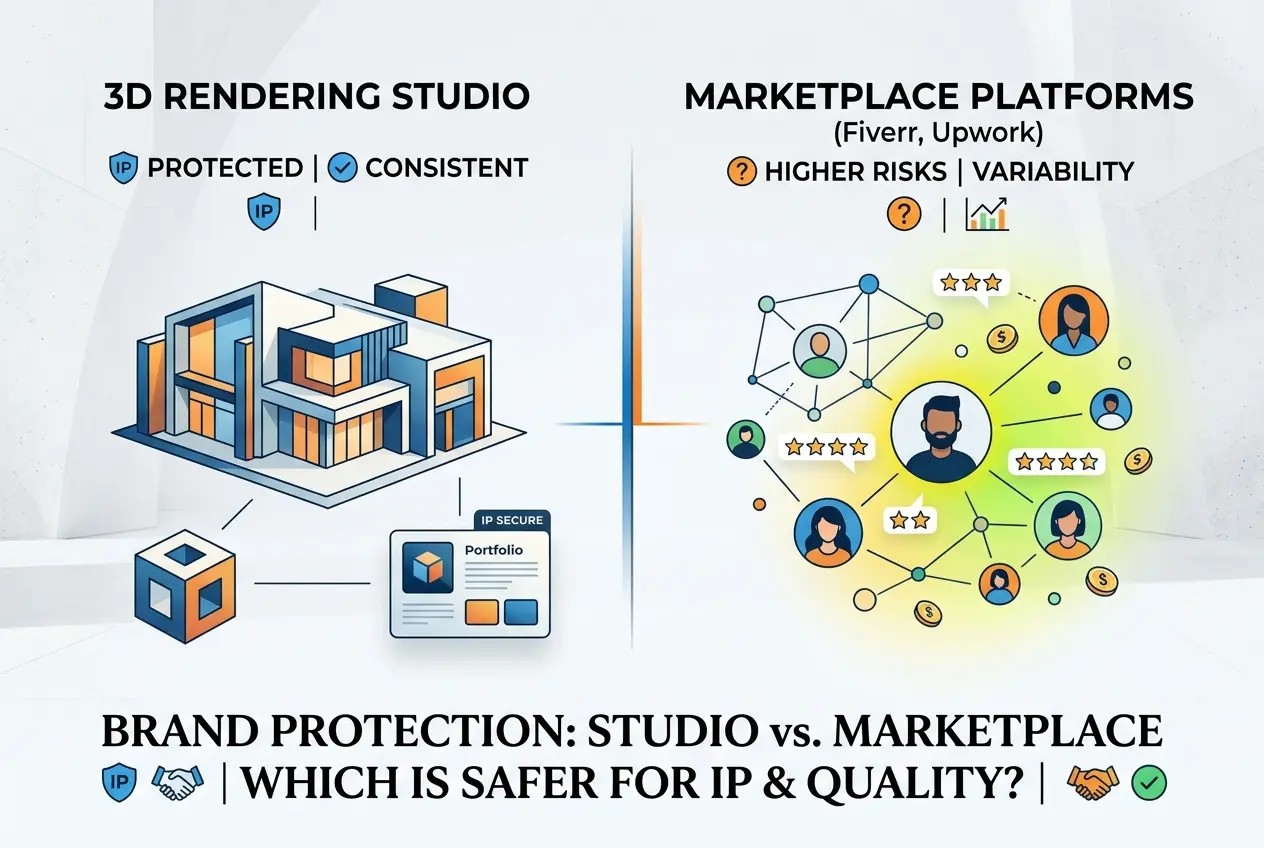
If you’re deciding between a freelancer on a marketplace and a dedicated agency, the question usually starts with price. It shouldn’t. For brands with unreleased products, confidential floor plans, or a catalogue that needs to look identical across hundreds of images, the real issue is risk. This post looks at 3D Rendering Studio vs Marketplace Platforms Like Fiverr and Upwork: Which Is Safer for Brands That Need IP Protection and Consistent Quality, from the point of view of someone who builds these files every day.
Marketplaces are not bad. Plenty of talented artists work on them, and for a one-off, low-stakes job they can be a sensible choice. But the structure of the platform shapes what you can control, and most of what a brand needs to control sits outside the platform’s terms of service.
Below, we’ll go through where IP leaks actually happen, why quality drifts on repeat work, and what to check before you hand over a CAD file or a set of architectural drawings.
What You’re Really Handing Over When You Brief a 3D Artist
A render brief is rarely just a request for a picture. You’re sending CAD models, engineering drawings, material specs, brand colour references, and sometimes product designs that haven’t launched. For an architect, it’s a full set of plans for a client’s private project. That is intellectual property in its rawest form, and the source files are far more valuable than the final image.
Once a 3D artist has your STEP, FBX, or DWG file, they hold the geometry. A final JPEG shows a product from one angle. A source model can be re-lit, re-textured, and rendered from any angle, or sent to a prototyping shop. That’s why the question of who touches your files matters more than who delivers the prettiest sample.
Where Marketplace Platforms Fall Short on IP Protection
Marketplaces provide a payment escrow and a dispute process. They don’t provide the safeguards a brand with serious IP needs.
Individual contractors, not accountable entities
When you hire on a marketplace, you’re contracting with a single person, often under a username. Enforcing an NDA against an anonymous individual in another country is difficult in practice, even when the document is perfectly drafted. Platform terms typically cover basic confidentiality, but they rarely give you a practical route to recovery if a file surfaces somewhere it shouldn’t.
Subcontracting you can’t see
This one catches clients off guard. A freelancer who takes on more work than they can handle may pass part of it to someone else: a modeler, a texture artist, a friend with a faster workstation. You approved one person, but your files may now sit on several machines you know nothing about. On a marketplace there’s usually no mechanism to prevent or even detect this.
Uncontrolled file storage
Freelancers work from personal machines, personal cloud drives, and consumer-grade file transfer links. Project files linger long after delivery. There’s rarely a data retention policy, an access log, or a secure deletion process. Nobody is being malicious here; it’s simply that a solo operator doesn’t have an IT environment built around client confidentiality.
Portfolio reuse
Many freelancers want to show their best work. If your unreleased product looks great, it’s tempting to post it. Unless your contract explicitly forbids portfolio use until a release date, you have little recourse once it appears on a public gallery.
How a Studio Structures Protection Differently

A studio isn’t automatically safe just because it has an office. But the structure gives you things a solo contractor can’t easily offer.
- A legal entity you can contract with. NDAs and service agreements bind a registered company, not a username.
- Controlled working environments. Files live on company servers or managed storage, with access limited to the team assigned to your project.
- Known team members. You know who is on the job, and staff are bound by employment agreements that include confidentiality.
- Defined deletion and archiving practices. Files are stored or removed according to a policy rather than someone’s memory.
- Continuity. If one artist leaves, your project data stays with the studio, not with a person who has moved on.
In our studio, source files stay on internal storage, and project access is limited to the artists and reviewers who need it. That’s a basic operating habit, not a special service, and it’s the sort of thing you should ask any vendor to describe plainly.
Consistent Quality: The Problem Nobody Prices In
IP risk gets the headlines, but inconsistency is what most brands feel month to month. A single good render is easy to find. The harder thing is the fiftieth render looking like the first.
Consistency in 3D comes down to a handful of technical decisions: the lighting rig, camera focal length and framing, material library, colour management, and output settings. If those aren’t documented and reused, every new project is a fresh interpretation. Two freelancers will light the same sofa differently. The same freelancer will light it differently six months later, because they’ve changed software versions, switched render engines, or simply forgotten their settings.
A studio can maintain a shared setup for your brand: a saved lighting scene, a locked material library with your approved fabrics and finishes, and a style guide for camera angles. When a different artist picks up the next batch, they start from the same foundation. That matters most for e-commerce catalogues, where mismatched shadows or inconsistent white balance across a product page makes a brand look careless.
| Factor | Marketplace Freelancer | Studio |
|---|---|---|
| Contracting party | Individual, often pseudonymous | Registered company |
| File handling | Personal devices and storage | Managed internal storage |
| Subcontracting visibility | Usually none | Defined team, disclosed |
| Style continuity across projects | Depends on one person’s availability | Shared assets and documented setups |
| Capacity for large batches | Limited by one person | Team can scale the work |
| Revision process | Varies per freelancer | Structured review stages |
| Upfront cost | Often lower | Often higher, but includes process |
What Clients Get Wrong When Choosing
After years of taking over projects that started elsewhere, a few patterns repeat.
Judging by the portfolio alone. A portfolio shows the best outputs, not the process behind them. It tells you nothing about how files are handled or how the artist reacts to a third round of revisions.
Sending full source files when they don’t need to. For some jobs, a simplified or decimated model is enough. Strip internal components, proprietary mechanisms, and unnecessary detail before sharing. This is good practice with any vendor.
Skipping the written agreement. A marketplace chat thread is not a contract. Whoever you work with, get the ownership terms, confidentiality, and usage rights in writing. You should own the final renders and any source assets created for you, unless you’ve agreed otherwise.
Treating the cheapest quote as the safest. A low price often means the artist is stretched across many jobs, which is exactly when corners get cut on file security and revision rounds.
Ignoring the second project. The first render may look fine anywhere. It’s the follow-up, when the original artist is busy or gone, that exposes whether anyone documented how it was made.
When a Marketplace Still Makes Sense
To be fair, there are cases where a marketplace is a reasonable call. If you’re testing a concept with generic geometry, need a quick visual for an internal pitch, or have nothing confidential in the files, the lower commitment can suit you. Just be honest about what you’re sending. If a leak wouldn’t hurt, the risk is small. If it would, you need more than an escrow system.
A Practical Checklist Before You Hire Anyone
- Ask who will physically have access to your files, and where they’ll be stored.
- Ask whether any part of the work may be subcontracted, and require disclosure.
- Get an NDA signed by a legal entity, with clear terms on portfolio use.
- Confirm in writing that you own the final images and the source assets.
- Ask how they document lighting, camera, and material settings for repeat work.
- Request a small paid test project before committing a full catalogue or a major launch.
- Agree on a file deletion or return process at project close.
Any serious vendor will answer these without hesitation. If the answers are vague, that tells you what you need to know.
Final Thoughts
The comparison of a 3D Rendering Studio vs Marketplace Platforms Like Fiverr and Upwork: Which Is Safer for Brands That Need IP Protection and Consistent Quality comes down to accountability and repeatability. A marketplace gives you access to talent. A studio gives you a company that answers for how that talent handles your files and keeps your visual identity steady across every delivery. When the files are sensitive or the output has to match across dozens of images, structure matters more than a lower day rate.
If you’re weighing up a project with confidential designs or an ongoing catalogue, talk to our team at 360render and we’ll walk you through how we handle files, approvals, and style consistency before you commit to anything.
Frequently Asked Questions
Is a 3D rendering studio safer than Fiverr or Upwork for protecting my product designs and IP?
Generally, yes. Established studios work under custom contracts with NDAs, work-for-hire or IP assignment clauses, and secure file transfer, and they are accountable as a registered business. Marketplace freelancers operate under platform terms that offer limited IP protection, and enforcing rights against an anonymous or overseas individual is difficult if your files leak or are reused in a portfolio.
Who owns the copyright to 3D renders created through Fiverr or Upwork?
Ownership depends on the platform's terms and the agreement with the freelancer. Fiverr transfers rights to the buyer only upon full payment, with some exceptions, and Upwork's terms generally assign work product to the client once paid. Both leave gaps, since freelancers can still claim portfolio use, reuse of underlying 3D models, or third-party assets with restrictive licenses. For brand-critical work, get a signed agreement that explicitly assigns all rights, including source files, models, and textures.
How can I get consistent quality across multiple 3D rendering projects or product lines?
A studio provides consistency through standardized pipelines, shared lighting and material libraries, style guides, and internal quality control. With marketplaces you may hire a different freelancer each time, producing varied styles, and quality depends on one person's skills and availability. If you use freelancers, you can improve consistency by retaining one vetted artist, supplying a detailed brand style guide, and reusing approved scene files.
Are marketplace freelancers cheaper than 3D rendering studios, and is the savings worth the risk?
Freelancers often charge less upfront because they have lower overhead, and for simple, low-stakes visuals this can be a good trade-off. However, hidden costs such as revision rounds, missed deadlines, re-dos, and potential IP disputes can erase the savings. For product launches, packaging, or hero marketing assets, a studio's reliability and legal protection usually justify the higher price.
What should I look for in a contract or NDA when hiring a 3D rendering provider?
Look for a clear IP assignment or work-for-hire clause, confidentiality terms covering all files and references, and a ban on portfolio use without written approval. The contract should also specify deliverables (source files, formats, resolution), revision limits, deadlines, data security and deletion practices, and liability or indemnification for third-party asset licensing. Have a lawyer review it, especially if you work on unreleased products.