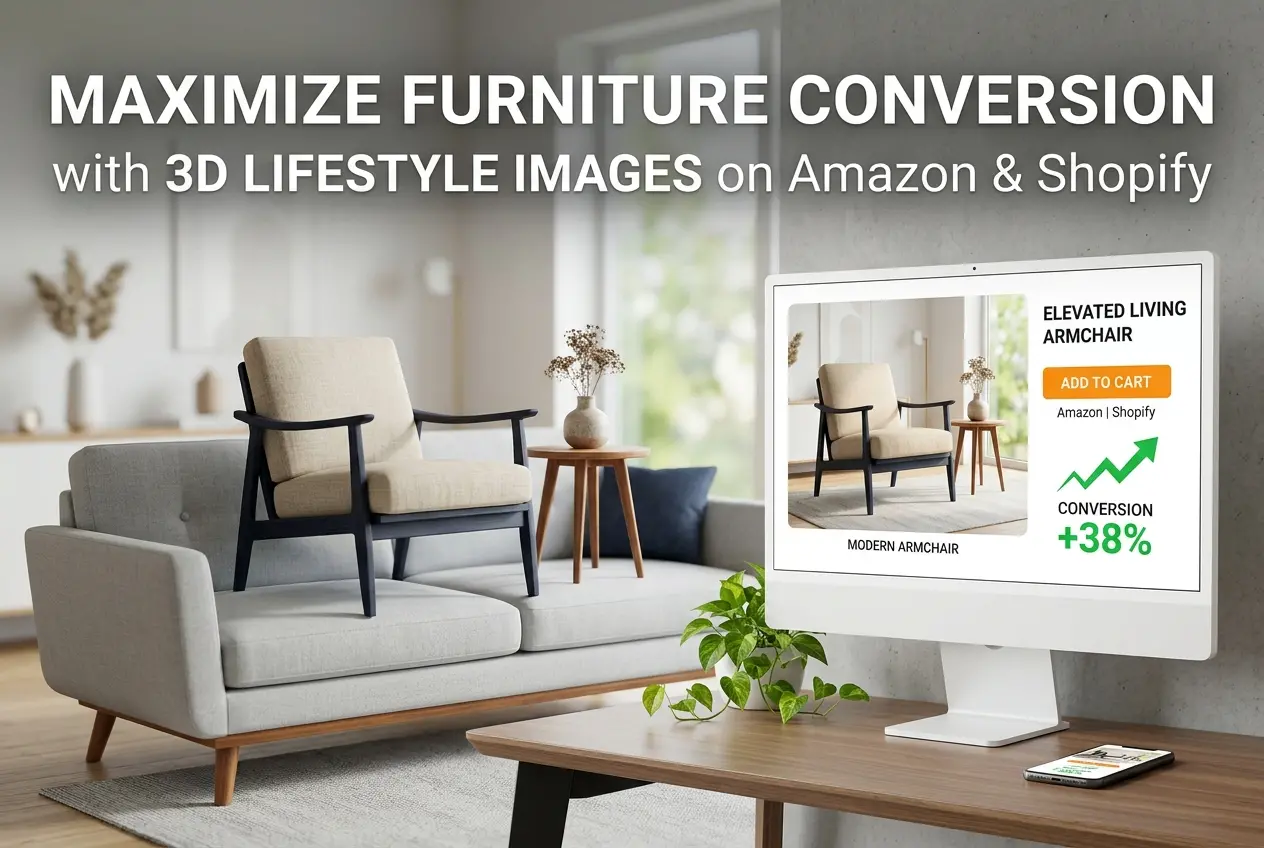
Selling furniture online is genuinely hard. Shoppers can’t sit on it, press the cushions, or walk around it. All they have is your product listing — and if your images don’t do the heavy lifting, they’ll bounce. Knowing how to use 3D lifestyle images to increase furniture conversion rates on Amazon and Shopify is one of the most practical skills any furniture seller can develop. Not because it’s trendy, but because it directly answers the questions buyers have before they hit “Add to Cart.” In our studio, we work with furniture brands ranging from small Shopify stores to large Amazon sellers, and the difference a well-executed lifestyle render makes to a listing is not subtle.
A plain product shot on a white background tells you what something looks like. A lifestyle render tells you what it’s like to live with it. That’s a completely different kind of visual communication. When someone is buying a sofa or a dining table, they’re imagining it in their home. They need to see scale, proportion, material texture, and how the piece fits into a real-seeming space. A 3D lifestyle image does all of that in a single frame — and unlike photography, it gives you full control over every variable.
Let’s get specific about what that looks like in practice, where brands get it wrong, and how to set up a workflow that actually moves the needle.
Why Lifestyle Context Changes Buyer Psychology
There’s a reason physical showrooms are designed the way they are. IKEA doesn’t stack chairs in a warehouse and expect you to visualize them at home — they build entire rooms. That psychology applies directly to e-commerce. When a buyer sees a dining chair styled in a warm, well-lit dining room with a table, pendant light, and place settings, their brain stops evaluating the product in isolation and starts evaluating it as part of their life.
This is especially important for furniture because furniture is a considered purchase. Unlike impulse buys, furniture decisions involve multiple household members, measuring a room, debating colors, and comparing competitors. Every image in your listing is either building or eroding confidence in that decision. A lifestyle render that shows the chair next to a table of a recognizable scale — with a window suggesting natural light — does more to reassure a buyer than three pages of spec copy.
On Amazon specifically, the main image must be on a white background per policy. But the secondary image slots are where lifestyle renders earn their keep. Shopify gives you more freedom upfront, but the same principle applies: lead with clean product shots, support with lifestyle context.
How to Use 3D Lifestyle Images to Increase Furniture Conversion Rates on Amazon and Shopify — A Technical Breakdown

1. Start With the Right Camera Angle and Focal Length
One of the most common mistakes we see is furniture rendered from the wrong angle. Either too high (makes pieces look squat and small) or too low (distorts proportions). For most furniture, a camera height between 1 to 1.5 meters with a focal length of 50mm to 85mm replicates how a person naturally sees a room. This matters because it makes the scale feel real. A sofa rendered at eye level with a slight angle reads as full-size, luxurious, and spatially believable. Render it from above at 24mm and it looks like a dollhouse.
2. Match the Scene Aesthetic to Your Target Buyer
A Scandinavian minimal bedroom set should not be styled in a baroque maximalist interior. This sounds obvious, but we see it constantly — brands commission a lifestyle render and then put their product in a generic, off-brand environment because it was cheaper or faster. The scene has to speak to the same person the product speaks to. If you sell mid-century modern dining furniture, the lifestyle render should have warm wood tones, a mix of textures, natural light from a side window, and maybe a simple pendant. Not a cold, grey office lobby.
Before any lifestyle render begins, we define a brief that includes target demographic, room style, color palette, and the emotional feeling the scene should communicate. This isn’t about decoration — it’s about targeting.
3. Material Accuracy Is Non-Negotiable
Furniture returns on e-commerce are disproportionately driven by “looks different in person” complaints. The most common culprit is inaccurate material rendering — fabric that looks silky when it’s actually matte, wood grain that appears too perfect or too coarse, metal finishes that photograph silver when they’re actually brushed gold. A lifestyle image that misrepresents your materials creates expectations you can’t meet at delivery.
This is where professional furniture 3D rendering makes a measurable difference. When materials are built from real reference photos, measured physically, and calibrated with physically-based rendering (PBR) workflows, the result matches reality closely enough that customers don’t feel deceived. That’s the technical standard worth investing in.
4. Use Lighting to Communicate Quality
Lighting in a lifestyle render is not just about making the image look pretty. It’s about communicating material quality and spatial comfort. Soft, directional light that casts gentle shadows shows texture — the weave of an upholstered sofa, the grain variation in a timber tabletop, the reflectance variation in a lacquered cabinet finish. Flat, even lighting wipes out all of that information. Buyers subconsciously associate flat-lit product images with lower quality, even if the product is excellent.
In practice, we typically use a combination of a key light source (simulating a window or directional sun), fill light to manage shadow depth, and environmental HDRI for ambient bounce. This creates the layered, photographic quality that makes a render feel like a real interior photo.
Structuring Your Image Set for Amazon and Shopify Listings

A strong furniture listing doesn’t use one type of image — it uses a sequence. Here’s how we typically advise structuring a render package:
| Image Slot | Image Type | Purpose |
|---|---|---|
| Main Image | White background product render | Amazon compliance; clean catalog look |
| Image 2 | Full lifestyle scene — wide | Context, scale, emotional pull |
| Image 3 | Close-up detail renders | Material accuracy, craftsmanship |
| Image 4 | Alternate angle lifestyle or styled scene | Different viewing perspective |
| Image 5 | Infographic render (dimensions, materials) | Removes last-minute purchase hesitation |
| Image 6+ | Variant color/material swaps | Reduces return rate from color confusion |
Shopify gives you more flexibility in the hero section — you can use a lifestyle render as the first image without policy restrictions. Use it. The emotional impact of landing on a product page and immediately seeing the piece in a beautiful room is significant.
Common Mistakes Furniture Sellers Make With Lifestyle Images
We’ve seen the same mistakes repeat often enough that they’re worth naming directly.
Overcrowding the scene. More props do not equal better lifestyle images. A cluttered render with too many accessories distracts from the product. The furniture should dominate the frame. Supporting elements — a rug, a plant, some books — should support the narrative, not compete with it.
Wrong scale relationships. If the sofa is paired with a coffee table that’s proportionally wrong, buyers notice — even if they can’t articulate why. Everything in the scene needs to be scaled correctly relative to the hero product and to real human dimensions. We always include at least one contextual scale reference (a standard door, a ceiling height, a table at dining height) to ground the viewer.
Reusing the same scene for every product in a catalog. This is a cost-cutting move that backfires. If every product in your catalog uses the same background room, buyers pick up on it. It reads as templated and cheap, which undermines the premium positioning you’re trying to establish.
Ignoring mobile display. Most Shopify and Amazon traffic now comes from mobile. A lifestyle render that looks great on a 27-inch monitor might lose critical detail on a phone screen. Images should be composed with mobile crop behavior in mind — key product areas should be centered or slightly above center so they’re not lost to letterboxing.
When 3D Outperforms Photography for Furniture
Photography still has its place. But for furniture specifically, 3D has some structural advantages. You can produce renders before the physical product exists — useful for pre-launch campaigns, crowdfunding, or testing demand before committing to a production run. You can create dozens of color and material variants from a single base model without reshooting anything. You can adjust a camera angle, change a prop, or swap a wall color in post without booking a studio day.
For sellers managing large catalogs across Amazon and Shopify, the economics of product 3D rendering make increasing sense at scale. Once a model is built and approved, derivative renders — different angles, different environments, different finishes — are significantly cheaper than additional photography sessions.
That said, the technical bar matters. A poorly executed 3D lifestyle render is worse than a clean product photograph. Buyers have visual sophistication now. They can spot a flat, lifeless render, and it signals that the brand didn’t care enough to get it right.
Conclusion
Understanding how to use 3D lifestyle images to increase furniture conversion rates on Amazon and Shopify comes down to treating every image as a sales argument, not just a visual asset. Each render needs to answer a real buyer question: Does it fit my space? Will the color work? Does it look like quality? What does it feel like to own this? When your image set answers those questions before the customer asks them, hesitation drops and purchase confidence rises.
At 360render.com, we work with furniture brands specifically on this problem — building image sets that are technically accurate, aesthetically targeted, and optimized for platform requirements. If your current product listing isn’t converting the way you expect, the images are usually the first place to look. Get in touch with our team and we’ll assess what your listings need.
Frequently Asked Questions
What are 3D lifestyle images and how do they differ from regular product photos for furniture listings?
3D lifestyle images are computer-generated visuals that place your furniture in a realistic, styled room environment without requiring physical photography or staging. Unlike standard product photos on a white background, 3D lifestyle images show customers how a sofa, table, or bed will look in a real living space with complementary decor, lighting, and context. This emotional and spatial connection helps shoppers visualize the product in their own home, directly reducing purchase hesitation and return rates.
How much can 3D lifestyle images actually improve furniture conversion rates on Amazon and Shopify?
Studies and seller case studies have shown that listings using high-quality lifestyle imagery can increase conversion rates by 30% to 60% compared to plain product-only photos. On Amazon specifically, listings with multiple lifestyle images rank higher in A/B testing and see lower bounce rates because they satisfy customer intent to understand scale, style, and fit. Shopify stores using 3D lifestyle visuals also report longer session durations and higher average order values since customers feel more confident before purchasing.
What types of furniture benefit most from 3D lifestyle imagery on e-commerce platforms?
Large furniture items such as sectional sofas, dining sets, bedroom furniture, and home office desks benefit the most because customers struggle most to visualize these pieces within their own space. Modular or customizable furniture also sees dramatic conversion improvements since 3D rendering allows sellers to show multiple configurations, fabrics, or finishes without costly reshoots. Any product where size, proportion, and aesthetic compatibility are key purchase decision factors will see measurable gains from investing in 3D lifestyle visuals.
How do I create 3D lifestyle images for my furniture products without a huge budget?
You can use 3D rendering software platforms like Homestyler, Roomvo, or hire freelance CGI artists on platforms like Fiverr or Upwork to create professional-grade lifestyle scenes at a fraction of traditional photography costs. Many furniture brands start with 3 to 5 hero lifestyle images per SKU and expand as they see conversion data improve. Providing a detailed creative brief with room style, target customer persona, and brand color palette ensures the rendered images align with your brand and resonate with your specific buyer audience.
What are the Amazon and Shopify image requirements I need to follow when uploading 3D lifestyle images for furniture?
Amazon requires your main listing image to be on a pure white background, but secondary images can be 3D lifestyle renders as long as they meet the minimum 1000×1000 pixel resolution requirement for zoom functionality, with 1600×1600 or higher strongly recommended. Shopify has no strict image restrictions, but optimizing 3D lifestyle images to under 500KB using formats like WebP ensures fast page load speeds that protect your SEO rankings and reduce cart abandonment. Always ensure your furniture product remains the clear focal point in every lifestyle scene to comply with Amazon's policy against misleading imagery.