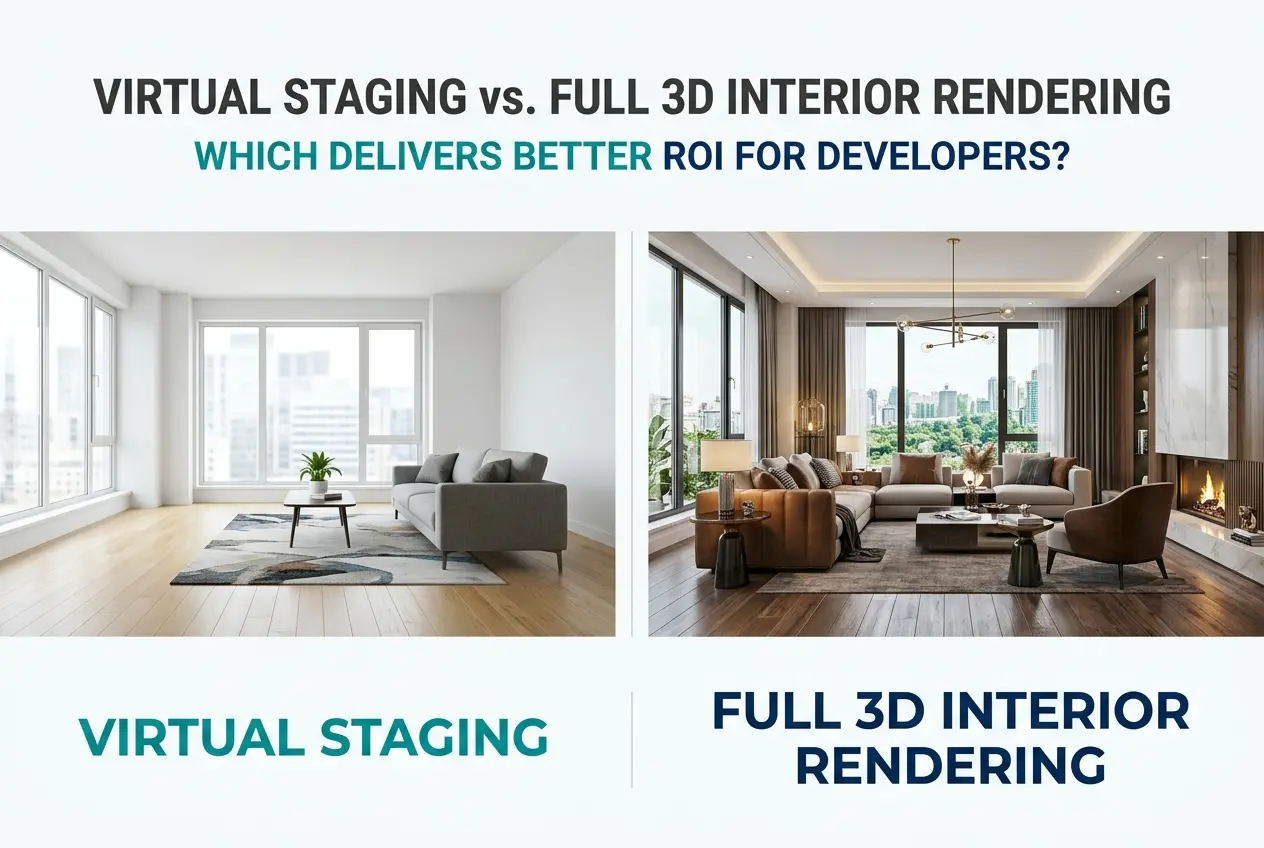
When developers come to us asking about Virtual Staging vs. Full 3D Residential Interior Rendering: Which Delivers Better ROI for Developers?, there’s rarely a one-size-fits-all answer. Both approaches have legitimate use cases, both can be done well or badly, and choosing the wrong one for your project type can genuinely cost you — either in upfront spend, or in missed sales velocity. I’ve worked on both extensively, and the decision is more nuanced than most people assume when they first start comparing price tags.
The confusion usually starts because the two techniques look similar in the final output — you see a furnished, styled interior room. But the underlying process, the flexibility, the cost structure, and more importantly, the results you can expect from each are quite different. Understanding those differences is what this post is about.
What Virtual Staging Actually Is (And Isn’t)
Virtual staging takes a photograph of an existing, empty room and uses 2D compositing or light 3D placement to drop furniture and decor into that photo. The room itself — the walls, flooring, windows, light coming in — stays as the photograph captured it. The staging elements are rendered separately and blended in.
It’s fast. It’s comparatively cheap. And when done well, it can look convincing. Where it breaks down is when the photography itself is poor, when the lighting in the staged furniture doesn’t match the ambient light in the photo, or when the perspective of the 3D objects doesn’t quite align with the camera angle of the original shot. These are fixable problems with skilled artists, but they’re structural limitations of the technique.
Virtual staging works best on completed or near-completed construction where you already have quality photography. If you’re working with a resale property, a show flat that’s been photographed, or an existing unit you want to market furnished without paying for actual furniture rental — virtual staging is genuinely efficient.
Full 3D Residential Interior Rendering: Building the Space from Scratch
Full 3D interior rendering means the entire scene is modeled and rendered in 3D — the architecture, the materials, the furniture, the lighting, all of it. Nothing is a photograph. You’re working from floor plans, elevation drawings, or a 3D model of the space, and you’re constructing every element from the ground up inside software like 3ds Max, Corona, or V-Ray.
The advantage here is total control. You can change the wall color, the flooring material, the time of day, the furniture layout — any of it — without needing to go back to the physical space. The space doesn’t even need to exist yet. That’s the key point: full 3D rendering works at any stage of development, including before a single brick is laid.
In our studio, we regularly produce interior renders for projects that are still in the design approval phase. Developers use these visuals to secure financing, run pre-sales campaigns, and make design decisions that would otherwise require building a physical show flat. That’s a fundamentally different capability than virtual staging can offer.
Virtual Staging vs. Full 3D Residential Interior Rendering: Which Delivers Better ROI for Developers?

Let’s get practical about this. The ROI question depends on three variables: the project stage, the volume of content needed, and the intended use of the visuals.
Project Stage
If your project is under construction or pre-construction, virtual staging is simply not available to you. You don’t have a physical space to photograph. Full 3D rendering is your only realistic option, and the ROI on it is very strong because it enables pre-sales activity that would otherwise be impossible.
If your project is completed and you have good photography, virtual staging is a cost-efficient tool for getting listings marketed quickly. The turnaround is fast, the cost is lower, and for a straightforward residential listing where you just need furnished rooms for an online portal, it does the job.
Volume and Flexibility
Here’s where full 3D rendering starts to pull ahead even for completed projects: flexibility. Once a 3D model of a space exists, producing multiple variants is incremental work. You can show the same room in three different furniture styles, two different flooring options, alternate color schemes — without re-photographing anything. For developers selling multiple units with different finishes or targeting different buyer segments, this is genuinely valuable.
Virtual staging, by contrast, is tied to the photograph. Changing the furniture requires another round of compositing. Changing the wall color means re-touching the entire photo first. The flexibility just isn’t there.
Content Longevity
A full 3D model of your space can produce renders today, 360-degree virtual tours next month, and animation for a sales video the month after. The asset keeps working. Virtual staged photos are essentially static — what you have is what you have.
What Developers Often Get Wrong
The most common mistake I see is developers choosing virtual staging for the wrong reason: price. They look at the lower per-image cost and assume it’s automatically the more economical choice. Sometimes it is. But when you factor in what you’re giving up — the pre-sales capability, the flexibility, the reusability of the asset — the calculation often shifts.
We had a situation where a developer came to us mid-project asking for virtual staging on completed show flat photography. The photography they’d had done was shot at a wide angle that distorted the room proportions significantly. Every furniture piece we dropped in looked slightly off because the perspective was already compromised. We ended up recommending a partial 3D approach — keeping the architectural shell from the photo but rebuilding key furniture placements in 3D for a better composite. It cost more than pure virtual staging but produced actually usable marketing material.
That’s the other thing developers underestimate: the quality of the source photography directly determines the quality of the virtual staging output. Poor photography produces poor virtual staging no matter how skilled the artist. Full 3D has no such dependency — we control every element of the scene.
The Show Flat Problem

Many mid-to-large residential developers build a physical show flat and then photograph it for marketing. This is expensive — you’re furnishing, dressing, and photographing a real space. Virtual staging on existing photography is often presented as the budget-friendly alternative to this. And it can be, for small developers or resale properties.
But consider what full 3D residential rendering offers by comparison: no physical show flat needed, unlimited camera angles, the ability to produce imagery for multiple unit types from a single design phase, and the flexibility to update visuals if design decisions change during construction. When you add up the cost of physically furnishing a show flat and compare it to a comprehensive 3D rendering package covering multiple rooms and unit types, the economics look very different from the per-image comparison.
We’ve worked with developers who replaced their show flat entirely with a suite of high-quality interior renders and an interactive 3D virtual tour, and found that buyers were just as engaged — sometimes more so, because they could explore the space at their own pace online before visiting the site.
Quality Ceiling and Buyer Perception
There’s a quality ceiling with virtual staging that’s hard to break through. Sophisticated buyers — especially in the luxury segment — often sense something is slightly off even if they can’t articulate it. The lighting mismatch, the slightly too-perfect furniture, the shadows that don’t quite behave like real shadows. It reads as staged in a way that full 3D, done well, doesn’t.
Full architectural rendering at a high production level is indistinguishable from photography to most viewers. That perception matters. If your buyers are in a premium price bracket, the visual quality of your marketing material signals the quality of the product. Virtual staging can sometimes undercut that signal.
A Practical Decision Framework
| Scenario | Recommended Approach |
|---|---|
| Pre-construction or under construction | Full 3D rendering — only viable option |
| Completed unit, quick listing turnaround, budget-conscious | Virtual staging — efficient and appropriate |
| Multiple unit types, different finish options | Full 3D rendering — flexibility and reusability justify cost |
| Luxury or premium segment marketing | Full 3D rendering — quality ceiling matters |
| Resale or rental listing, single unit | Virtual staging — cost-effective, fits the use case |
| Need virtual tour or animation in addition to stills | Full 3D rendering — the model serves multiple outputs |
Final Thoughts
The debate around Virtual Staging vs. Full 3D Residential Interior Rendering: Which Delivers Better ROI for Developers? is really a question about what kind of developer you are and what stage your project is at. Virtual staging is a legitimate, useful tool in the right circumstances — don’t let anyone tell you it’s always inferior. But full 3D rendering offers capabilities that virtual staging structurally cannot match, and for most residential development projects at scale, that capability gap matters.
If you’re making pre-sales before completion, selling a premium product, managing multiple unit configurations, or need visuals that can serve multiple marketing formats over time, full 3D rendering will deliver better returns on what you spend. If you have completed photography and need furnished rooms on a tight timeline and budget for a standard listing, virtual staging does what it’s supposed to do.
The worst outcome is picking one because it’s cheaper in the short term, only to find it doesn’t serve your actual marketing needs. Get the brief right first, then choose the tool. If you’re not sure which approach fits your project, reach out to our team — we can look at your project stage, scope, and goals and give you an honest recommendation before any money changes hands.
Frequently Asked Questions
What is the difference between virtual staging and full 3D residential interior rendering?
Virtual staging adds digitally created furniture and décor to photos of existing or empty spaces, while full 3D rendering builds an entirely computer-generated interior from scratch. Rendering offers more creative control, whereas virtual staging is faster and works best for properties that already exist.
Which option costs less for real estate developers, virtual staging or 3D interior rendering?
Virtual staging typically costs $50–$300 per image, making it significantly cheaper than full 3D interior rendering, which can range from $500 to several thousand dollars per scene. For developers on tight budgets or marketing existing units, virtual staging usually delivers a lower upfront investment.
Does virtual staging or 3D rendering generate a higher ROI for pre-construction residential developments?
Full 3D rendering delivers higher ROI for pre-construction projects because it can market units before anything is built, helping developers secure buyers and investors earlier. Virtual staging is better suited for completed properties, where it can reduce days on market and increase sale prices.
How quickly can developers get virtual staging versus full 3D interior renderings completed?
Virtual staging is typically delivered within 24–72 hours, making it ideal for fast-moving listings and immediate marketing needs. Full 3D interior renderings usually take one to three weeks depending on complexity, but provide more polished and customizable results for high-stakes presentations.