Why Context Changes Everything in Product Marketing
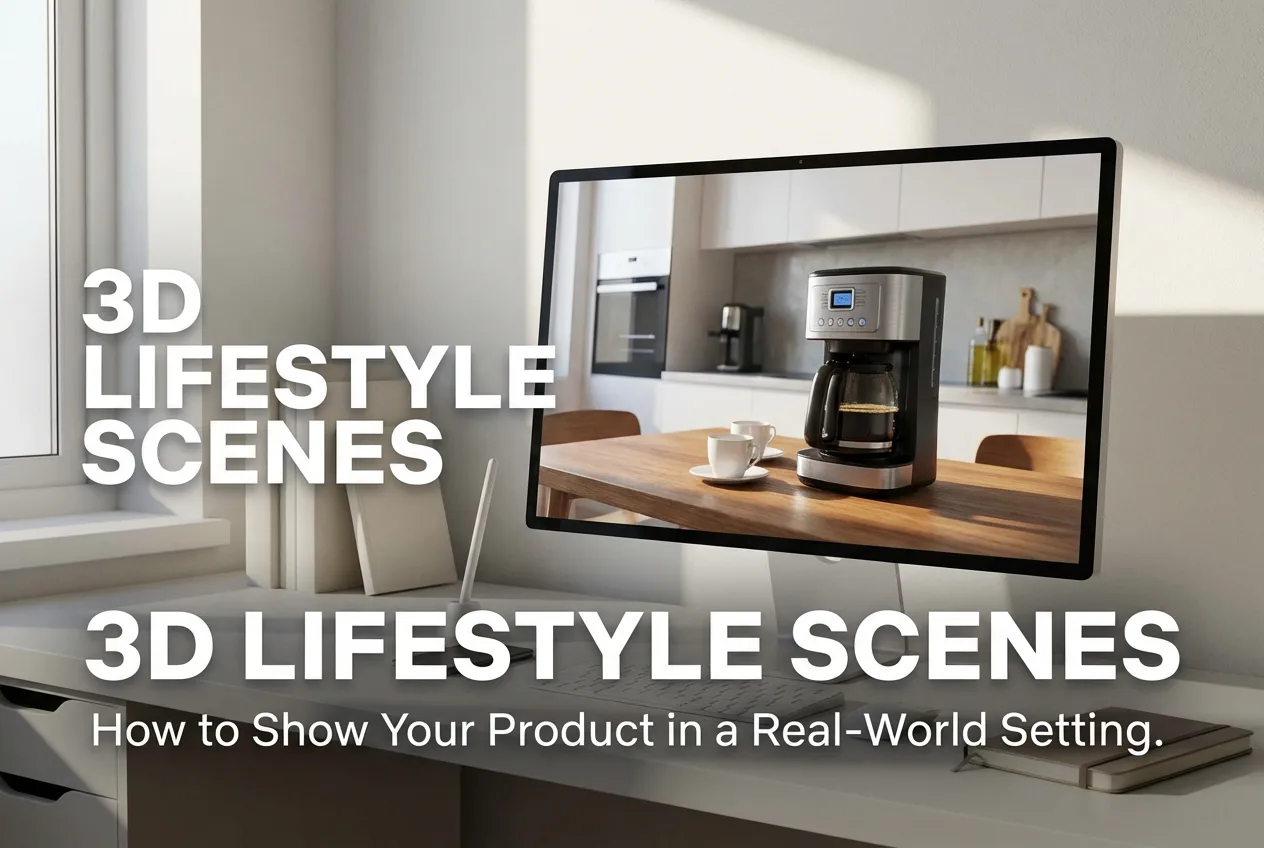
If you’ve ever scrolled past a product image that felt cold, isolated, or just plain boring, you already understand why 3D Lifestyle Scenes: How to Show Your Product in a Real-World Setting has become one of the most searched topics among product marketers and e-commerce brands today. Showing a product against a white background tells shoppers what something looks like. Showing it in a beautifully rendered kitchen, a sunlit living room, or a stylish outdoor patio tells them how it fits into their life — and that’s a completely different conversation. The emotional connection that comes from context is powerful, and smart brands are leaning into it hard.
Think about how you browse online. You’re looking at a lamp, and suddenly one photo shows it glowing warmly on a wooden bedside table next to a stack of books and a glass of water. You can practically smell the cedar and feel the calm. That’s what a well-executed lifestyle scene does. It doesn’t just display a product — it tells a story. And the good news? You don’t need an expensive photo shoot, a location scout, or a team of stylists to pull it off. That’s where 3D rendering steps in.
For brands in furniture, home décor, consumer electronics, apparel accessories, kitchen goods, and dozens of other categories, 3D product rendering has opened the door to lifestyle imagery that used to cost tens of thousands of dollars. Now you can create photorealistic scenes, swap out colors and materials, and test dozens of settings without ever building a physical set. Let’s break down exactly how this works and why it matters for your business.
3D Lifestyle Scenes: How to Show Your Product in a Real-World Setting — The Core Concept
At its most basic, a 3D lifestyle scene is a digitally constructed environment designed to make your product feel at home somewhere real. That “somewhere” is carefully chosen based on your target audience, your brand identity, and the story you want to tell.
Artists use software like 3ds Max, Blender, Cinema 4D, or KeyShot to build out full three-dimensional environments — walls, floors, furniture, lighting, textures, even dust particles floating in a beam of afternoon sun. Your product is placed into this scene as a 3D model, and then everything is rendered together using advanced lighting simulation to produce an image that looks like it was shot with a camera. Often, people genuinely can’t tell the difference from a photograph. And sometimes, honestly, the 3D version looks better than a real photo because every detail is controlled.
The environments themselves vary widely. A lifestyle scene for a luxury sofa might feature a mid-century modern living room with warm timber floors, curated bookshelves, and a soft afternoon glow coming through sheer curtains. A lifestyle scene for a blender might place it on a granite countertop surrounded by fresh fruit, with pendant lights overhead and a tiled backsplash behind. The goal is always to make the product feel like it belongs — like it’s already part of someone’s daily life.
Why Lifestyle Scenes Outperform White Background Images
White background images have their place. They’re essential for Amazon listings, technical spec sheets, and certain catalog formats. But they’re rarely the images that make someone stop scrolling and actually feel something about a product.
Lifestyle imagery performs better across almost every metric that matters to marketers. Conversion rates go up. Time spent on product pages increases. Social shares climb. People share things that make them feel something, and a product floating in digital space doesn’t usually do that.
There’s also a trust factor. When a potential customer sees a sofa styled in a realistic room, they start doing something valuable — they mentally place it in their own home. They ask themselves, “Would this work with my floors? Does this fit the vibe of my living room?” That kind of mental engagement moves people significantly closer to a purchase decision. It shortens the gap between interest and buying.
For brands that sell aspirational products — furniture, home décor, luxury goods, wellness products — lifestyle imagery is practically essential. Your customer isn’t just buying a chair. They’re buying a version of themselves that owns that chair in a beautiful space. The scene helps them make that imaginative leap.
What Makes a 3D Lifestyle Scene Actually Work
Not every lifestyle render lands the way it should. A lot of brands get 3D images back and they look… fine. Technically correct, but somehow lifeless. Here’s what separates a truly effective lifestyle scene from a mediocre one.
Lighting That Feels Natural
Lighting is probably the single biggest factor in whether a render reads as real. Natural light — the kind that comes through windows, scatters through fabric, and casts soft shadows — is what our eyes expect to see in a home environment. When the lighting in a render is too uniform or too perfect, it triggers a subconscious “something’s off” feeling even in people who can’t articulate why. Skilled interior 3D rendering artists spend enormous amounts of time getting the light right, because that’s what sells the illusion.
Thoughtful Prop Selection and Styling
The objects around your product matter just as much as the product itself. A coffee table styled with a design magazine, a small plant, and a ceramic coaster tells a very different story than one with a remote control and takeout container on it. Lifestyle renders are styled with the same care a professional set designer would bring, but it’s all done digitally. Every prop is chosen to reinforce the lifestyle your target customer aspires to — and none of it needs to be physically sourced or rented.
Realistic Materials and Textures
This is where 3D modeling services really shine. Getting fabric to look like fabric — with the right amount of softness, drape, and micro-texture — or making metal look cold and reflective, or wood look warm and grainy, requires serious technical skill and high-quality material libraries. When textures are done well, you feel them. When they’re not, the whole image looks like a video game from 2012.
Camera Angle and Composition
A lifestyle scene is also a photograph, in the compositional sense. The camera angle, depth of field, and framing all need to follow the same principles a skilled photographer would apply. Slightly off-center compositions often feel more natural than perfectly centered ones. A shallow depth of field — where the background is gently blurred — adds a sense of realism because that’s how real camera lenses behave. These small choices add up to a big difference in the final result.
Different Products, Different Scene Strategies
There’s no one-size-fits-all approach to lifestyle rendering. The right scene depends heavily on what you’re selling and who you’re selling it to.
Furniture and home décor brands almost always benefit from full-room lifestyle scenes. A dining table needs a dining room. A bed needs a bedroom. The context is inseparable from the product category. Furniture rendering has evolved to the point where even subtle details like the way a cushion compresses under weight or how a wood grain catches raking light are handled with remarkable accuracy.
Consumer electronics might use lifestyle scenes that emphasize a specific use case — a laptop open on a desk in a home office, earbuds sitting on a yoga mat next to a water bottle, a smart speaker on a kitchen counter while someone (implied, not shown) is cooking. The scene doesn’t need to be a full room. Often a partial environment — a corner, a surface, a section of a wall — is enough to establish context without distraction.
Outdoor products like garden furniture, grills, or sports gear can be placed in beautifully rendered exterior environments — a sunny patio, a mountain trail, a backyard at golden hour. These scenes use exterior lighting simulation, which has its own set of technical considerations around sky models, sun angles, and environmental reflections.
Smaller products like kitchenware, cosmetics, or accessories might use a tabletop or countertop lifestyle approach — fewer props, tighter framing, more focus on the product itself with just enough environmental context to make it feel grounded.
Practical Tips for Briefing a 3D Lifestyle Scene Project
If you’re working with a 3D rendering agency, how you brief the project has a direct impact on the quality of what you get back. Here are some concrete things that make a big difference.
- Provide reference images. Even rough mood boards help artists understand the aesthetic direction. Pinterest boards, competitor images, interior design photos — all of it is useful.
- Be specific about your audience. “Young professionals with urban apartments” and “established homeowners with traditional tastes” require completely different scenes. The more specific you can be, the better the artist can make decisions that serve your actual buyer.
- Specify the intended use. A scene designed for a 9:16 Instagram Reel needs to be composed very differently from one destined for a wide website banner or a print catalog spread. Tell your agency upfront where these images will live.
- Share any brand guidelines. If there are color palettes, style rules, or aesthetic standards your brand adheres to, they should inform the scene design.
- Provide high-quality product files. The quality of your 3D model is foundational. If you don’t have 3D files yet, a good agency can help you build them — but the more detail and accuracy you provide upfront, the smoother the process goes.
The ROI of Getting This Right
Some brands still hesitate at the investment required for premium 3D lifestyle imagery. But it helps to think about it in comparison. A single professional lifestyle photo shoot — location rental, photographer, stylist, props, talent, post-processing — can easily run $5,000 to $20,000 or more. And at the end of it, you have a fixed set of images in one configuration, one color, one season.
With 3D, you get the same quality of imagery (often better) with far more flexibility. Need to see the same sofa in four colorways? That’s a material swap, not four separate shoots. Want to show the product in a winter setting and a summer setting? Done. Want to try a different room layout to see which one tests better? Easy. The flexibility is built in, and that flexibility has real dollar value over the lifetime of a product line.
Understanding 3D lifestyle scenes: how to show your product in a real-world setting isn’t just a creative exercise — it’s a strategic business decision that affects your conversion rates, your brand perception, and your marketing efficiency over time.
Ready to See Your Product in Its Best Light?
If you’re ready to bring your products to life in compelling, photorealistic lifestyle environments, the team at 360render.com is here to help. Whether you need a single hero image or a full suite of lifestyle renders for a product launch, we build scenes that connect with your audience and make your product feel like it already belongs in their world.
Reach out to our team through our 3D rendering services contact page and let’s talk about what your project needs. Show your product where it belongs — in a world your customers already want to live in.
Frequently Asked Questions
What are 3D lifestyle scenes and how do they differ from traditional product photography?
3D lifestyle scenes are computer-generated images that place your product in a realistic, real-world environment—such as a living room, kitchen, or outdoor setting—without requiring a physical photoshoot. Unlike traditional product photography, they are created entirely using 3D rendering software, allowing brands to showcase products in context before they are even manufactured. This makes them faster, more cost-effective, and infinitely customizable compared to hiring photographers, models, and renting physical locations.
How much does it cost to create a 3D lifestyle scene for a product?
The cost of a 3D lifestyle scene can range from $200 to $2,000 or more per image, depending on the complexity of the scene, the level of detail required, and the experience of the 3D artist or studio you hire. Simple scenes with minimal props and basic lighting tend to fall on the lower end, while highly detailed, photorealistic environments with multiple products and custom elements command premium pricing. Many businesses find that the investment pays off quickly, as the same 3D assets can be reused and repositioned for multiple marketing campaigns without additional shooting costs.
What types of products benefit most from 3D lifestyle scene rendering?
Products that benefit most from 3D lifestyle scenes include furniture, home decor, electronics, apparel, kitchenware, and beauty products—essentially any item where showing it in a real-world context helps consumers visualize how it fits into their lives. E-commerce brands selling items that are difficult or expensive to photograph in traditional settings, such as large furniture pieces or customizable products with many variants, see particularly strong returns. Additionally, brands launching new products before manufacturing is complete can use 3D lifestyle renders to begin marketing and gather customer feedback immediately.
How do 3D lifestyle scenes improve conversion rates for e-commerce products?
3D lifestyle scenes improve conversion rates by helping shoppers visualize how a product will look and function in their own space, which reduces purchase hesitation and buyer uncertainty. Studies in e-commerce have shown that contextual product imagery can increase conversions by up to 40% compared to plain white-background shots, because customers feel more confident about their buying decision. By showing scale, texture, and real-world use in a compelling environment, lifestyle renders build emotional connection and trust with potential buyers before they ever click 'Add to Cart.'
What software and tools are used to create professional 3D lifestyle product scenes?
Professional 3D lifestyle scenes are typically created using industry-leading software such as Blender, Cinema 4D, 3ds Max, or Maya for modeling and animation, combined with rendering engines like V-Ray, Corona Renderer, or Cycles for photorealistic lighting and materials. Artists also use tools like Adobe Substance Painter for detailed texture creation and Photoshop for final compositing and color correction touches. The choice of software often depends on the artist's expertise and the specific style or realism level required, with V-Ray and Corona being particularly popular for high-end architectural and product visualization work.