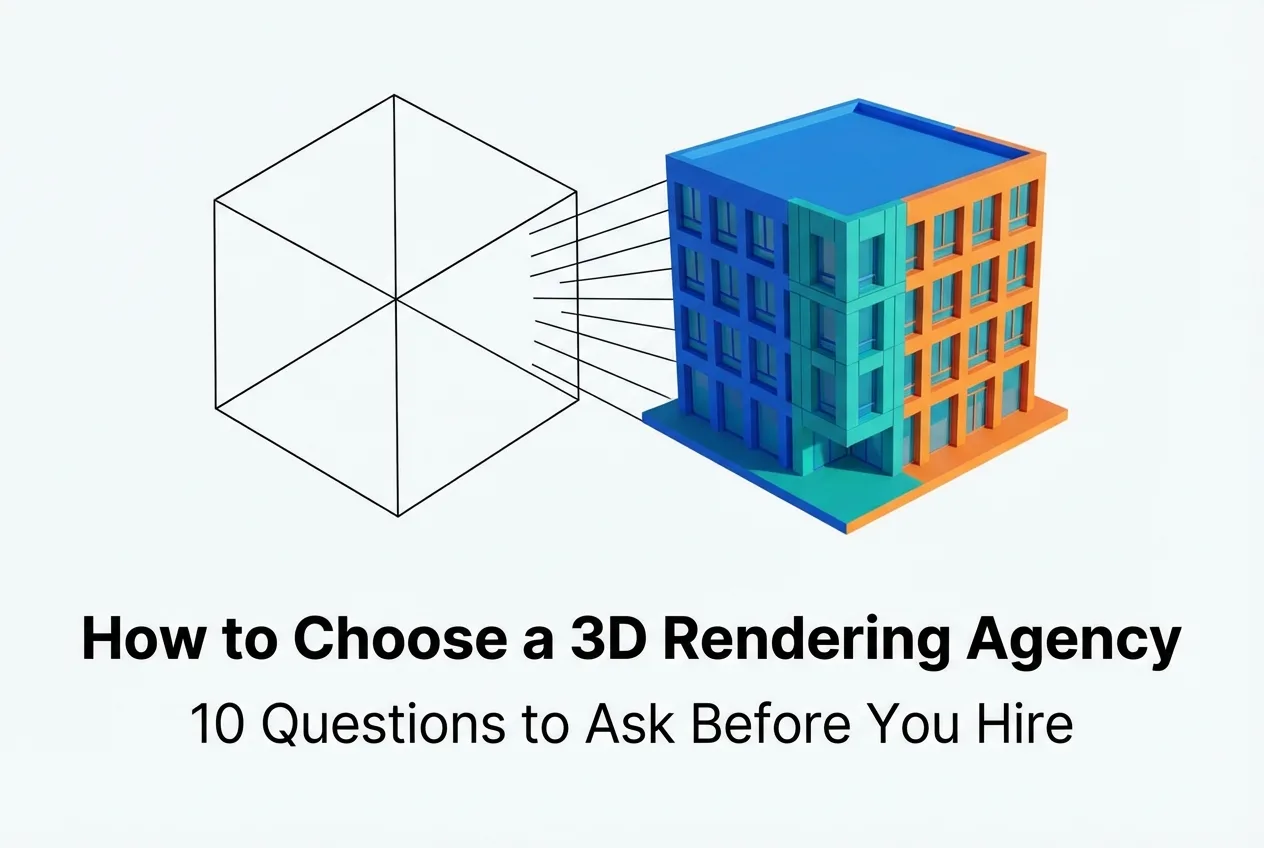
How to Choose a 3D Rendering Agency: 10 Questions to Ask Before You Hire
Hiring the wrong 3D rendering agency can cost you time, money, and a whole lot of frustration. Whether you’re a real estate developer trying to pre-sell units, an architect presenting to clients, or a product designer building a brand, the quality of your visuals matters enormously. That’s why knowing how to choose a 3D rendering agency: 10 questions to ask before you hire is one of the smartest moves you can make before signing any contract. The process doesn’t have to be complicated, but it does require asking the right questions — and knowing what good answers actually look like.
The market is flooded with studios offering everything from budget renders to premium architectural visualization. Some are solo freelancers working from home. Others are full-service agencies with dedicated teams, project managers, and specialized artists. Not all of them will be the right fit for your project. So before you send over your floor plans or product specs, take a breath and do a little homework. The questions below will help you filter out the wrong partners fast and find the agency that can actually deliver what you need.
This guide is built for decision-makers — people who need clear, reliable visuals and can’t afford to gamble on an untested vendor. Let’s walk through the ten essential questions you should ask any 3D rendering agency before you commit.
1. What Industries and Project Types Do You Specialize In?
Not every rendering agency does everything well. Some studios have spent years perfecting photorealistic architectural rendering, while others focus on product visualization or interior design. There’s a real difference in skill set, software, and workflow depending on the niche. Asking about specialization right up front tells you a lot.
If you’re working on a large residential development, you want an agency that has genuinely done that kind of work — not one that mostly handles furniture catalogs. Ask to see specific examples within your sector. Don’t just look at the pretty pictures; look at whether the scale, materiality, lighting, and context feel realistic and relevant to what you’re trying to achieve.
2. Can I See a Portfolio of Work Similar to My Project?
A portfolio is your single best tool for evaluating quality. Any reputable agency should have one readily available. Look for consistency. One or two stunning images can be misleading — what you really want to see is a body of work that holds up across multiple projects and styles.
Pay close attention to lighting quality, material realism, and scene composition. Does the grass look like plastic? Are the shadows too harsh or too soft? Do the interiors feel livable? These are the details that separate average renders from truly compelling ones. If an agency’s portfolio gives you pause, trust that instinct. It’s much easier to walk away before the project starts than after.
3. Who Will Actually Be Working on My Project?
This is a question many people forget to ask — and it’s critically important. Some agencies pitch you using senior artists’ work during the sales process, then hand your project off to a junior team member once you’ve signed. That’s not necessarily a dealbreaker, but you deserve to know who will be touching your files.
Ask whether the work is done in-house or outsourced to subcontractors. Ask about team size. Ask who your main point of contact will be. Good communication structures are a strong sign of a professional operation. You want someone who can give you clear updates, interpret your feedback accurately, and escalate issues quickly if needed.
How to Choose a 3D Rendering Agency: Understanding Workflow and Communication
4. What Is Your Revision Policy?
Revisions are where a lot of agency relationships go sideways. You assume a certain number of changes are included. They assume you meant something entirely different. Before you start, get the revision policy in writing.
Find out how many rounds of revisions are included in the base price, what constitutes a “major” versus “minor” change, and what additional revisions cost. A professional agency will have a clear, documented policy. If they’re vague or hesitant when you ask, that’s a warning sign.
5. What Is Your Typical Turnaround Time?
Deadlines matter. If you’re presenting to investors next Thursday, you can’t afford a studio that delivers in four weeks. Ask for typical timelines on projects similar to yours. Then ask what happens if a deadline slips — do they have contingency plans or a dedicated capacity for rush projects?
Faster isn’t always better, though. An agency promising photorealistic interior rendering in 24 hours at a low price should raise eyebrows. Quality visualization takes time. What you’re looking for is a studio that gives you realistic timelines and then actually meets them.
6. What File Formats and Deliverables Will I Receive?
This sounds boring, but it matters. Will you receive high-resolution TIFFs or just compressed JPEGs? Will the 3D model files be included or retained by the agency? If you’re planning to use these images across multiple platforms — print, web, social, presentations — you need to make sure the output meets those requirements.
For larger projects involving walkthroughs or interactive presentations, clarify the specific deliverable format early. A 3D walkthrough animation, for instance, has entirely different technical specifications than a still render, and you want to make sure both parties are aligned on what “done” actually looks like.
7. How Do You Handle Feedback and Creative Direction?
Every client has a vision. The agency’s job is to translate that vision into something visual. But how they handle your input during the process says a lot about the working relationship you can expect.
Some agencies want a detailed brief upfront and then prefer to minimize back-and-forth. Others build in regular check-ins and concept stages. Neither approach is inherently wrong, but you need to find an agency whose process matches your working style. Ask for a walkthrough of their standard project flow. Do they use mood boards? Do they share progress renders at early stages? Do they encourage client involvement or prefer to present finished work?
Understanding how they handle creative direction also helps prevent scope creep. If your feedback isn’t being captured and acted on clearly, you’ll end up in a revision spiral that costs everyone time and money.
8. What Software and Technology Do You Use?
You don’t need to be a technical expert to ask this question, but the answer tells you something important. Industry-standard tools like 3ds Max, Corona Renderer, V-Ray, Cinema 4D, and Unreal Engine are good signs. These platforms have strong communities, extensive resources, and are widely used for professional-grade output.
If you’re exploring more immersive options — say, for a luxury real estate development — you might want to ask about capabilities in virtual reality or real-time rendering. Studios offering virtual reality for real estate experiences are increasingly valuable for high-end sales and marketing. Technology is constantly evolving, and a forward-thinking agency should be investing in staying current.
9. Can You Provide References or Client Testimonials?
Ask for references. Seriously — just ask. Most agencies are happy to share testimonials, and many will connect you with past clients directly if you request it. A quick conversation with a previous client can reveal things that no portfolio or sales pitch ever will.
What was the communication like? Were timelines respected? Did the final output match what was promised? Were there any surprises in the invoicing? These are the questions you want answered before you’re the one learning the hard way.
Online reviews and case studies are also fair game. Look for agencies that publish detailed project breakdowns — it shows confidence in their work and transparency about their process.
10. What Does Pricing Actually Include?
Pricing is often the most awkward conversation to have, but it’s absolutely necessary. A quote that looks affordable can quickly balloon if you don’t understand what’s included and what costs extra.
Ask for an itemized breakdown wherever possible. Find out whether conceptual development, modeling from scratch, texture sourcing, lighting setup, and post-production are all included — or whether some are billed separately. Ask about licensing fees if stock assets are used. Ask what happens if the project scope changes midway through.
The goal isn’t to find the cheapest option. It’s to find the agency that offers the best value for your specific needs. A higher upfront quote from an experienced studio often saves money in the long run compared to a cheap vendor who requires five rounds of revisions and still doesn’t get it right.
Practical Tips Before You Sign Anything
Beyond the ten questions above, here are a few practical habits that will serve you well in the hiring process:
- Request a small test project. Before committing to a large scope, ask if the agency will complete a paid test render. This gives you real evidence of quality and communication style with minimal risk.
- Compare at least three agencies. Don’t just go with the first studio you find. Comparing proposals, portfolios, and pricing from multiple vendors gives you context and negotiating leverage.
- Get everything in writing. Revision rounds, timelines, deliverables, payment terms — all of it should be documented in a contract or formal proposal before work begins.
- Look at the brief they give you. How an agency structures their intake form or creative brief tells you a lot about their professionalism. Detailed, thoughtful intake processes tend to produce better work.
- Check their communication response time. Send an inquiry and see how long they take to respond. Speed and clarity of initial responses often predict how the working relationship will feel when you’re mid-project and need answers fast.
For projects that involve outdoor or contextual visualization, make sure the agency has solid experience with exterior 3D rendering. Site context, landscaping, lighting conditions, and environmental details all require a different skill set than interior work, and you want proof they can handle it convincingly.
Making the Final Decision
By the time you’ve worked through these questions with two or three candidate agencies, you should have a very clear sense of who you’d actually want to work with. Trust isn’t built on portfolios alone — it’s built on communication, transparency, and demonstrated competence. The agency that answers your questions clearly, presents a structured process, and shows genuine interest in your project goals is almost always the right choice, even if they’re not the cheapest.
Understanding how to choose a 3D rendering agency: 10 questions to ask before you hire really comes down to one thing: doing enough due diligence that you’re not surprised once the work begins. The more you invest in the evaluation process upfront, the smoother the project will go.
If you’re ready to talk to an agency that can actually answer all ten of these questions with confidence, we’d love to hear about your project. Whether you need photorealistic architectural stills, immersive walkthroughs, or large-scale development marketing visuals, our team is built to deliver. Get in touch with the team at 360render.com and let’s figure out what you need.
Frequently Asked Questions
What should I look for in a 3D rendering agency's portfolio before hiring them?
You should look for diversity in project types, industries, and rendering styles that align with your specific needs, whether architectural visualization, product rendering, or interior design. Pay close attention to lighting realism, texture quality, and attention to detail in their previous work, as these indicate the level of craftsmanship you can expect. A strong portfolio should also include projects similar in scope and complexity to yours, demonstrating proven experience rather than just general capability.
How much does it cost to hire a professional 3D rendering agency?
The cost of hiring a 3D rendering agency typically ranges from $500 to $5,000+ per image depending on complexity, level of detail, turnaround time, and the agency's experience level. Architectural exterior renderings may cost differently than photorealistic product shots or animated walkthroughs, which can run from $2,000 to $20,000 or more. Always request a detailed quote that breaks down deliverables, revision rounds, and licensing rights to avoid unexpected charges later in the project.
How do I verify that a 3D rendering agency is legitimate and reliable?
You can verify an agency's legitimacy by checking client testimonials, third-party reviews on platforms like Clutch or Google, and asking for verifiable references from past clients you can contact directly. Legitimate agencies will have a clear contract, transparent communication processes, and a professional website with documented case studies. Additionally, checking their social media presence and how long they have been in business can help you assess their stability and reputation in the industry.
What questions should I ask a 3D rendering agency about turnaround time and revisions?
You should ask specifically how many business days a standard project takes from brief submission to final delivery, and whether rush options are available at an additional cost. It is equally important to clarify how many revision rounds are included in the quoted price and what counts as a revision versus a new request, since scope creep can significantly increase costs. Understanding their revision policy upfront protects you from delays and unexpected expenses when changes are needed mid-project.
What file formats and deliverables should I expect from a 3D rendering agency?
A professional 3D rendering agency should deliver high-resolution image files typically in JPEG, PNG, or TIFF formats at print-ready resolution of at least 300 DPI for physical use or optimized sizes for web and marketing applications. You should also clarify whether you receive the native 3D project files, scene files, or only the final rendered outputs, as retaining source files can be valuable for future updates or modifications. Always confirm ownership and licensing rights in your contract to ensure you have full commercial usage rights to all delivered assets.
Also read: What Is 360 Virtual Rendering and How Does It Work for Products?