If you’re selling products on Amazon, Shopify, or any major e-commerce platform, the quality of your product visuals can make or break a sale. Knowing how to choose the best 3D product rendering company for Amazon and ecommerce isn’t just a procurement decision — it’s a creative and technical one that directly affects your conversion rates, your brand perception, and ultimately your revenue. I’ve worked with sellers who upgraded from flat photography to professional CGI and saw their listings transform overnight — not because of magic, but because the images finally showed the product the way it deserved to be shown. So if you’re evaluating studios right now, here’s what you actually need to know.
Why 3D Rendering Has Become the Default for E-Commerce Product Visuals
Photography has limits. You can’t shoot a product that’s still in development. You can’t easily show a sofa in 12 different fabric colors with six different leg finishes without physically producing every single variant. You can’t shoot a glass perfume bottle on a white background and make it look genuinely luxurious without a serious investment in a photography studio, lighting rigs, and post-production. 3D rendering solves all of these problems in one workflow.
Product CGI gives you photorealistic images without a physical sample. You can create lifestyle scenes, show exploded views, animate product features, and generate every color variant from a single 3D model. For Amazon specifically, where your hero image needs to be on a pure white background and your secondary images need to do serious selling work, CGI gives you total creative control. The best studios understand Amazon’s image requirements inside out — the pixel dimensions, the file format rules, the zoom threshold — and they build the work to those specs from the start.
The catch is that not every studio is equipped to do this well. There’s a significant gap between a studio that does architectural visualization and one that specializes in product rendering for commerce. They require different skills, different workflows, and a very different understanding of what “good” looks like.
What to Actually Look For: How to Choose the Best 3D Product Rendering Company for Amazon and Ecommerce
Portfolio Quality and Specialization
The most important thing you can evaluate before making any contact is a studio’s portfolio. And when you look at it, you need to look critically. Does the work look like a photograph or does it look like a render? Can you tell the material is CG? Are the reflections believable? Does the lighting feel real?
Look specifically for examples in your product category. A studio that primarily renders furniture may not be the right choice for cosmetics, electronics, or food packaging — and vice versa. Each product category has its own visual language. Cosmetics need a clean, premium finish. Electronics need precise geometry and branded accuracy. Food products require an understanding of how to make textures look appetizing rather than artificial.
At our studio, we keep our product rendering portfolio organized by category precisely because clients want to see that we’ve handled something similar. If a studio can’t show you relevant examples, that’s a red flag.
Technical Capability: Modeling, Texturing, and Lighting
A render is only as good as the model behind it. Many sellers don’t realize that a poor 3D model produces a poor render no matter how skilled the lighting is. Ask any studio you’re evaluating: what software do you use? How do you handle complex materials like glass, fabric, brushed metal, or transparent packaging? What render engine do you work with?
Professional studios typically work in software like 3ds Max, Cinema 4D, or Blender, and render using engines like V-Ray, Corona, or Arnold. These aren’t the only valid options, but they indicate a serious technical setup. If a studio is using tools primarily designed for gaming or low-poly visualization, the output quality for product photography replacement simply won’t be there.
Texturing and material work is where many mid-tier studios fall short. A glass bottle needs accurate refraction. A matte cardboard box needs subtle surface variation to look real. Fabric needs proper displacement to show weave and texture. These aren’t small details — they’re what separates a render you’d actually put on Amazon from one that looks like a video game asset.
Turnaround Time and Revision Process
E-commerce moves fast. Listings go live, ad campaigns start, and you need images on a schedule. Before committing to a studio, ask: what’s your standard turnaround for a single product with four to five views? What happens when you need revisions? How many revision rounds are included?
A good studio will give you a clear timeline upfront and will have a structured revision process. Watch out for studios that quote very fast turnarounds — three to four images overnight — without clarifying quality or revision limitations. Speed without quality control costs you more in the long run.
In our workflow, we deliver a draft render at around 70% resolution before committing to a final high-resolution output. This lets clients review composition, angles, and lighting without us burning render time on a direction they might want to change. It’s a simple process that saves time for everyone.
Red Flags to Watch For
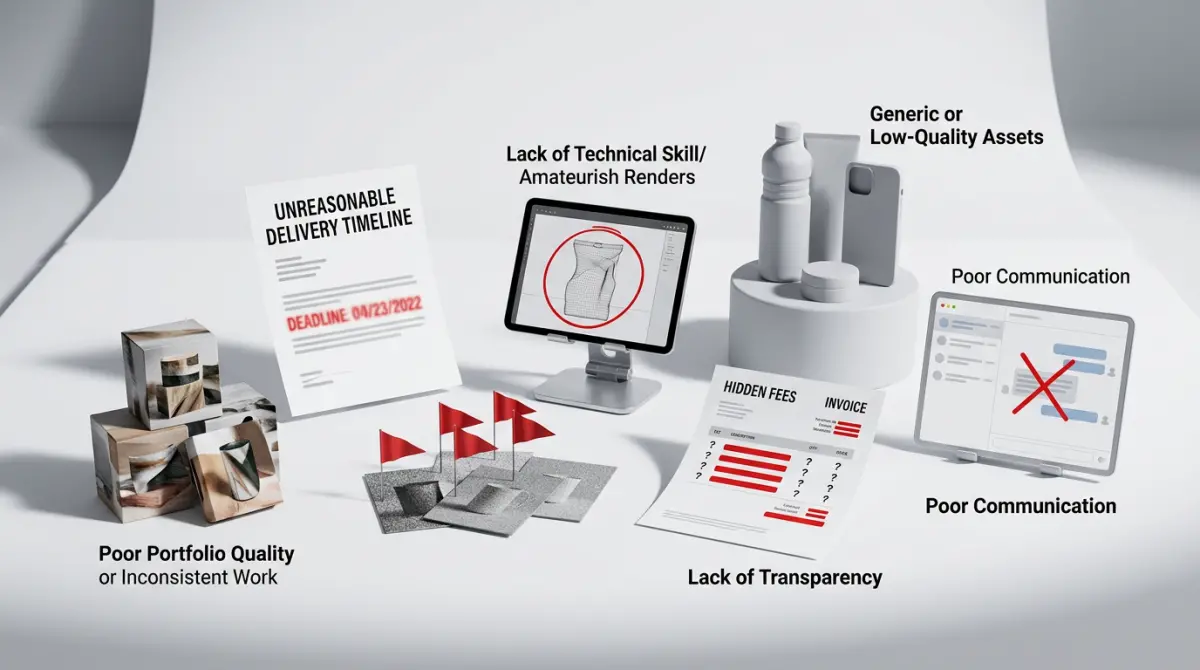
There are a few things that consistently signal a studio isn’t the right fit for serious e-commerce work.
Generic stock-scene portfolios. If every product in their portfolio appears in the same handful of lifestyle environments, it’s likely they’re selling template-based renders rather than custom work. Template renders are cheaper, but they won’t give your product a distinctive look, and they often look indistinguishable from a dozen other listings.
No clear communication before signing. If a studio is vague about process, can’t explain their workflow clearly, or takes days to respond to an inquiry, that behavior doesn’t improve after you’ve paid. The way a studio communicates before the project is the best preview of how they’ll communicate during it.
Unrealistically low pricing. Product rendering takes skilled labor and powerful hardware. A studio quoting prices that seem too good to be true usually means one of three things: the work is being outsourced without quality control, the renders are template-based, or the studio is newer and using your project to build their portfolio. None of these are necessarily dealbreakers, but you should understand what you’re buying.
Amazon-Specific Requirements You Should Discuss Upfront
Not every 3D studio understands Amazon’s technical requirements. Before hiring anyone, ask whether they’re familiar with Amazon’s image guidelines — specifically the requirement for a pure white background on the hero image (RGB 255, 255, 255), minimum image dimensions, and the need for the product to fill at least 85% of the frame on main images.
Beyond the hero image, ask about infographic design capability. Amazon listings benefit significantly from secondary images that call out features, show scale, explain use cases, and include text overlays. A studio that only delivers raw renders but doesn’t assist with infographic composition leaves you with half a workflow. The best agencies handle the full pipeline from 3D model to publication-ready image.
If you’re selling in multiple marketplaces — Amazon US, Amazon Europe, Flipkart, or your own Shopify store — ask how the studio handles image repurposing. A well-structured 3D scene can be efficiently relit and recomposed for different market requirements without starting from scratch. That’s one of the real advantages of CGI over photography.
Questions to Ask Before You Hire
Here’s a practical shortlist of questions that will tell you a lot about a studio’s competence and fit:
Can you share examples of products similar to mine that you’ve rendered? How do you handle complex materials specific to my product type? What’s your revision policy and how many rounds are included? Do you deliver just raw renders or final retouched, print-ready files? Have you worked with Amazon listing images specifically? What file formats do you deliver and at what resolution? How do you handle confidentiality for unreleased products?
That last question matters more than people expect. E-commerce often involves new product launches, and your 3D files and renders represent real commercial assets. A professional studio should have no problem signing an NDA or agreeing to confidentiality clauses.
Getting the Most Value from Your Rendering Partner
The studios that deliver the best results are the ones that get treated like partners rather than vendors. Share as much product reference as possible — technical drawings, physical samples, competitor imagery you like, brand guidelines. The more context a studio has, the closer the first draft will be to what you want, and the fewer revisions you’ll need.
If your product is still in development, CGI is particularly powerful. You can begin creating assets before manufacturing is complete, so your Amazon listing, website, and ad creatives are ready the day the product ships. This is something photographers simply cannot offer.
Conclusion
Choosing the right studio comes down to portfolio quality, technical specialization, communication, and a clear understanding of the e-commerce context you’re working in. Knowing how to choose the best 3D product rendering company for Amazon and ecommerce is ultimately about asking the right questions before you commit — not just looking at pretty images on a website.
If you’re ready to work with a studio that understands both the craft and the commerce side of product CGI, explore our 3D product rendering services or get in touch with our team to discuss your project. We’re happy to walk you through our process, share relevant portfolio work, and give you a realistic assessment of what we can do for your listings.
Frequently Asked Questions
What should I look for in a 3D product rendering company for Amazon listings?
When choosing a 3D rendering company for Amazon, prioritize vendors with a proven portfolio of ecommerce product images that meet Amazon's technical requirements, including white background standards and high-resolution specs. Look for companies that have experience with your specific product category, offer fast turnaround times, and can produce lifestyle renders alongside standard product shots. Reading client reviews and requesting sample renders of similar products will help you evaluate quality before committing to a contract.
How much does professional 3D product rendering cost for ecommerce sellers?
Professional 3D product rendering for ecommerce typically ranges from $50 to $500 per image depending on the complexity of the product, the level of detail required, and the studio's experience level. Basic product renders on white backgrounds cost less, while complex lifestyle scenes with multiple props and environments command higher prices. Many rendering companies offer package deals for multiple images or ongoing retainer agreements, which can significantly reduce per-image costs for Amazon sellers with large catalogs.
Is 3D product rendering better than traditional product photography for Amazon?
3D product rendering offers several advantages over traditional photography for Amazon sellers, including lower costs at scale, the ability to make product variations without reshoots, and photorealistic results that meet Amazon's strict image guidelines. Rendering is especially beneficial for products still in development, fragile items, or products with dozens of color and size variants that would be expensive to photograph individually. However, highly textured organic products like food or fabric sometimes benefit from traditional photography, so many top sellers use a combination of both approaches.
How long does it take a 3D rendering company to deliver Amazon product images?
Most professional 3D rendering companies deliver initial drafts within 3 to 7 business days after receiving all product specifications, CAD files, or reference photos, with final revisions typically completed within 10 to 14 business days total. Rush delivery options are often available for an additional fee, which can reduce turnaround to 24 to 48 hours for simpler products. Providing accurate dimensions, material references, and clear brand guidelines upfront will help eliminate revision rounds and speed up your final delivery timeline.
What files or information do I need to provide to a 3D rendering company for my ecommerce product?
To get accurate and photorealistic renders, you should provide your 3D rendering company with CAD files in formats like OBJ, STL, or STEP, or at minimum high-quality reference photos taken from multiple angles. You should also supply material specifications such as fabric swatches, paint codes, Pantone colors, and finish types like matte or gloss to ensure color accuracy. Including your brand guidelines, target audience details, and examples of competitor or inspiration images will help the rendering team create images that align with your positioning and convert shoppers on Amazon and other ecommerce platforms.