Exploded View 3D Render Services: What They Are and When You Need One
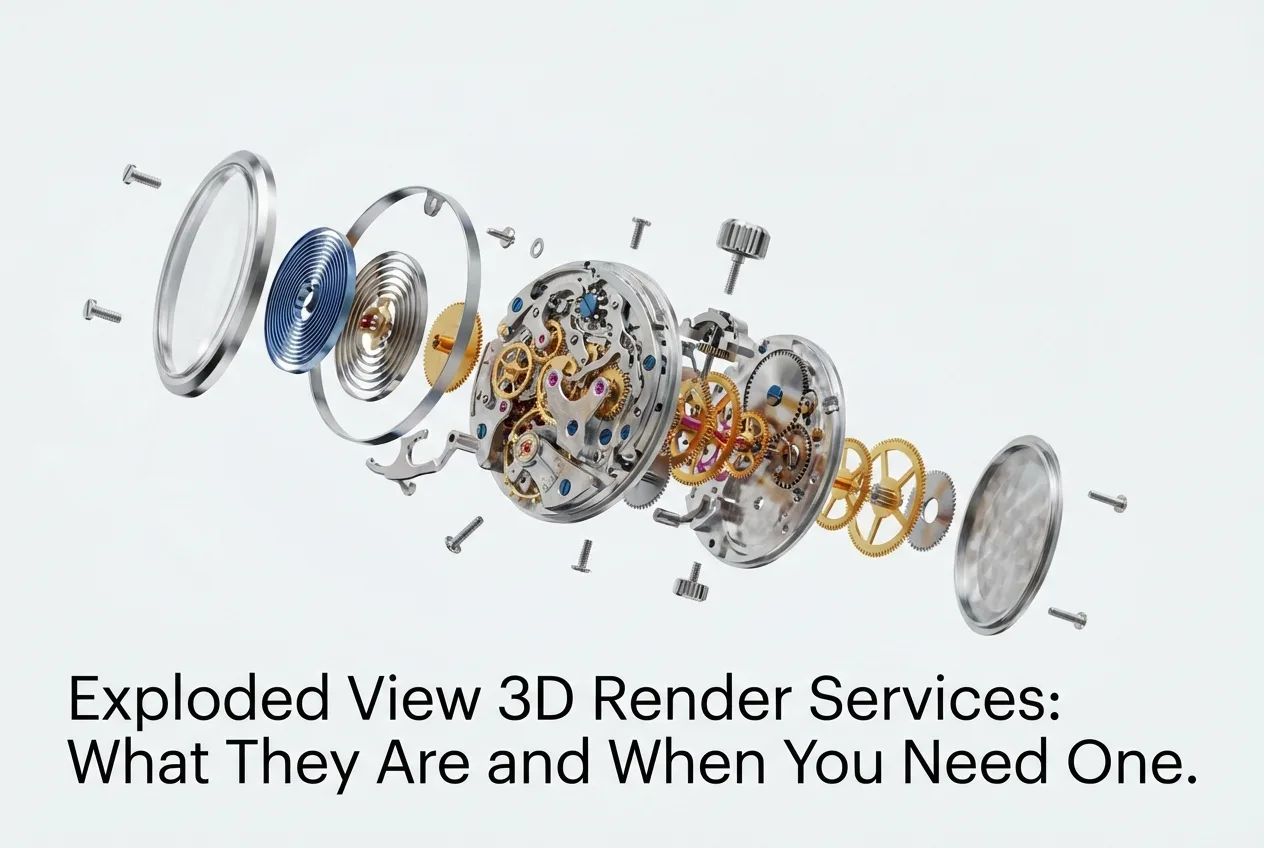
If you’ve ever looked at an instruction manual and seen a diagram showing every single part of a product floating apart from each other in perfect order, you already know what an exploded view is. Now imagine that same concept — but rendered in photorealistic 3D, with lighting, materials, and depth that make every component look tangible. That’s exactly what Exploded View 3D Render Services: What They Are and When You Need One is all about. These renders are one of the most powerful visual tools a product company can have, whether you’re launching a new gadget, pitching to investors, or writing technical documentation. They communicate complexity in a way that words and flat photos simply can’t.
The demand for this type of visualization has grown significantly over the past decade. More companies are selling complex products online, and buyers want to understand what they’re getting before they commit. Engineers need clear documentation. Marketing teams need stunning visuals that do more than just look pretty — they need to explain. That’s where exploded view rendering steps in. It breaks a product into its individual parts, spreads them out along a logical axis, and lets viewers understand how everything fits together at a glance.
In this post, we’re going to cover everything you need to know: what these renders actually are, how they’re made, who uses them, and when they’re truly worth investing in. If you’ve been wondering whether your product needs one, you’ll have a clear answer by the end.
What Exactly Is an Exploded View 3D Render?
Let’s start with the basics. An exploded view render is a three-dimensional visualization where a product’s components are separated and spread out — typically along a single axis — so that each part is clearly visible. The “explosion” isn’t random. Every piece is positioned along a deliberate path that reflects how those parts would actually come together in the real product. A screw sits just outside the hole it threads into. A battery hovers above the compartment it drops into. A lens floats just in front of the camera body it attaches to.
The result is an image (or animation) that gives viewers a complete understanding of a product’s internal structure without requiring any technical knowledge. It’s intuitive. Your brain naturally understands the spatial relationship between the parts, even if you’ve never studied engineering.
These renders are typically created from existing CAD files or 3D models of a product. A skilled 3D artist takes those files, separates the components in a 3D environment, applies materials and textures, sets up lighting, and renders the final image at whatever resolution the client needs. The whole process can be done before a product even exists physically — which makes exploded views incredibly useful during product development and pre-launch marketing phases.
How the Process Actually Works
A lot of clients come to us with CAD data straight from their engineering team. That’s ideal. Files in formats like STEP, IGES, or SolidWorks can be imported directly into professional 3D rendering software, where they get cleaned up and prepared for visualization. If you don’t have CAD files, a 3D modeling team can build the product from scratch using reference images, technical drawings, or physical samples — it just takes a bit more time.
Once the model is ready, the artist organizes the parts and creates the “explosion.” This step requires real judgment. A good exploded view isn’t just mathematically separating parts — it’s about communication. Which components need the most attention? What order should the viewer’s eye follow? How far apart should the pieces be spread so they’re clearly distinct without looking chaotic? These are artistic decisions that matter.
After the layout is finalized, the artist adds materials (metals, plastics, rubber, glass), sets up the lighting environment, and renders the image. Many clients also ask for annotations — labels that identify each component — which can be added in post-production. Others want the exploded view as an animation, where the parts slowly come together or drift apart. Both are entirely achievable.
Industries That Use Exploded View Renders Most
Almost any industry that sells or documents physical products can benefit from this type of visualization. But a few sectors tend to use them especially heavily.
Consumer Electronics
Headphones, smartphones, cameras, laptops — these products are packed with components, and companies love showing that complexity as a point of pride. An exploded view of a high-end pair of wireless headphones, for instance, immediately communicates quality. Consumers see the layers of engineering that went into something they’re about to spend $300 on. It builds trust and justifies the price.
Industrial and Manufacturing Equipment
This is probably the most traditional use case. Industrial companies have used exploded view diagrams in technical manuals for decades. The 3D rendered version takes that concept and makes it dramatically more useful and visually impressive. Assembly workers can understand part relationships at a glance. Maintenance teams can identify components without hunting through dense text. The visual clarity is simply better than anything a 2D illustration can offer.
Medical Devices
Medical device manufacturers need to communicate complex mechanisms to a wide range of audiences — from highly trained surgeons to hospital procurement teams to regulatory bodies. An exploded view render can show exactly how a device is constructed, how sterile components are isolated, and how the product is assembled. This is incredibly valuable for both marketing and compliance documentation.
Automotive and Aerospace
Parts catalogs, service manuals, sales materials — the automotive and aerospace industries have enormous documentation needs. Exploded view 3D renders are used extensively in both sectors to illustrate assemblies, subassemblies, and individual components. When you’re dealing with safety-critical systems, visual clarity isn’t just nice to have — it’s essential.
Furniture and Home Products
Flat-pack furniture companies, appliance manufacturers, and home goods brands use exploded views in their assembly instructions. A well-rendered exploded view of a flat-pack chair is infinitely more helpful than a confusing line drawing. Consumers appreciate it. Customer service calls go down. Returns drop. It’s a practical win.
When Do You Actually Need an Exploded View Render?
This is the real question, isn’t it? Not every product needs an exploded view. A simple water bottle doesn’t have enough internal complexity to make one worthwhile. But if any of the following situations apply to you, it’s probably worth the investment.
You’re launching a product with meaningful internal complexity. If your product has components, mechanisms, or internal systems that distinguish it from competitors, showing them matters. An exploded view is one of the most effective ways to do that during a launch campaign or crowdfunding pitch.
You’re creating technical documentation. User manuals, service guides, assembly instructions — all of these benefit enormously from exploded view renders. The clearer your documentation, the fewer support calls you get and the better your customers’ experience.
You’re pitching to investors or buyers. When you’re trying to get someone to invest in your product or sign a large purchase order, showing them a detailed, professional exploded view communicates that you’ve thought through every aspect of what you’re building. It signals maturity and engineering rigor.
You’re selling technical products online. Ecommerce is hard for complex products. Customers can’t pick things up, feel the materials, or see how things work. A well-executed exploded view on a product page can answer questions that would otherwise lead to abandoned carts or post-purchase confusion.
You need training or onboarding materials. If your product needs to be assembled, maintained, or operated by people who need training, visual materials make that training far more effective. Exploded view renders are particularly useful in manufacturing environments where assembly line workers need to quickly understand part sequences.
Practical Tips: Getting the Most From Your Exploded View Render
If you’ve decided an exploded view render is right for your project, here’s how to get the best possible result.
Provide the best possible source files. CAD data is always preferable to reference images. If you have detailed engineering files, share them. The higher the quality of the input, the better the output. If you don’t have CAD files, mention that upfront so the team can plan accordingly.
Know your audience before you brief the project. An exploded view for a consumer marketing campaign looks different from one designed for a technical service manual. Consumer-facing renders tend to use dramatic lighting, richer materials, and cleaner backgrounds. Technical renders are often more neutral, with annotations and part numbers. Decide which you need — or whether you need both — before the project starts.
Think about whether you need an animation. Static renders are often enough. But if you’re presenting at a trade show, launching a product video, or creating a premium brand experience, an animated exploded view — where parts slowly separate or come together — can be worth the additional investment. It creates genuine wow moments that still images can’t match.
Plan for multiple uses. Once a 3D model exists, rendering it in different ways is relatively affordable. If you’re investing in an exploded view render, consider commissioning lifestyle renders, cutaway views, or product packshots at the same time. You’ll get more visual assets from the same model, which spreads the cost effectively.
Give feedback early. Most studios (including ours) provide preview renders for approval before final production. Use these checkpoints seriously. It’s much easier to make changes to lighting, spacing, or component visibility at the preview stage than after the final render is complete.
Why Quality Matters More Than You Might Think
There’s a big difference between a mediocre exploded view and a great one. A poor render with flat lighting, inaccurate materials, and awkward part spacing can actually undermine confidence in your product. If the visualization looks cheap, some viewers will assume the product is too. That’s not fair, but it’s human nature.
A high-quality render, on the other hand, creates a halo effect. It signals craft, attention to detail, and professionalism. The same product, visualized well versus visualized poorly, reads very differently to a buyer or investor. This is why working with an experienced 3D rendering studio — one that understands both technical accuracy and visual composition — is worth paying for.
Ready to See What an Exploded View Can Do for Your Product?
Understanding Exploded View 3D Render Services: What They Are and When You Need One is the first step. The next step is actually getting one made. Whether you’re preparing a product launch, building a technical manual, or trying to give your ecommerce listings the kind of visual depth that converts browsers into buyers, our team at 360render.com can help.
We work with product companies across industries — from consumer tech startups to established industrial manufacturers — and we know how to turn complex engineering into visuals that actually communicate. Every exploded view we produce is built around your specific goals: who’s looking at it, what they need to understand, and where the image is going to live.
If you’re ready to talk about your project, get in touch with our team here. Tell us about your product, your timeline, and what you’re trying to achieve, and we’ll put together a plan that makes sense for your needs and your budget. Great visualization starts with a conversation — let’s have one.
Frequently Asked Questions
What is an exploded view 3D render and how does it differ from a standard product render?
An exploded view 3D render is a specialized visualization that shows a product's individual components separated and arranged along an axis to reveal how they fit together, unlike a standard product render which displays the item as a fully assembled whole. This technique allows viewers to understand internal structure, assembly sequences, and part relationships without physically disassembling the product. It is commonly used in technical documentation, marketing materials, and instruction manuals to communicate complex mechanical or structural information clearly.
When should a business invest in exploded view 3D render services instead of traditional photography or diagrams?
Businesses should choose exploded view 3D rendering when their product contains internal components, layered materials, or complex assembly steps that cannot be captured effectively through photography or flat 2D diagrams. It is especially valuable during the pre-production phase when physical prototypes do not yet exist, allowing teams to visualize and market the product before manufacturing begins. Industries such as electronics, furniture, medical devices, automotive, and consumer goods benefit most from this service due to the technical complexity of their products.
How much do professional exploded view 3D render services typically cost?
The cost of exploded view 3D render services generally ranges from a few hundred dollars to several thousand dollars per project, depending on the complexity of the product, the number of components, the level of photorealism required, and the turnaround time. Simple consumer products with fewer parts tend to fall on the lower end of the pricing spectrum, while intricate industrial machinery or medical equipment with dozens of components commands higher rates. Most studios offer custom quotes based on your specific files, deliverable formats, and intended use cases.
What file formats or assets do I need to provide to a 3D rendering studio for an exploded view project?
Most professional 3D rendering studios prefer to receive CAD files in formats such as STEP, IGES, SolidWorks, or OBJ, as these contain accurate geometry and part structure needed to separate and position components precisely. If CAD files are unavailable, studios can sometimes work from detailed technical drawings, physical samples, or high-resolution reference photos, though this may increase production time and cost. Providing brand guidelines, material specifications, and color references upfront helps the studio deliver results that align with your visual identity on the first revision.
Can exploded view 3D renders be used for both marketing and technical documentation purposes?
Yes, exploded view 3D renders are highly versatile and can be optimized for both marketing campaigns and technical documentation with adjustments to style, labeling, and level of detail. For marketing use, renders are typically styled with soft lighting, clean backgrounds, and brand colors to create visually engaging content for websites, brochures, and social media. For technical documentation such as assembly manuals or patent filings, the same base 3D model can be rendered with numbered callouts, dimension lines, and a more neutral aesthetic to meet functional communication requirements.
Also read: 3D Product Renders for Medical Devices: Compliance, Accuracy and Visual Quality