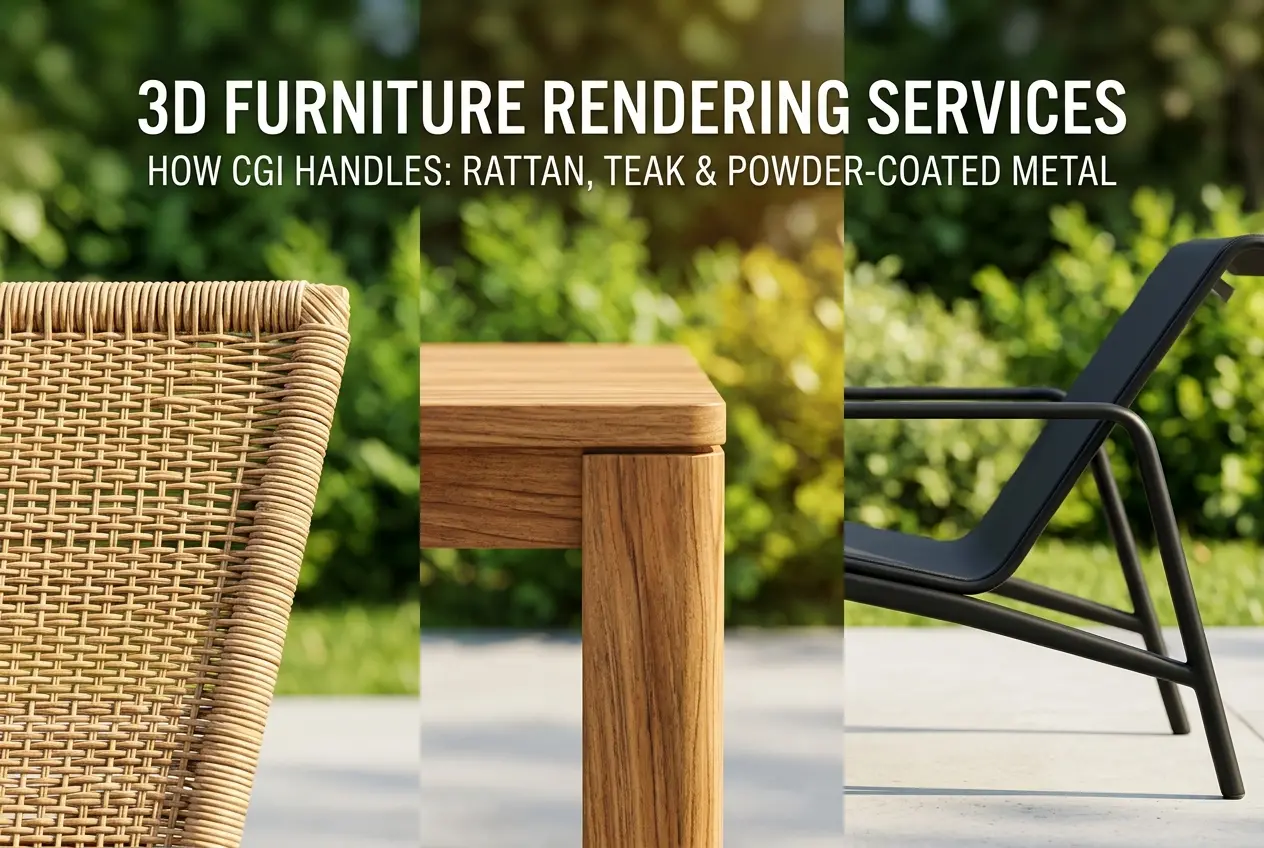
Outdoor furniture is the hardest category we render, and it isn’t close. Rattan is thousands of tiny overlapping strands, teak is a living material that changes color with weather, and powder-coated metal sits somewhere between matte plastic and brushed paint depending on the supplier’s finish. This guide to 3D Furniture Rendering Services for Outdoor and Garden Furniture: How CGI Handles Rattan, Teak and Powder-Coated Metal explains how we approach each material, where the shortcuts hide, and what you should check before you approve a render.
The stakes are real. Outdoor buyers can’t sit on the sofa before ordering, so the image has to carry the weave, the grain and the finish. If the rattan looks like a plastic mesh or the teak looks like orange laminate, shoppers sense it immediately, even if they can’t say why.
Below, we cover what makes each material difficult, how we build and shade it, how we light garden scenes, and the mistakes we see clients make most often.
Why Outdoor Furniture Is Harder Than Indoor
Indoor furniture usually sits in controlled light. Outdoor pieces sit under a huge, bright, constantly shifting light source: the sky. Sunlight is hard and directional, shadows from foliage break up surfaces, and the ground bounces green and warm light back onto everything. Materials that look fine under a studio softbox can fall apart under a simulated sun.
Outdoor materials are also built for weather, which means their surfaces are full of intentional texture: woven synthetic fibers, open grain, textured powder coats, water-repellent fabrics. All of that micro-detail catches light, and a flat texture map can’t fake it for long.
Rattan: Modeling the Weave, Not Painting It
Most rattan furniture today is synthetic polyethylene (PE) wicker wrapped around an aluminum frame, with a few natural rattan and cane pieces in the mix. Both are rendered the same basic way, and both go wrong the same way: someone applies a weave photo to a flat surface and calls it done.
Geometry versus texture
For hero shots and close-ups, we model the strands. That can mean splines with a profile swept along them, or a procedural weave generated in Houdini or a similar tool, then fitted to the frame. Actual geometry gives you correct silhouettes, real gaps where light leaks through, and self-shadowing between strands. A bump map can’t deliver any of those.
For wider lifestyle scenes where the chair is a small part of the frame, a well-built displacement or normal-mapped weave is enough and keeps render times sane. The decision depends on camera distance, and we make it shot by shot rather than model by model.
Shading synthetic strands
PE wicker is slightly glossy, with a soft sheen along the strand’s curved edge. The highlights should break up across the weave, not sit in one smooth patch. We add subtle roughness variation and slight color variation between strands, because real extrusion is never perfectly uniform. Flat, identical strands are the fastest way to make a render look fake.
Teak: Grain, Aging and the Color Question
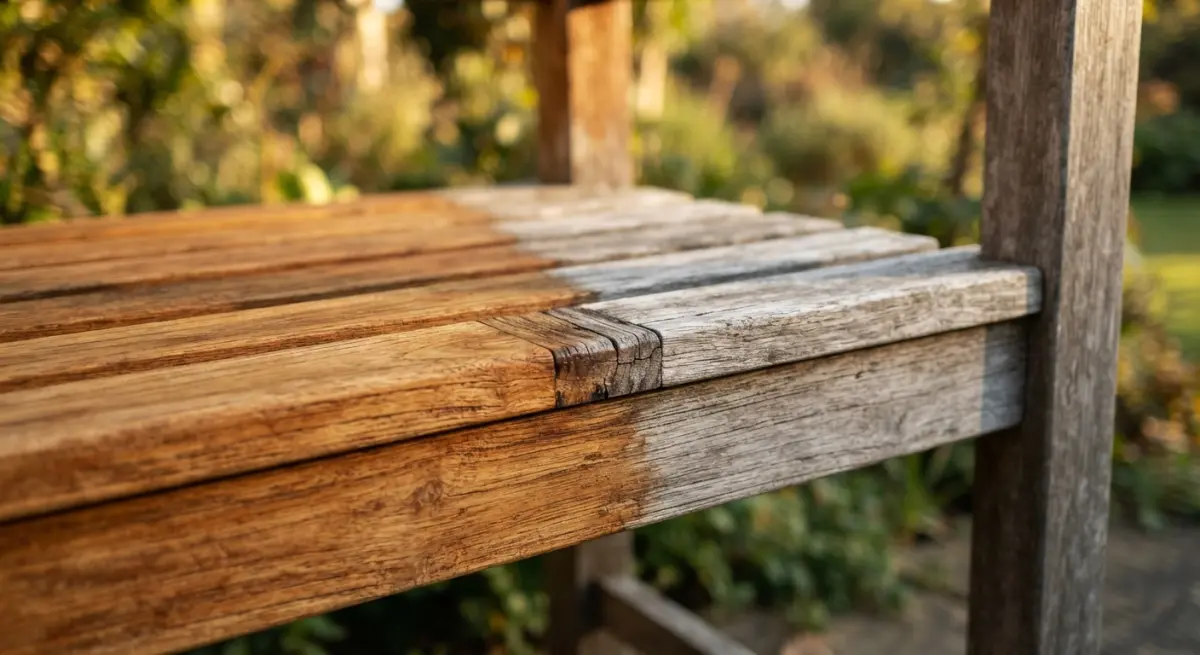
Teak is where color accuracy becomes a business problem. New teak is golden-brown. Left outdoors, it weathers to silver-gray. Some brands sell it oiled, others sell it raw and expect it to age, and your render needs to match the product the customer will actually receive.
Building believable wood
Good teak shading starts with real grain reference, ideally photographed from your actual material samples. We use scanned or photographed textures, then break up tiling by blending multiple texture variations and offsetting them across individual boards. Slats on a bench should not all share the same grain pattern, and in real life they never do.
Teak also has natural oils, so the surface has a soft, low sheen rather than a varnished shine. We layer a subtle clearcoat or reduce roughness only slightly, and we let fine pores catch light through a small bump or displacement component. End grain matters too. The cut ends of slats look different from the faces, and showing that detail sells the construction quality.
Rendering weathered states
Clients sometimes want both a new and an aged version for the same listing. That is easy in CGI: we keep one model and swap the material set. This is one of the places where rendering beats photography, since you don’t have to leave a sample outside for a year.
Powder-Coated Metal: Simple on Paper, Tricky in Practice
Powder-coated aluminum and steel look like the easy material. They aren’t, because the finish is the whole point. A matte charcoal frame, a fine-texture black, and a satin white each behave differently under light, and customers notice when a render shows glossy paint on a textured coat.
Powder coating has a slight orange-peel texture, a tiny surface ripple that diffuses reflections. Without it, metal looks like car paint. We add very fine bump detail and tune roughness to match the supplier’s finish spec. A quick tip: ask your factory for the RAL or Pantone code and a physical swatch. Matching a color on a calibrated screen against a swatch is far more reliable than matching to a product photo.
Welds, tube joints and edge radii matter too. Real tubing has small bevels where surfaces meet. A perfectly sharp edge doesn’t catch light the way a real one does, so we bevel almost everything, even when the bevel is barely visible.
Lighting and Context for Garden Scenes
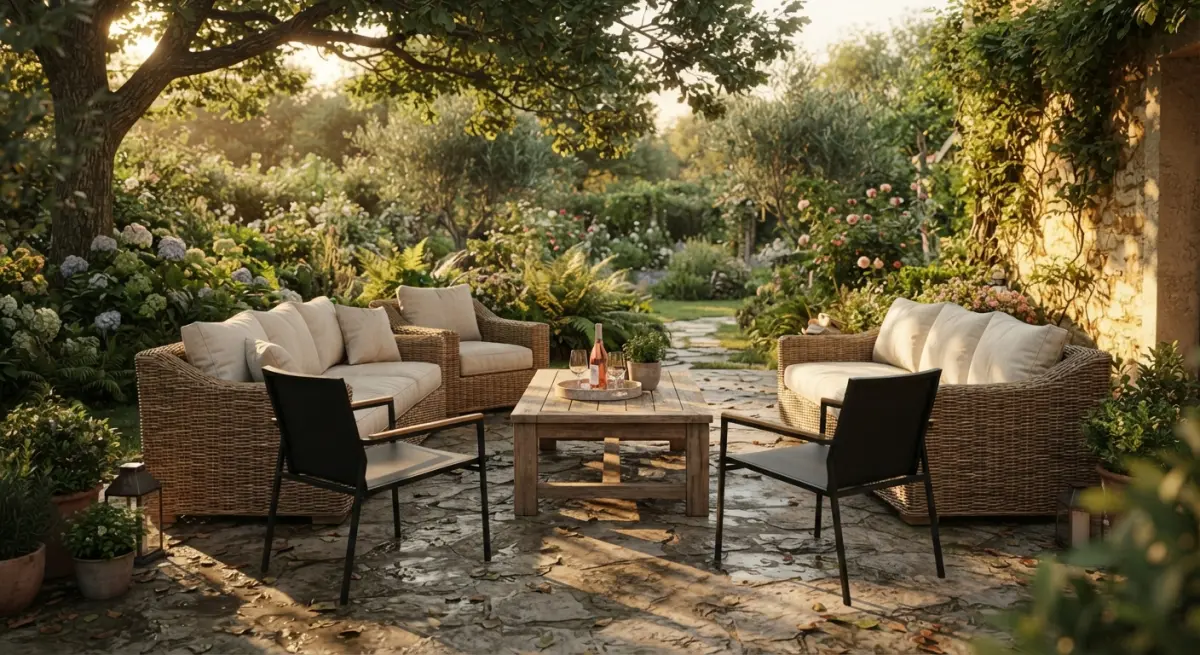
Material accuracy only gets you halfway. The other half is the environment. We typically use an HDRI sky for believable ambient light, paired with a physical sun so shadows fall correctly. Overcast skies flatter rattan and fabric, while low golden-hour sun shows off teak grain but can blow out light powder coats.
For lifestyle imagery, props and landscaping carry a lot of the story: lawn, planters, stone paving, a table setting. Grass and foliage need care, because repeating patterns and plastic-looking leaves undermine otherwise good furniture. If you’re also planning interior or patio scenes, our 3D furniture rendering services cover both product and styled environments.
What Clients Get Wrong (and What Actually Works)
- Sending only a CAD file. CAD gives us shape, not material behavior. Send swatches, finish codes, and clear photos of the real product, especially the weave and joinery.
- Ignoring cushions and fabric. Outdoor fabrics have a specific woven look and a slight sheen. Pillows should sag and wrinkle under their own weight. Perfectly puffed cushions look pasted on.
- Over-polished finishes. Clients often ask us to make everything cleaner and brighter. Pushing too far makes the product look like a toy. A little imperfection reads as real.
- Mixing lighting across a catalog. If half your range is shot at noon and half at dusk, the collection looks disjointed. Agree on one lighting setup early.
- Skipping the material test. We always recommend approving a close-up material render before the full scene. Fixing a rattan weave at that stage costs minutes. Fixing it after final output costs a re-render.
One more practical point: for e-commerce, we often deliver a clean white-background set alongside lifestyle scenes, since marketplaces usually require the former and ad campaigns benefit from the latter. Building both from one model saves time and keeps color consistent.
Choosing the Right Approach for Your Range
| Material | Main risk | What we do |
|---|---|---|
| Rattan / PE wicker | Flat, repetitive weave | Modeled strands for close-ups, varied roughness and color |
| Teak | Wrong color or tiled grain | Sample-based textures, per-slat variation, new and aged states |
| Powder-coated metal | Wrong finish type | Match to swatch, add orange-peel texture, bevel edges |
Conclusion
Rendering outdoor furniture convincingly comes down to respecting how each material actually behaves: strands that cast shadows, wood that varies board to board, and metal finishes that match the spec sheet. Get those right and CGI lets you launch products before samples exist, show every color option, and keep a consistent look across a whole catalog.
If you have an outdoor range to launch, send us your CAD files, swatches and reference photos, and we’ll tell you honestly what level of detail each shot needs. You can start with our 3D furniture rendering services page or reach out directly to talk through your project.
Frequently Asked Questions
How do 3D artists realistically render woven rattan furniture?
Artists typically model each weave strand using splines or procedural weaving tools, then apply a normal or displacement map to capture fine surface depth. Anisotropic reflections and subtle color variation between strands help mimic natural or synthetic PE rattan. For large catalog scenes, optimized instancing keeps render times manageable without sacrificing close-up detail.
What is the best way to render teak wood so it looks authentic in outdoor furniture visuals?
Authentic teak rendering relies on high-resolution scanned or photographed textures with accurate grain direction, plus a layered material that combines a soft satin reflection with slight bump detail. Artists can also create variants showing fresh golden-brown teak versus silver-gray weathered teak so clients can show how the product ages. Correct UV mapping on each plank prevents repeating patterns that make the wood look fake.
How does CGI replicate powder-coated metal finishes on garden furniture?
Powder-coated metal is recreated with a physically based material that has a low-to-medium roughness, a subtle orange-peel micro-texture, and accurate color values from RAL or Pantone references. Soft edge bevels on the models catch highlights realistically, which is key to making aluminum or steel frames look manufactured rather than flat. Matte, satin, and textured finishes are adjusted by tuning the specular and clearcoat settings.
Can 3D rendering show outdoor furniture in different weather and lighting conditions?
Yes, using HDRI skies and physically accurate lighting, artists can present the same product in bright midday sun, golden-hour light, overcast conditions, or even evening scenes with lanterns and string lights. Wet surfaces, dew, or light rain effects can also be added to demonstrate material behavior. This lets brands produce a variety of lifestyle images without costly location shoots or waiting for ideal weather.
Is 3D furniture rendering more cost-effective than photography for outdoor and garden collections?
For most catalogs, 3D rendering is more cost-effective because one model can generate unlimited colorways, material options, and settings without reshooting or shipping bulky samples. It also allows marketing to begin before prototypes exist, which speeds up product launches. Photography may still make sense for a few hero shots, but CGI scales much better for large ranges and e-commerce configurators.