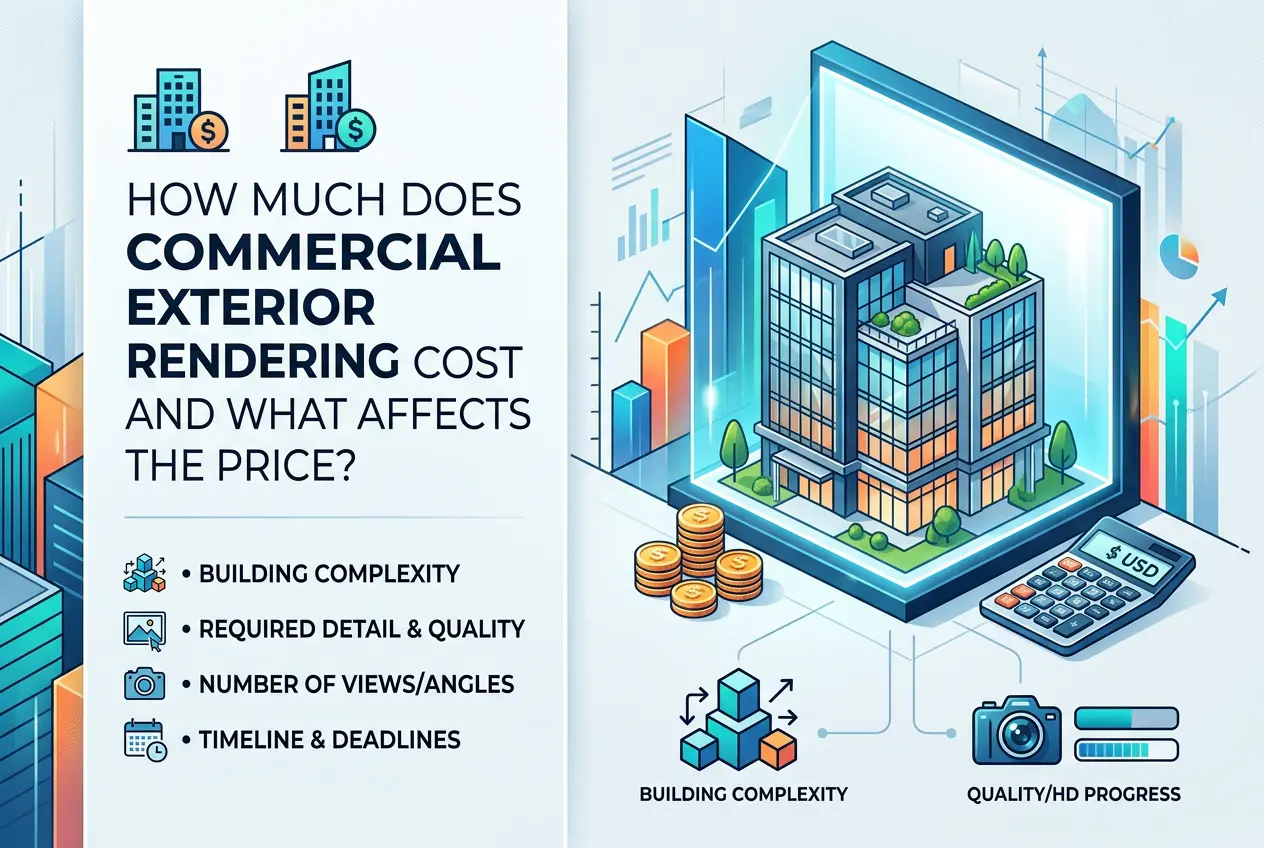
If you’re planning a commercial development and trying to figure out your pre-sales or marketing budget, you’ve probably already asked yourself: how much does commercial exterior rendering cost and what affects the price? It’s one of the most common questions we get — and honestly, it’s also one of the hardest to answer with a simple number. That’s not a dodge. It’s just the reality of a service that varies enormously depending on project scope, complexity, and how the final images will be used. But stick with us, because by the end of this post, you’ll have a solid understanding of what drives pricing and what to expect when you request a quote.
Commercial exterior rendering isn’t a commodity. Unlike printing 500 business cards or buying a stock photo, each rendering is built from scratch to reflect your specific building, your site context, your materials, and your vision. That custom nature means the price isn’t fixed — it’s shaped by a range of factors that we’ll break down clearly below. Whether you’re a developer, architect, or marketing director, understanding those factors helps you plan smarter and get better value from your investment.
Let’s get into it.
What Exactly Are You Paying For in a Commercial Exterior Rendering?
Before we talk about price, it helps to understand what the work actually involves. A high-quality commercial exterior rendering isn’t just a pretty picture dropped into a nice background. It’s a technically complex 3D visualization that starts with your architectural drawings, CAD files, or BIM models, and ends with a photorealistic image that could easily be mistaken for a photograph of a finished building.
The process involves building a detailed 3D model of the structure, applying realistic materials and textures, setting up accurate lighting (including time of day and weather conditions), populating the scene with people, vehicles, trees, and surrounding context, and then rendering and post-processing the final image. Each of those stages takes time, software, skill, and artistic judgment. A junior freelancer working from a basic brief will produce a very different result than an experienced studio working from full architectural documents — and the price reflects that difference.
It’s also worth noting that commercial projects tend to be more involved than residential ones. A single-family home render is relatively contained. A mixed-use development with retail ground floors, multiple facades, rooftop terraces, and a surrounding streetscape? That’s a different level of complexity entirely.
Key Factors That Affect the Cost of Commercial Exterior Rendering
1. Project Scale and Building Complexity
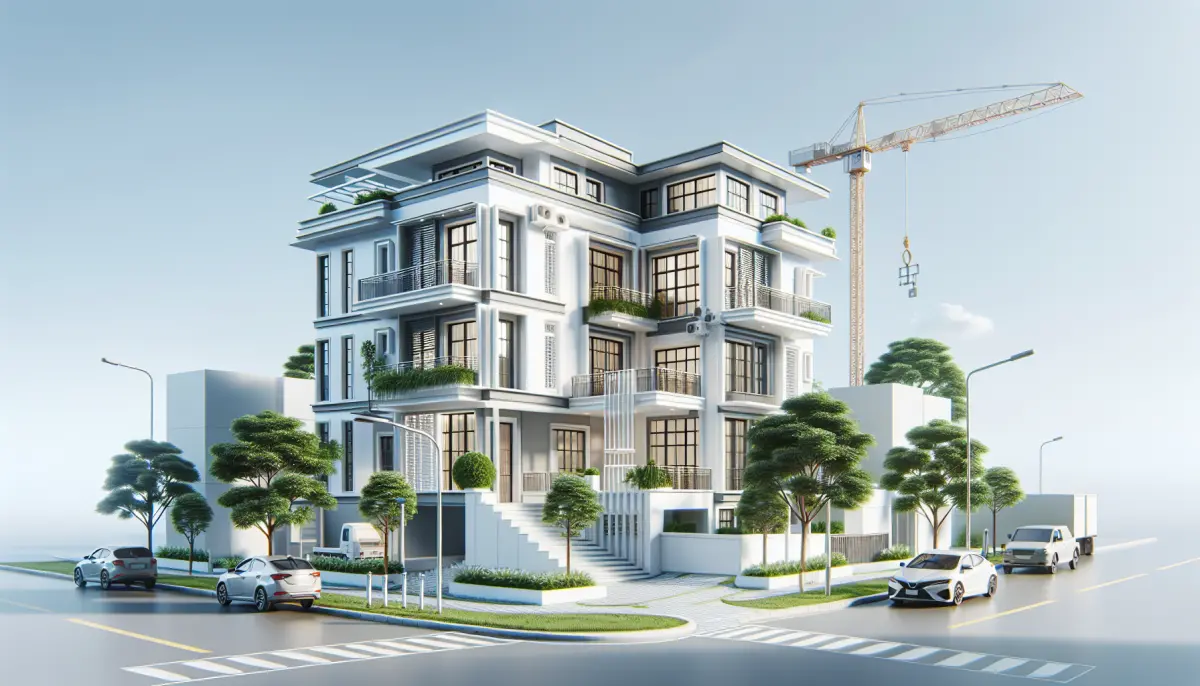
This is probably the biggest driver of cost. A small retail unit on a corner plot requires far less modelling time than a large-scale office tower or a multi-building commercial campus. The more surfaces, architectural details, structural complexity, and unique design features your building has, the longer it takes to model accurately — and time is directly tied to cost.
Curved facades, intricate cladding systems, complex roof structures, and bespoke architectural elements all add to the modelling workload. A straightforward rectangular building with clean lines and standard materials is significantly quicker (and cheaper) to render than a statement building with custom geometry and highly detailed façade treatments.
2. Number of Views and Camera Angles
Most clients start by asking for one or two hero shots — a primary front-facing view and perhaps a street-level perspective. But once you see the quality of those initial images, it’s common to want more: aerial views, dusk shots, interior courtyard angles, or close-up material studies. Each additional camera angle requires additional rendering time and, in some cases, additional scene setup.
If you know upfront that you’ll need multiple views for a planning submission, investor deck, or marketing campaign, it’s always more cost-effective to brief them all at once. Studios can optimise their workflow when everything is planned together rather than adding views piecemeal after the initial render is complete.
3. Quality of Input Files and Design Stage
The quality and completeness of the files you provide has a direct impact on cost. If your architectural team hands over a detailed BIM model with all materials, dimensions, and specifications clearly defined, the 3D artist can work efficiently from day one. But if you’re working from early concept sketches, incomplete drawings, or rough design ideas that are still evolving, expect the process to take longer — and cost more.
This is why many clients commission architectural rendering services at specific design milestones rather than mid-process. When the design is more resolved, the output is better and the production is faster.
4. Scene Context and Environmental Detail
Commercial buildings don’t exist in a vacuum. A great exterior render shows your building in context — surrounded by realistic streetscapes, neighbouring buildings, landscaping, people, and cars. Creating that context from scratch takes time. If your project is located in a well-documented urban environment, the studio might be able to use aerial photography and map data to recreate the surroundings accurately. If it’s a greenfield site with no existing context, the team will need to build that environment themselves.
The more detailed and accurate the environment needs to be — particularly for planning applications where accuracy matters — the more time it takes to produce.
5. Lighting Scenarios and Time of Day
Daylight renders are the standard. But dusk renders — those golden-hour shots with lit interiors glowing through glazing against a deep blue sky — are enormously effective for marketing and often requested alongside daytime views. Producing multiple lighting scenarios requires additional rendering passes and post-production work. It’s not simply a case of pressing a button to switch from day to night.
If your brief includes a daytime hero shot, a dusk mood image, and an aerial view, that’s three separate renders — each requiring its own lighting setup, rendering time, and post-processing. Budget accordingly.
6. Turnaround Time
Rush jobs cost more. That’s true in almost every creative industry, and 3D rendering is no exception. If you need images for a planning submission next week, or a marketing campaign launches in 10 days, studios will often accommodate tight deadlines — but they’ll allocate additional resources and prioritise your project over others in the queue. That comes at a premium.
Planning ahead is one of the simplest ways to keep costs manageable. If you can brief a project four to six weeks before the deadline, you’re far less likely to incur rush charges.
How Much Does Commercial Exterior Rendering Cost and What Affects the Price? — A Practical Breakdown
Rather than inventing specific price brackets that could mislead you, here’s a more useful way to think about cost tiers:
Entry-level commercial renders — Simpler buildings, limited context, standard daylight, one to two views. Suitable for early-stage presentations or internal design reviews where photorealism matters less than concept communication.
Mid-range commercial renders — More complex buildings, detailed context, high-quality lighting, two to four views. Appropriate for planning applications, investor presentations, or pre-marketing materials where quality and accuracy both matter.
Premium commercial renders — Large-scale or flagship developments, highly detailed environments, multiple views including dusk and aerial, post-production to a marketing-ready standard. Used for major campaigns, international investor decks, or high-profile planning submissions where the imagery directly influences commercial decisions.
The gap between entry-level and premium can be significant. That’s not padding — it reflects real differences in time, expertise, and output quality.
Practical Tips to Get the Best Value From Your Rendering Budget
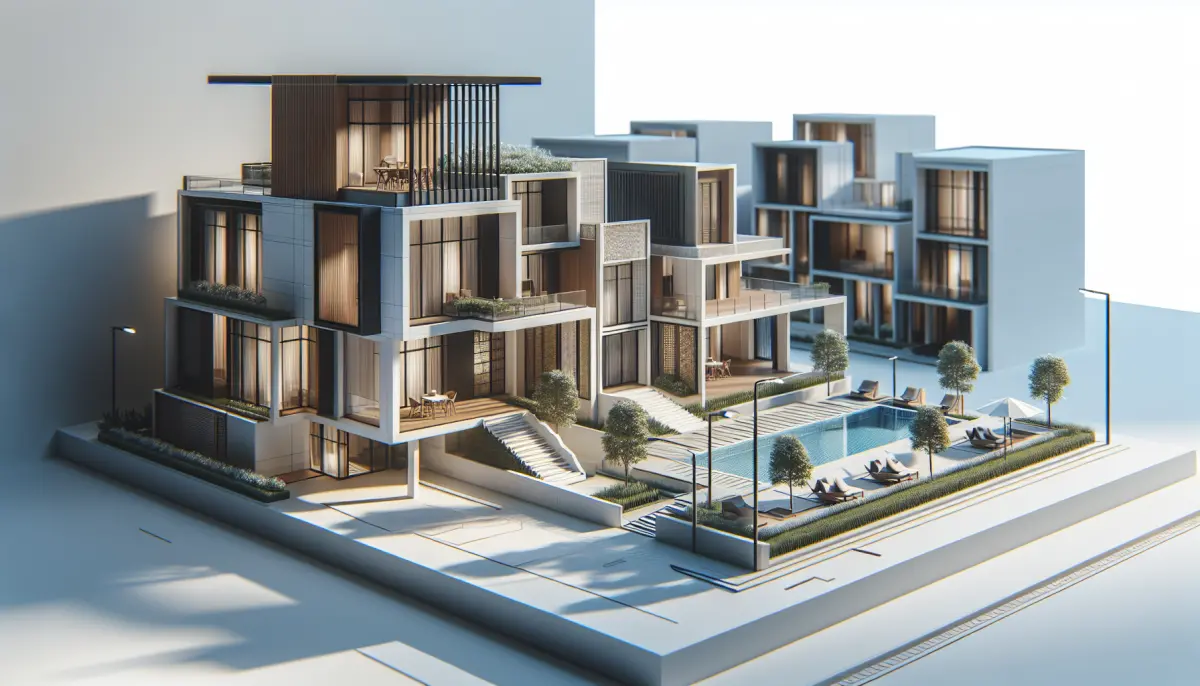
Brief thoroughly from the start. The more information you provide upfront — materials, colours, site context, intended use of images — the less back-and-forth there will be during production. Revisions are part of any creative process, but excessive changes caused by unclear briefing add cost.
Prioritise your must-have views. Identify the two or three angles that will do the most work for your project. Get those right first, then decide whether additional views are genuinely needed or just nice to have.
Consider the end use. An image for a planning portal has different requirements than a billboard or a full-bleed magazine spread. Understanding how the images will be used helps the studio optimise the output — and helps you avoid paying for a level of quality you won’t actually see in the final application.
Plan for animation if it’s on your radar. If there’s any chance you’ll want a 3D architectural animation of the same project, brief it alongside the stills. Once a 3D model is built for a still render, producing animation from it is far more cost-effective than starting from scratch later.
Communicate your deadline early. Tell the studio your hard deadline on day one. That allows them to schedule your project properly without needing to charge rush fees.
For retail and commercial interior spaces that accompany exterior renders, a commercial rendering brief that covers both exterior and interior views together will almost always save you money compared to commissioning them separately.
Why Quality Matters More Than a Low Quote
It can be tempting to go with the cheapest option, especially when project budgets are tight. But for commercial exterior rendering specifically, the quality of the output has real commercial consequences. These images are used to secure planning permission, attract investors, close pre-sales, and launch marketing campaigns. A render that looks unconvincing or amateurish doesn’t just fail to impress — it can actively undermine confidence in your development.
When you’re asking how much does commercial exterior rendering cost and what affects the price?, the better question might be: what does a poor-quality render cost me in missed opportunities? That’s a figure that’s much harder to recover from than a higher upfront production fee.
Experienced studios bring not just technical skill but design intelligence — they know how to compose a scene, what lighting makes a building sing, and how to make your development look its absolute best while remaining accurate and credible.
Ready to Get a Quote?
Understanding the factors behind commercial exterior rendering pricing puts you in a much stronger position to brief effectively, budget accurately, and get the best possible output for your project. Every development is different, which means every quote should be tailored — not templated.
If you’re working on a commercial project and want a clear, honest conversation about what your brief would cost and how long it would take, get in touch with the team at 360render. We’ll give you a straightforward assessment based on your actual files and requirements — no vague ballparks, no hidden extras.
Frequently Asked Questions
How much does commercial exterior rendering cost per square metre in the UK?
Commercial exterior rendering typically costs between £30 and £80 per square metre in the UK, depending on the render type and complexity of the project. Monocouche and silicone renders sit at the higher end of the range, while sand and cement renders are more affordable. For an accurate quote, most contractors will assess the building size, access requirements, and surface condition before pricing.
What factors affect the cost of commercial exterior rendering?
The main factors that influence commercial rendering costs include the size and height of the building, the type of render chosen, and the current condition of the existing exterior surface. Additional costs can arise from scaffolding requirements, surface preparation such as repairs or cleaning, and the location of the property. Labour rates also vary by region, with projects in London and the South East typically costing more than those elsewhere in the UK.
Is silicone render more expensive than traditional sand and cement render for commercial buildings?
Yes, silicone render is generally more expensive upfront, costing around £50 to £80 per square metre compared to £30 to £50 for sand and cement render on commercial properties. However, silicone render offers superior flexibility, weather resistance, and a longer lifespan, which can reduce long-term maintenance costs. Many commercial property owners find the higher initial investment worthwhile when considering the reduced need for repainting and repairs over time.
Do scaffolding costs significantly increase the overall price of commercial rendering?
Scaffolding can add a substantial amount to the total cost of a commercial rendering project, often ranging from £1,000 to over £10,000 depending on the height and size of the building. For multi-storey commercial properties, scaffolding is almost always required to ensure safe access and quality workmanship. It is important to confirm whether scaffolding is included in a contractor’s quote or charged separately to avoid unexpected costs.
How can I reduce the cost of commercial exterior rendering without compromising quality?
One of the most effective ways to reduce costs is to obtain at least three detailed quotes from reputable rendering contractors and compare what is included in each price. Choosing a mid-range render product that balances durability with affordability, such as a standard silicone thin coat system, can also help manage expenses. Scheduling the work during off-peak seasons and ensuring the building surface is well-prepared before work begins can further minimise costs by reducing labour time and material waste.