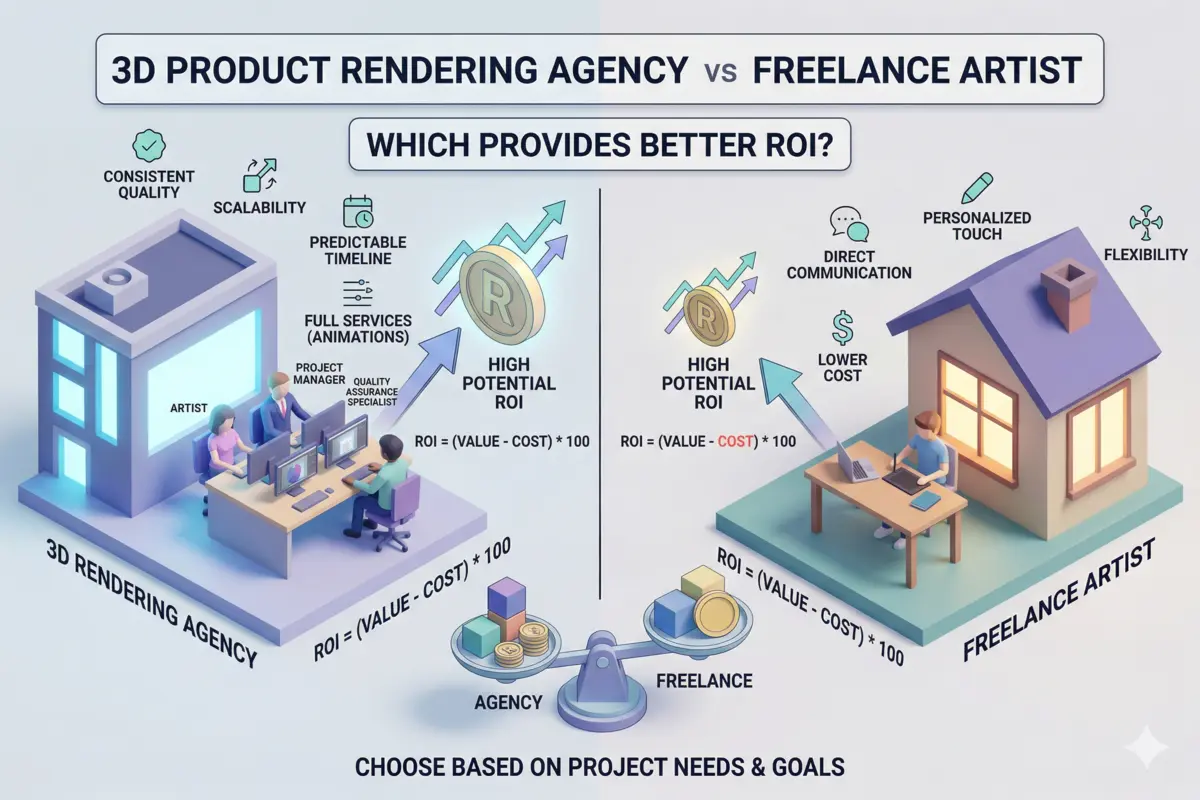
Every product business eventually hits the same crossroads: you need high-quality 3D visuals, and you’re trying to figure out whether to hire a freelance artist or work with a professional studio. It’s a real question worth thinking through carefully, because the answer directly affects your budget, your timeline, and the quality of output you actually get. The debate around 3D Product Rendering Agency vs Freelance Artist: Which Provides Better ROI? isn’t black and white — both options have genuine strengths. But in my experience running a rendering studio and talking to clients who’ve tried both, there are patterns that show up consistently. Let me break them down honestly.
When we talk about ROI here, we’re not just talking about cost per image. We’re talking about the total value equation: how quickly you get results, how many revision cycles burn time and money, whether the output actually performs in your marketing, and how much of your own bandwidth gets consumed managing the process. A cheaper render that takes three rounds of corrections, misses your launch deadline, and still doesn’t look shelf-ready is not a good deal.
Let’s look at both sides of this properly.
What a Freelance 3D Artist Actually Brings to the Table
Freelancers can be exceptionally talented. Some of the best 3D artists I know work independently. When you find a great one, they’re focused, often deeply specialized in one product category, and willing to iterate closely with you. The communication can feel more personal — you’re dealing directly with the person doing the work, not a project manager acting as a relay station.
Cost is usually lower upfront. A freelancer doesn’t carry the overhead of a full studio, so their hourly or per-image rates often come in below agency pricing. For a small business testing the waters with 3D rendering, or someone who needs a handful of SKU images on a limited budget, this makes real sense.
But here’s where it gets complicated. Freelancers are one person. They have capacity limits, and when life happens — illness, another large project, a family situation — your deadline absorbs the consequence. We’ve had clients come to us mid-project after a freelancer went quiet for two weeks. The renders were partially done, the source files were with someone unreachable, and the product launch was on a fixed date. That’s a hard position to recover from.
What a 3D Product Rendering Agency vs Freelance Artist Comparison Misses
Most comparisons online focus purely on price per render. That framing misses the operational picture entirely. When you hire an agency, you’re not just buying a render. You’re buying a system — a workflow that handles modeling, texturing, lighting, QC review, and revisions in a structured way, with accountability at each stage.
At 360render.com, a single product render goes through multiple hands before it reaches a client. The 3D modeler builds the geometry, a separate texture artist handles surface materials, then a lighting and rendering specialist sets up the scene, and there’s a quality review before delivery. This pipeline exists because rendering for commercial use has technical standards that are easy to miss if you’re one person doing everything alone.
That internal QC layer is something freelancers structurally can’t offer — at least not at the same depth. They are the checker and the checked simultaneously. Good freelancers compensate for this with experience and discipline, but it’s still a single point of failure compared to a reviewed pipeline.
Where the Real Cost Differences Live

| Factor | Freelance Artist | 3D Rendering Agency |
|---|---|---|
| Upfront cost per image | Lower | Higher |
| Turnaround reliability | Variable | Structured, more predictable |
| Revision management | Direct but unstructured | Tracked, documented |
| Scale for large SKU volumes | Limited by one person’s bandwidth | Scales with team capacity |
| Internal QC process | Self-reviewed | Peer-reviewed before delivery |
| Specialization breadth | Often one style or category | Multiple specialists on one project |
| Risk if artist is unavailable | Project stalls | Another team member continues |
The hidden costs are where freelancers often lose their price advantage. Every revision cycle that runs over, every miscommunication about material finish, every render that looks technically correct but doesn’t match your brand packaging — these eat into the savings. If you end up needing four rounds of revisions instead of two, or if the file gets delivered without proper layering for your design team to work with, you’re spending more time and money than the invoice showed.
When Freelancers Are Actually the Right Call
I want to be fair here. Freelancers are the right choice in a specific set of circumstances:
- You have a small, well-defined project — maybe five to ten product images with clear reference photos
- You’ve already worked with this artist before and you have an established shorthand
- Your deadline is flexible and you can absorb some timeline risk
- You’re a startup testing whether 3D renders will improve your conversion rate before committing to larger production
In these cases, a skilled freelancer can deliver excellent work at a price point that makes sense. The risk profile is manageable because the project scope is contained.
When a 3D Rendering Agency Is the Smarter Investment

The calculation shifts meaningfully as scope increases. If you’re an e-commerce brand launching a new line with forty product variants, if you’re an architect who needs a consistent visual style across an entire project presentation, or if you’re a consumer goods company preparing for a trade show — you need reliability and capacity that one person can’t provide.
Consistency is one of the most underrated factors in commercial rendering. When you’re producing dozens of images for one product line, they all need to match: same lighting logic, same shadow behavior, same color calibration, same level of surface detail. An agency maintains that consistency through shared standards and internal review. A freelancer does their best to maintain it through memory and personal style — which can drift across a large project, especially if work is spread across weeks.
For product categories like furniture, electronics, cosmetics, or packaging, where the render is often the primary sales asset on your website or Amazon listing, quality directly connects to revenue. If your competitors are running professionally lit, photorealistic images and yours look slightly flat or have unrealistic material rendering, that gap costs you conversions. This is where the agency pricing starts to look more rational — not because agencies are better in principle, but because the output stakes are higher.
If you’re working in product visualization specifically, you might want to look at what a structured 3D product rendering service actually includes, because the deliverable goes well beyond just a rendered image file.
What Clients Get Wrong About This Decision
The most common mistake I see is treating this as purely a price comparison. A client will get three quotes — one from an agency, two from freelancers — and pick the lowest number. That logic works fine when you’re buying a commodity. It doesn’t work well for creative technical services where the quality range is enormous and the hidden variables (revision handling, file delivery format, color accuracy, communication speed) have real downstream impact on your business.
The second mistake is underestimating how much of your own time goes into managing a freelancer. You become the project manager. You’re chasing updates, explaining feedback, coordinating reference files. With a studio that has a defined intake process, most of that coordination load gets absorbed by the agency’s own structure. Your time is a real cost too.
A third thing people get wrong: assuming that a cheaper render today is a savings. If that render doesn’t perform in your marketing — if your product looks unconvincing, if the lighting is slightly off in a way that makes the product look cheaper than it is — you’ve spent money producing something that isn’t working for you. A better render that converts more visitors is worth more than a cheaper render that doesn’t.
The ROI Question, Answered Directly
For small, one-off projects with flexible timelines and limited budgets: a good freelancer often delivers better ROI simply because the overhead of an agency isn’t necessary for the scope.
For ongoing work, larger catalogs, commercial launches, or any context where consistency and deadline reliability matter: an agency typically delivers better ROI when you account for the full cost picture — your time, revision cycles, the actual commercial performance of the images, and the risk cost of a project stalling mid-way.
The 3D product rendering agency vs freelance artist question ultimately comes down to scope and stakes. Know your project, know what failure would cost you, and make the call from there rather than from the line-item price alone.
If you’re working on a product launch or catalog project and want to talk through what makes sense for your specific situation, the team at 360render.com is happy to give you a straight answer — even if that answer is that a freelancer might serve you better for what you need. Get in touch with us here and we can discuss your project scope, timeline, and what kind of production structure would actually serve your goals.
Frequently Asked Questions
Is it cheaper to hire a freelance 3D artist or a rendering agency for product visuals?
Freelancers typically charge less upfront, making them cost-effective for small or one-off projects. However, agencies offer bundled services and faster turnaround that can reduce total project costs at scale.
Which delivers faster turnaround times for 3D product rendering — an agency or a freelancer?
Agencies generally provide faster delivery due to dedicated teams working in parallel on complex projects. Freelancers may take longer when juggling multiple clients or handling technically demanding renders alone.
What are the main risks of hiring a freelance 3D artist over a professional rendering agency?
Freelancers carry higher risks of inconsistent quality, missed deadlines, and limited availability for revisions or ongoing work. Agencies offer contracts, quality controls, and backup resources that minimize project disruptions.
When does hiring a 3D product rendering agency provide better ROI than a freelancer?
Agencies deliver better ROI for large product catalogs, tight deadlines, or campaigns requiring consistent brand visuals across multiple assets. For single-product startups or tight budgets, a skilled freelancer can still offer strong value.