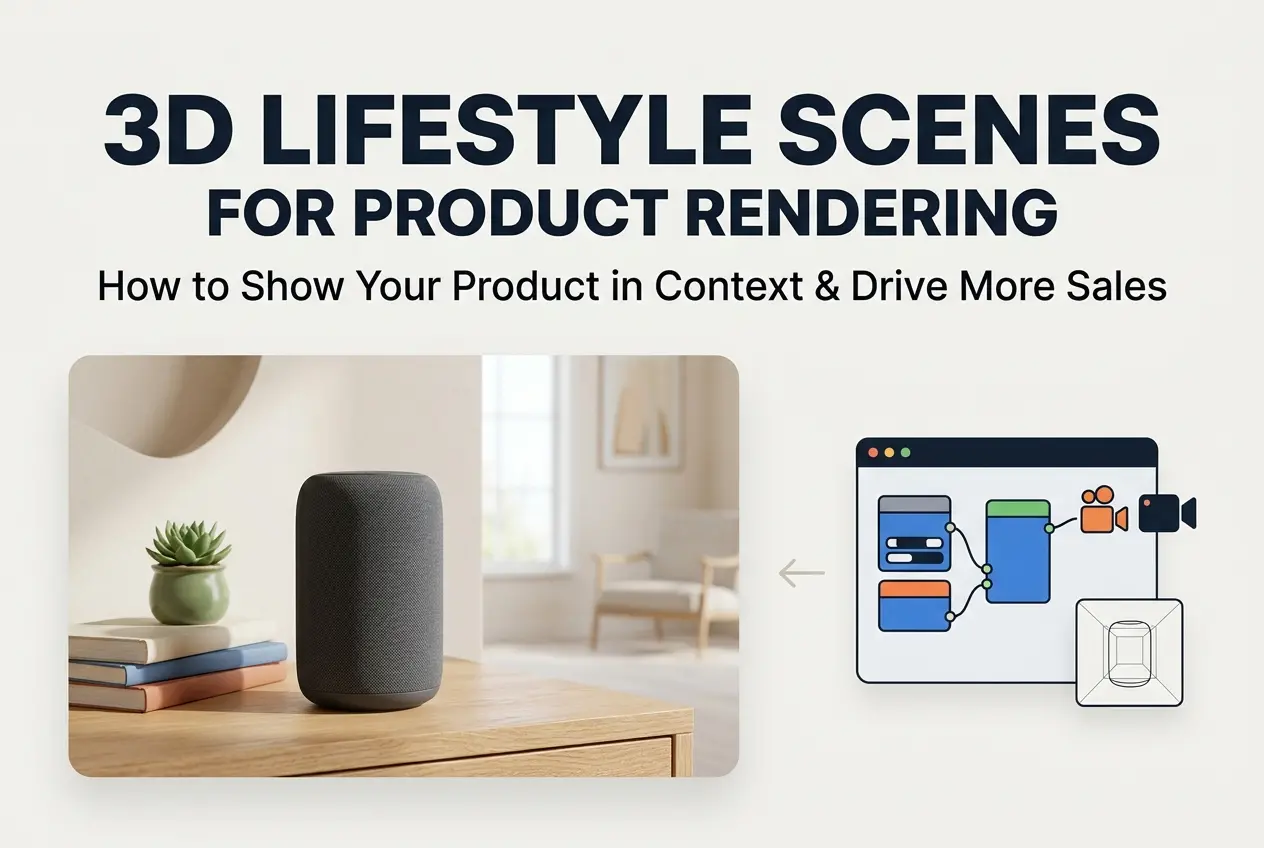
When someone lands on a product page and sees a single object floating on a white background, they’re looking at specs. When they see that same product sitting in a beautifully lit room, styled with complementary furniture, natural light pouring through a window — they’re imagining their life with it. That’s the fundamental difference between a product shot and a lifestyle render, and it’s exactly why 3D lifestyle scenes for product rendering have become one of the most requested services we handle at 360render.com. The goal isn’t just to show your product — it’s to show your product in context and drive more sales by helping buyers picture it in their space before they commit to a purchase.
We work with clients across furniture, home appliances, lighting, HVAC, and consumer electronics — and the pattern we see consistently is this: products shown in realistic, contextual environments get more engagement, require less back-and-forth with sales teams, and convert better at the decision stage. It’s not magic. It’s just how human visual perception works. People don’t buy products in a vacuum. They buy them for their homes, their offices, their lives. Your product imagery should reflect that.
This post breaks down how 3D lifestyle scene rendering works in practice, what makes a scene genuinely effective (versus just pretty), and how to approach this as a strategic part of your product marketing — not just a nice aesthetic upgrade.
What Is a 3D Lifestyle Scene, Exactly?
A 3D lifestyle scene is a fully computer-generated environment that places your product inside a realistic setting — a living room, a kitchen, a bedroom, a retail space, an outdoor terrace. Everything in the scene is modeled and rendered in 3D: the furniture, the walls, the lighting, the props, the textures. Your product is either modeled from scratch or integrated from existing files, and the entire image is rendered using physically accurate lighting engines like V-Ray, Corona, or Chaos Phoenix.
The key word is physically accurate. Modern rendering software simulates how light actually bounces around a space — off walls, through fabric, across glossy surfaces. This is what separates a high-quality lifestyle render from something that looks like a video game screenshot. When done well, the output is indistinguishable from a real photograph. And in many cases, it’s actually better than a photograph because you have total control over every variable: the time of day, the angle of the sun, the color of the walls, the styling of the space.
This is also where the real value proposition kicks in for product brands. You don’t need a physical sample. You don’t need to rent a location, hire a stylist, book a photographer, or ship a prototype overseas for a shoot. All of that gets replaced by a 3D pipeline that can produce multiple variations of the same scene in a fraction of the time.
How 3D Lifestyle Scenes for Product Rendering Drive Real Buying Decisions
When a buyer is browsing products online — whether it’s a sofa, a ceiling fan, or an air conditioning unit — the white-background shot answers one question: what does it look like? The lifestyle scene answers the more important one: where does it belong?
A great example from our own studio work: our client Idealclima, a manufacturer of air conditioning systems, came to us because they needed a way to show their products in real home environments without organizing expensive on-location photoshoots. Air-con units are notoriously difficult to shoot in context — they’re installed high on walls, require specific room setups, and coordinating actual installations just for photography is a logistical headache. We built lifestyle scenes for them showing their units installed in contemporary living rooms, bedrooms, and open-plan spaces — styled to match the markets they were targeting. The result was that Idealclima had a full suite of contextual product imagery without a single physical shoot taking place. They told us this was exactly what they’d been looking for — imagery that showed the product in context the way a real photo could, but without any of the production overhead.
That’s the practical win. But there’s a deeper psychological one too. Seeing a product in a beautiful, relatable space creates emotional association. The product stops being a commodity and starts feeling like part of a lifestyle. That shift — from object to aspiration — is what good lifestyle rendering is designed to trigger.
What Goes Into Building an Effective Lifestyle Scene

Not all lifestyle renders are created equal. We’ve seen plenty of images where the product floats awkwardly in a generic room that looks like a 3D stock scene. That doesn’t work. Here’s what actually matters when building a scene that earns its place in your marketing.
Scene Design That Serves the Product
The environment should support the product, not compete with it. If you’re rendering a minimalist lamp, the room styling needs to breathe — too many busy props will pull attention. If you’re rendering a bold statement piece, the surrounding environment should be more neutral to let the product lead. We always ask clients: who is your buyer, and what space do they live in? A product going into Scandinavian-influenced homes needs different styling than one targeted at Middle Eastern luxury markets or South Asian urban apartments.
Lighting Is the Real Work
Lighting in a lifestyle scene is what makes or breaks the render. Natural light behaves differently at different times of day, through different window types, in differently sized rooms. We set up HDRI environments or custom sun-sky systems and then layer in artificial light sources to match the mood of the scene. For product rendering specifically, we’re always careful to make sure the light flatters the product’s key features — the shine on a metal finish, the softness of an upholstered surface, the glow of a display panel.
This is where having a technical director involved makes a significant difference. Lighting decisions that look minor in isolation — the angle of a window, the intensity of a floor lamp — change the entire perception of a product’s quality.
Camera Angle and Composition
The camera position in a lifestyle render is a deliberate choice, not just a default view. We shoot from eye-level angles for products that benefit from being seen as a person would see them in a room. We use slightly elevated angles for surfaces and tabletop products. For architectural products like HVAC units or built-in appliances, we frame the product within the architecture, the way an interior photograph would. Composition rules — rule of thirds, leading lines, negative space — apply here exactly as they do in actual photography.
Common Mistakes Clients Make When Requesting Lifestyle Renders
We’ve worked with enough brands to know where the process goes sideways. Here are the honest mistakes we see repeatedly.
Providing low-quality product files and expecting perfection. The render is only as good as the model. If you send us a rough CAD file with no material references, no finish details, and no dimensions confirmed, the lifestyle scene will take longer and require more revisions. Before briefing any studio, get your product model in the best possible shape. Ideally, provide STEP or OBJ files along with reference photos showing the actual finishes.
Asking for a generic scene with no market direction. “Just put it in a nice room” is not a brief. A nice room in Stockholm looks completely different from a nice room in Mumbai or Dubai. Tell your rendering studio who the buyer is, where they live, what their aesthetic preferences are. The more specific the brief, the better the output.
Treating the lifestyle render as the last step instead of a strategic asset. Lifestyle renders can be repurposed across e-commerce listings, social media, trade catalogues, dealer portals, and packaging. Clients who plan for that from the start — requesting multiple camera angles, multiple scene variations, and transparent-background cutouts alongside the lifestyle images — get significantly more value from the same production budget.
Formats, Deliverables, and What to Ask For

When you commission a lifestyle scene, you should be asking for more than just one final JPEG. A properly structured deliverable package from a studio like ours typically includes high-resolution renders at print-ready sizes, web-optimized versions, multiple camera angles from the same scene, and sometimes short animated turntables or camera flythrough clips for video content.
For e-commerce specifically, you’ll want lifestyle images alongside your white-background cutouts — many platforms require both. We often set up the same 3D scene to export both: the full styled lifestyle render and an isolated product render against a clean background, both coming from the same accurate 3D model. This keeps everything consistent across your product catalogue.
If you’re scaling a large product range — say, an entire collection of furniture or multiple SKUs of an appliance range — a lifestyle render pipeline is far more efficient than photography. You build the scene once, populate it with different products, adjust materials and configurations, and render multiple variants. That kind of flexibility is simply not possible with physical shoots.
Is 3D Lifestyle Rendering Right for Your Product?
Honestly, it works best for products that have a natural home: furniture, lighting, appliances, decor, kitchenware, bathroom fittings, electronics. Anything that gets installed, placed, or used in a physical space. If your product has complex configurations or colour variants, lifestyle rendering is especially valuable because you can show every variant without producing every variant physically.
It’s less obviously suited for something like a medical device with a clinical use context, or a raw industrial component. But even then, contextual rendering — showing the product in its operating environment — often adds more clarity than an isolated technical shot.
If you’re selling on platforms like Amazon, Houzz, Wayfair, or your own DTC site, lifestyle scenes are close to essential now. Buyers expect to see the product in a real space. The brands that provide that context win attention over those that don’t.
At 360render.com, we’ve built lifestyle render pipelines for product brands across India, Europe, and the Middle East — from single hero images to full catalogue workflows. If you’d like to discuss what a 3D lifestyle scene could look like for your product range, get in touch with our team and let’s talk through your brief. We’ll tell you honestly what’s achievable, what it takes, and how to get the most out of the process.
Frequently Asked Questions
What are 3D lifestyle scenes for product rendering and how do they differ from standard product shots?
3D lifestyle scenes are computer-generated environments that place your product within a realistic, relatable context—such as a living room, kitchen, or outdoor setting—rather than displaying it against a plain white background. Unlike standard product shots that isolate the item, lifestyle renders show the product in use or in a natural setting, helping customers emotionally connect with it and visualize it in their own lives. This contextual storytelling approach has been shown to significantly increase purchase confidence and reduce return rates.
How do 3D lifestyle product renders help increase sales and conversion rates?
3D lifestyle renders drive sales by bridging the imagination gap between a customer seeing a product online and picturing it in their own space, which directly reduces purchase hesitation. Studies in e-commerce show that contextual product imagery can boost conversion rates by up to 40% compared to plain background shots because shoppers gain a clearer sense of scale, style, and real-world application. Additionally, these renders can be tailored to target specific buyer personas or interior styles, making the product feel more personally relevant to different customer segments.
What types of products benefit most from 3D lifestyle scene rendering?
Products in categories like furniture, home décor, kitchenware, consumer electronics, apparel accessories, and beauty products benefit enormously from 3D lifestyle rendering because buyers heavily rely on context to judge fit, scale, and aesthetic compatibility before purchasing. High-ticket or visually complex items especially gain an advantage, as lifestyle scenes justify the price point by communicating quality and craftsmanship within a premium environment. Even small products like candles or skincare items can see dramatic engagement increases when placed in aspirational, well-lit lifestyle settings.
Is 3D lifestyle product rendering more cost-effective than traditional lifestyle photography?
Yes, 3D lifestyle rendering is often significantly more cost-effective than traditional photography once you factor in expenses like studio rental, professional photography, props, models, set design, and logistics. With 3D rendering, a single scene can be reused and modified endlessly—swapping colors, materials, or backgrounds—without any additional photoshoot costs, making it ideal for product variants or seasonal campaigns. For brands with large catalogs or frequent product updates, the long-term savings and flexibility of 3D renders far outweigh the initial investment in high-quality CGI assets.
How do I choose the right 3D lifestyle scene style to match my brand and target audience?
Choosing the right lifestyle scene style starts with understanding your target audience’s aspirations, living environments, and aesthetic preferences—for example, a minimalist Scandinavian setting appeals to a different buyer than a warm, rustic farmhouse backdrop. Your brand identity should also guide decisions around lighting mood, color palettes, and prop selection to ensure the render feels cohesive with your overall marketing visuals. Working with an experienced 3D rendering studio or artist who specializes in product visualization can help you translate brand guidelines into compelling, on-strategy scenes that resonate with your specific customer base.
Also read: How 3D Product Rendering Works for Consumer Electronics: From CAD to Final Packshot