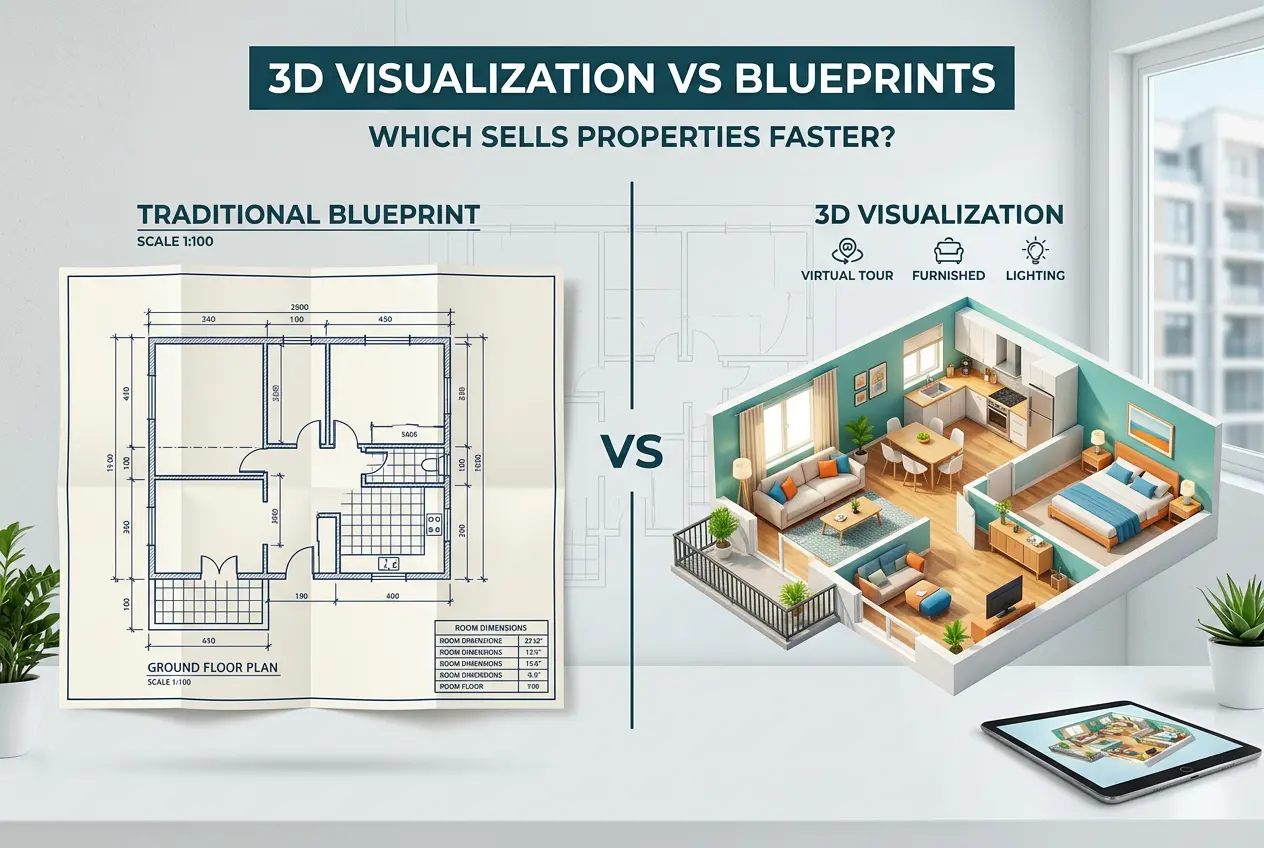
If you’ve ever tried to sell a property using nothing but a flat, technical blueprint, you already know the struggle. Buyers glaze over. They can’t picture themselves living there. They ask the same questions over and over — “Where does the light come in? How big does the kitchen actually feel?” The debate around 3D Floor Plan Visualization vs Traditional Blueprints: Which Sells Properties Faster? has become one of the most practical conversations happening in real estate marketing right now. And it’s not just a matter of preference. The format you choose to present a property directly affects how quickly buyers commit.
Traditional blueprints have served architects and engineers well for over a century. They’re precise, technical, and loaded with information. But here’s the thing — they were never designed for buyers. They were designed for builders. When a prospective homeowner squints at a 2D floor plan with tiny measurements and room labels printed in a small font, they’re doing mental gymnastics just to understand the space. Most people simply can’t do it. And in a competitive market, confusion is the enemy of conversion.
This is where 3D floor plan visualization steps in — not as a gimmick, but as a genuine communication tool. It bridges the gap between a technical drawing and a human experience. Let’s break down exactly how these two formats compare, and which one gives property sellers the real edge.
Understanding the Core Difference: Blueprint vs. 3D Visualization
A traditional blueprint is essentially a top-down, flat representation of a property drawn to scale. It shows walls, doors, windows, and room dimensions. For a trained professional — an architect, contractor, or engineer — this is incredibly useful. For a first-time homebuyer? It’s often close to unreadable without some guidance.
A 3D floor plan visualization takes the same spatial information and renders it in three dimensions, often with furniture, lighting, textures, and color. It gives buyers a bird’s-eye view that actually makes sense to the human eye. You can see how the open-plan kitchen flows into the living room. You can understand why the master bedroom feels spacious. You can spot that the second bedroom, while smaller on paper, still fits a queen bed and a wardrobe.
The key distinction is emotional legibility. Blueprints communicate information. Visualizations communicate experience. In property sales, experience wins every time.
Why Buyers Struggle With Traditional Blueprints
Let’s be honest — most buyers are not trained to read architectural drawings. When someone is looking for their next home or investment property, they’re thinking about lifestyle, not load-bearing walls. Presenting a flat blueprint asks them to perform a cognitive task they haven’t been trained for. That friction slows decisions.
There’s also an emotional dimension here. Buying property is one of the biggest financial decisions most people will ever make. Emotion plays a huge role in that process. Blueprints are cold. They’re clinical. They don’t evoke the feeling of Sunday morning sunlight pouring through a bay window or the sense of space in a well-designed open-plan living area.
Agents frequently report that when only blueprints are available — especially for off-plan or pre-construction properties — buyers take longer to commit. They need more viewings, more conversations, more reassurance. That translates directly into a longer sales cycle.
3D Floor Plan Visualization vs Traditional Blueprints: Which Sells Properties Faster? — A Real-World Perspective
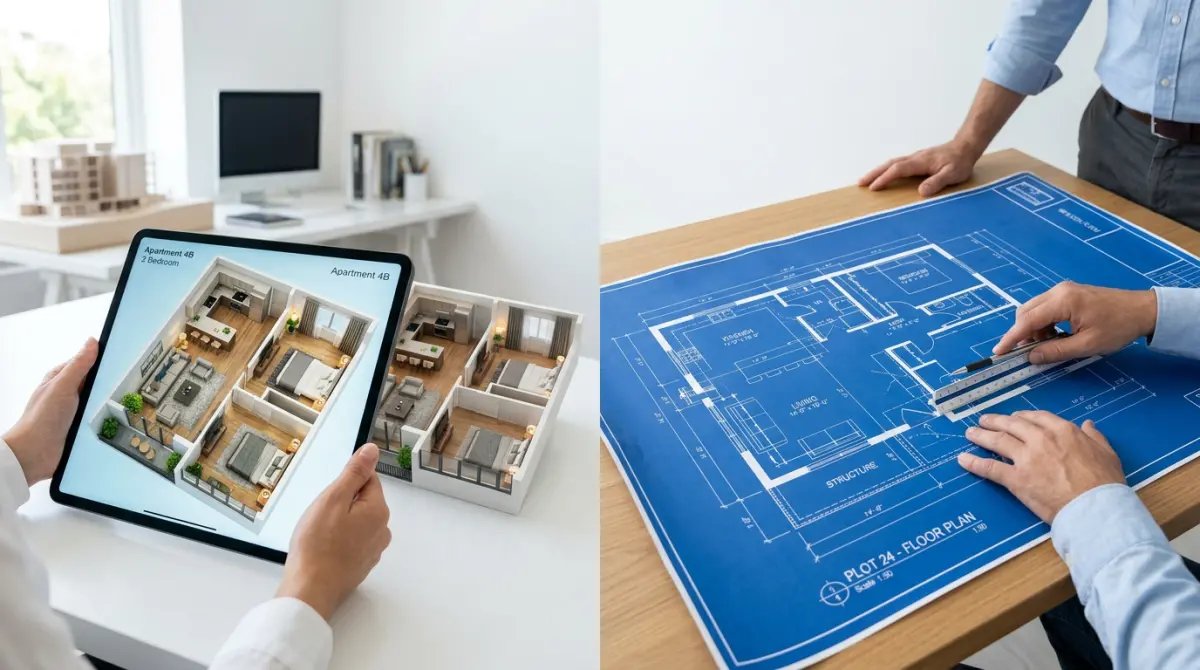
Consider a common scenario in new development sales. A developer is selling 40 units in a residential apartment block that hasn’t been built yet. There’s no show apartment. There’s nothing to walk through. The sales team has blueprints and maybe a few interior mood boards.
In this situation, buyers are being asked to invest hundreds of thousands of dollars in something they cannot see or feel. That’s a massive ask. Now imagine the same scenario, but the developer uses detailed 3D floor plan rendering services to present each unit type with fully furnished, photorealistic overhead views. Buyers can see the exact layout with context. They can compare a one-bedroom layout to a two-bedroom layout in a way that actually makes visual sense.
The difference in buyer confidence is palpable. Questions reduce. Decision time shortens. Buyers feel informed rather than uncertain. And in off-plan sales especially, that confidence is everything.
What 3D Visualization Actually Does to Buyer Behavior
When you put a great 3D floor plan in front of a buyer, a few things happen almost immediately. First, they orient themselves. They find the front door, trace the hallway, locate the main living areas. This happens naturally and quickly because the image mirrors how we understand physical space.
Second, they start to imagine. They picture their furniture in the living room. They think about where their morning coffee routine would play out. This kind of mental inhabiting is a precursor to buying. Once a buyer starts imagining their life in a space, they’ve emotionally invested. That’s powerful.
Third, they ask better questions — and fewer of them. Rather than “I’m not sure I understand how the rooms connect,” they’re asking things like “Is there any flexibility on that internal wall?” or “Can we upgrade the kitchen finishes?” These are buying questions, not orientation questions. That shift is exactly what sales teams need.
For developers working on larger projects, combining floor plans with other visual tools amplifies this effect significantly. A 3D architectural rendering of the building exterior paired with a detailed interior floor plan gives buyers a complete picture — from how the building looks on the street to how their specific unit is laid out inside. That combination builds trust fast.
When Blueprints Still Have a Place
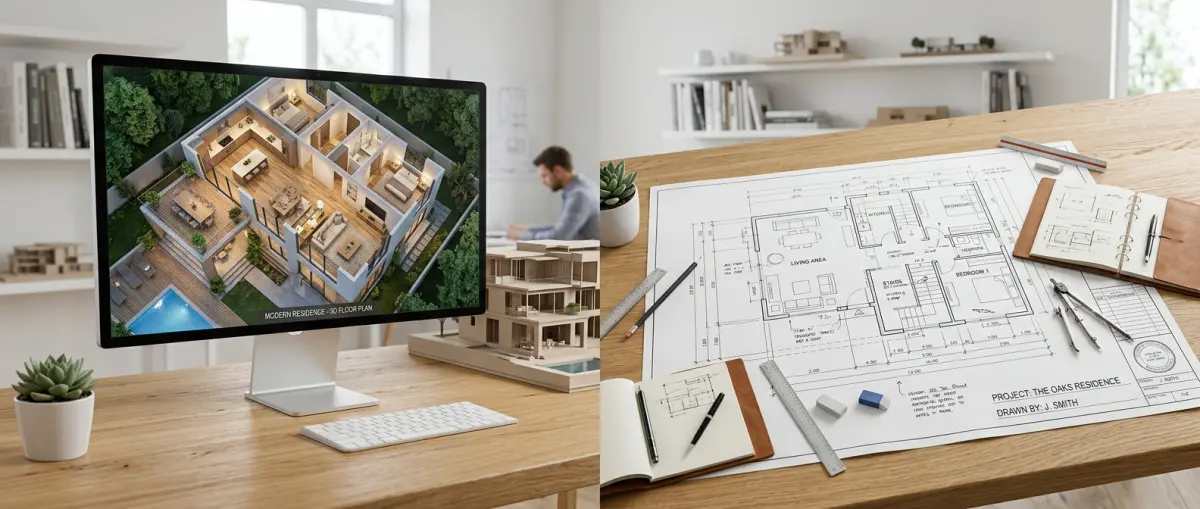
To be fair, blueprints aren’t obsolete. They still serve a very specific and important purpose. During the construction phase, contractors and engineers rely on precise technical drawings that no 3D visualization can replace. When buyers want to understand exact structural details or plan renovations, technical floor plans provide information that rendered images don’t.
Some sophisticated investors also prefer blueprints because they’re used to reading them and find the precision more useful than an artistic rendering. So it’s not about one format being universally better — it’s about knowing your audience and using the right tool for the right context.
For the purpose of selling property, especially to end-users and first-time buyers, visualization wins almost every time. For the purpose of building, coordinating, and approving construction, blueprints remain essential. Smart property marketers use both.
Practical Tips for Using 3D Floor Plans in Property Marketing
If you’re a developer, agent, or property marketer looking to get the most from 3D floor plan visualization, here are some practical ways to do it well.
1. Furnish the Space Thoughtfully
A 3D floor plan with appropriate, tasteful furniture gives buyers a sense of scale they simply can’t get from an empty room outline. Don’t overcrowd the space — choose furniture that reflects the target buyer. A young professional demographic responds to minimalist, contemporary setups. Family buyers want to see a family dining table and a sofa they can picture themselves on.
2. Show Multiple Unit Types Side by Side
If you’re marketing a development with several unit configurations, showing them in consistent visual format allows buyers to make meaningful comparisons. This reduces back-and-forth and helps buyers self-select into the right unit for their needs, speeding up the whole decision-making process.
3. Pair With Interior Renders for Off-Plan Sales
A floor plan shows layout; an interior render shows atmosphere. Using both together is particularly powerful for off-plan developments. Buyers get the logical overview from the floor plan and the emotional pull from the 3D interior rendering. Together, they cover both sides of the buying decision — rational and emotional.
4. Use High-Resolution Formats for Digital and Print
Your 3D floor plans will appear on property portals, in brochures, on social media, and in presentations. Make sure your renderings are produced at a resolution that holds up across all these formats. Blurry or pixelated images undermine the professional impression you’re trying to create.
5. Keep It Accurate
The worst thing you can do is show a 3D floor plan that misrepresents the actual layout — even slightly. If buyers feel misled when they finally visit or receive their property, trust collapses immediately. Work with your visualization provider to ensure every dimension is accurate and every room reflects reality.
The Marketing Impact Goes Beyond the Sales Room
Here’s something agents sometimes overlook: 3D floor plans don’t just help buyers in one-on-one conversations. They work around the clock on listing platforms, in email campaigns, and across social channels. A beautifully rendered floor plan catches the eye in a scroll. It gets saved, shared, and referenced. That kind of passive marketing doesn’t happen with a flat technical drawing.
For property developers with multiple projects running simultaneously, having a consistent library of high-quality visual assets — including floor plans, exterior views, and interior renders — creates a professional brand image that attracts buyers and investors alike. Consistency in quality signals credibility. And in property sales, credibility is the foundation everything else is built on.
Conclusion: Make the Choice That Closes Deals
So where does this leave us on 3D Floor Plan Visualization vs Traditional Blueprints: Which Sells Properties Faster? The answer, in practical terms, is clear. When your goal is to help buyers understand, connect with, and commit to a property — especially one they can’t physically visit yet — 3D visualization does the job that blueprints simply weren’t built for.
Blueprints remain essential in construction and technical planning. But in the hands of a sales team, they’re a missed opportunity. A well-produced 3D floor plan speaks to buyers in a language they already understand. It reduces hesitation, builds confidence, and shortens the path from interest to offer.
If you’re ready to give your property listings the visual edge they deserve, the team at 360render.com can help. Whether you need a single unit floor plan or a full suite of visuals for a large development, explore our 3D rendering services and let’s talk about what your project needs.
Frequently Asked Questions
Do 3D floor plan visualizations actually help sell properties faster than traditional blueprints?
Yes, studies and real estate industry data consistently show that listings featuring 3D floor plan visualizations sell significantly faster than those using only traditional blueprints. Properties with 3D visuals receive up to 49% more qualified leads because buyers can immediately understand spatial relationships, room flow, and scale without needing architectural training. This accelerated buyer decision-making directly reduces average days on market.
What is the cost difference between creating a 3D floor plan visualization versus a traditional blueprint?
Traditional blueprints typically cost between $500 and $2,000 depending on property size and complexity, while professional 3D floor plan visualizations range from $200 to $1,500 for standard residential properties. However, the gap has narrowed significantly with modern software tools, and many real estate photographers now offer 3D floor plans as affordable add-ons starting at $150. Considering the faster sales cycle and potentially higher offers 3D visuals generate, most real estate professionals find the ROI strongly favors 3D visualization.
Can buyers understand 3D floor plans better than traditional blueprints without any technical knowledge?
Absolutely, this is one of the most significant advantages of 3D floor plan visualization, as they are designed specifically for non-technical audiences unlike blueprints which require architectural literacy to interpret correctly. Research shows that over 85% of homebuyers report feeling more confident about a property's layout after viewing a 3D floor plan compared to a traditional 2D blueprint. The intuitive bird's-eye perspective with realistic furnishings and textures allows buyers to mentally move through the space and envision their lifestyle before ever visiting in person.
Are 3D floor plan visualizations better for online real estate listings and digital marketing?
3D floor plan visualizations are dramatically more effective for digital marketing because they are visually engaging, shareable, and optimized for the way modern buyers browse property listings on mobile devices and real estate platforms like Zillow and Realtor.com. Listings featuring 3D floor plans see up to 300% more engagement and longer page dwell times compared to listings with traditional blueprints, which translates directly into more inquiries and showings. Additionally, 3D floor plans perform exceptionally well in social media advertising campaigns where visual impact is critical for stopping the scroll.
When should real estate agents still use traditional blueprints instead of 3D floor plan visualizations?
Traditional blueprints remain essential during the construction, permitting, and renovation phases of a property because they provide precise technical measurements, structural details, and compliance specifications that architects, contractors, and building inspectors legally require. For commercial real estate transactions involving sophisticated investors and developers, blueprints may also be requested as part of due diligence documentation to verify structural integrity and zoning compliance. However, even in these professional contexts, most agents supplement blueprints with 3D visualizations for marketing purposes to maximize buyer appeal and accelerate the sales process.