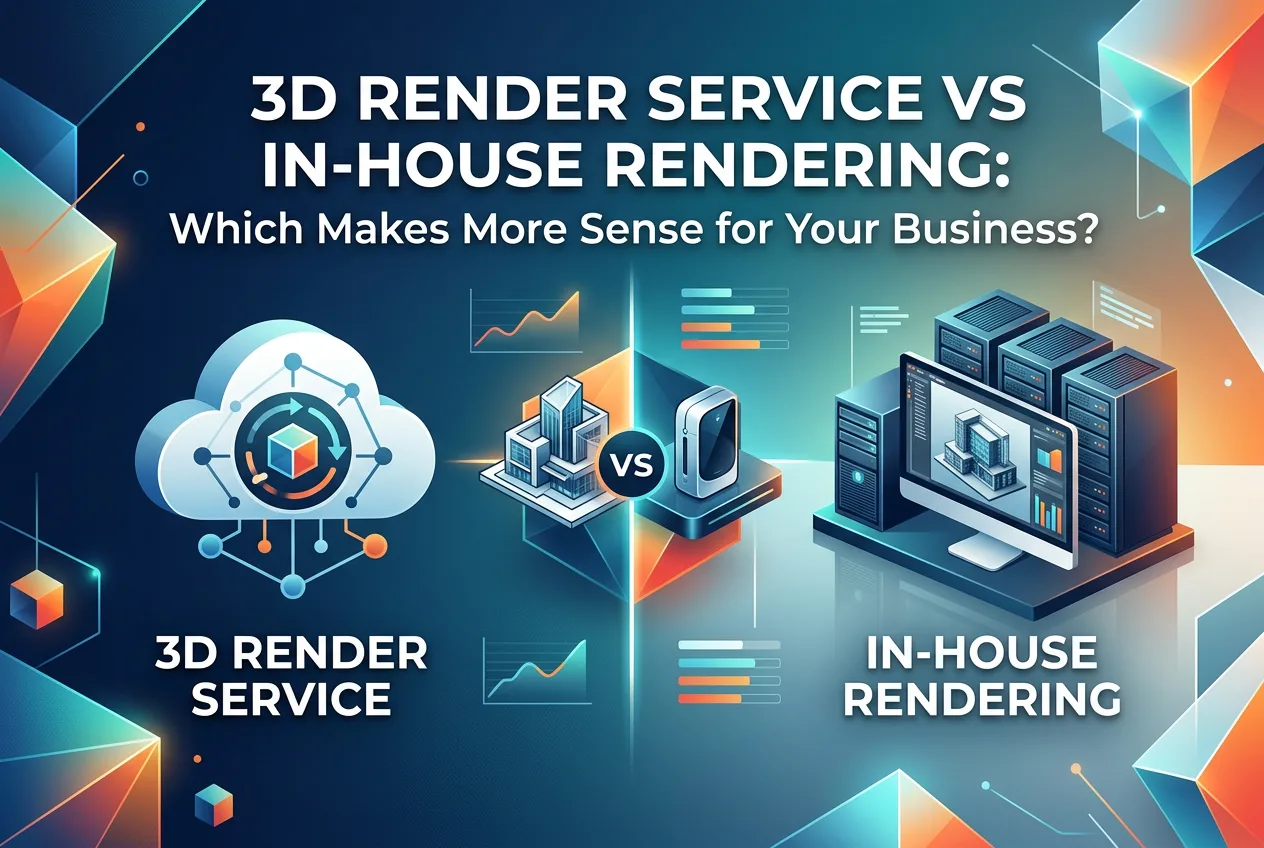
3D Render Service vs In-House Rendering: Which Makes More Sense for Your Business?
If you’ve been weighing up the question of 3D Render Service vs In-House Rendering: Which Makes More Sense for Your Business?, you’re definitely not alone. It’s one of the most common decisions that architects, developers, interior designers, and product companies face as 3D visualization becomes more central to how they sell, pitch, and communicate ideas. The answer isn’t always obvious — and honestly, it depends on a lot of factors specific to your workflow, budget, and output needs.
Some businesses jump straight into building an in-house team, attracted by the idea of full control and faster turnarounds on small revisions. Others outsource from day one and never look back. Both approaches have real merit. But there are also pitfalls that aren’t obvious until you’re already committed. In this post, we’re going to break it all down honestly — costs, quality, flexibility, scalability — so you can make a genuinely informed decision.
Whether you’re a solo architect trying to impress high-value clients, a real estate developer pitching a new community, or a product company that needs photorealistic visuals on a tight launch timeline, the right rendering strategy can make a real difference to your bottom line.
The Real Cost of Building an In-House Rendering Team
Let’s start with money, because it’s usually the first concern. Building an in-house rendering capability isn’t just about hiring one person who knows their way around 3ds Max or Cinema 4D. It’s a significant infrastructure investment that compounds over time.
First, there’s the hardware. High-quality 3D rendering is computationally intensive. A single workstation capable of handling complex architectural scenes with realistic lighting can cost anywhere from $5,000 to $15,000 — and that’s before you factor in render farms for larger projects. Then there’s software licensing. Industry-standard tools like V-Ray, Lumion, Corona Renderer, or Chaos Cloud don’t come cheap. Annual licenses can run into thousands of dollars per seat.
Then you’ve got the human element. A skilled 3D visualization artist commands a competitive salary — often $60,000 to $100,000+ per year depending on location and experience level. Add in benefits, training, management time, and onboarding, and the true cost of one in-house artist climbs fast. And here’s the thing — one artist is rarely enough if you have multiple projects running simultaneously.
Contrast that with a professional 3D rendering service, where you pay per project or per deliverable. No overhead, no idle capacity during slow periods. You only pay for what you actually need.
Quality and Specialization: Where Outsourcing Often Wins
Here’s something that doesn’t get discussed enough: specialization matters enormously in 3D visualization. A generalist artist who does a bit of everything is rarely going to match the output quality of a team that does nothing but architectural rendering, product visualization, or real estate marketing imagery all day, every day.
Professional rendering studios develop deep workflows, material libraries, lighting setups, and post-processing techniques that take years to refine. When you hire a dedicated service, you’re not just buying their time — you’re buying their accumulated expertise across hundreds or thousands of projects.
For example, if you need high-quality architectural rendering services, a specialized studio will know exactly how to handle complex glass facades, outdoor ambient lighting at different times of day, and how to stage a scene to make a building feel inviting rather than sterile. That level of craft takes serious experience to get right.
In-house artists can absolutely develop these skills over time — but during that learning curve, you’re potentially delivering subpar visuals to clients who have high expectations. That’s a risk not every business can afford.
Speed and Scalability: The Flexibility Factor
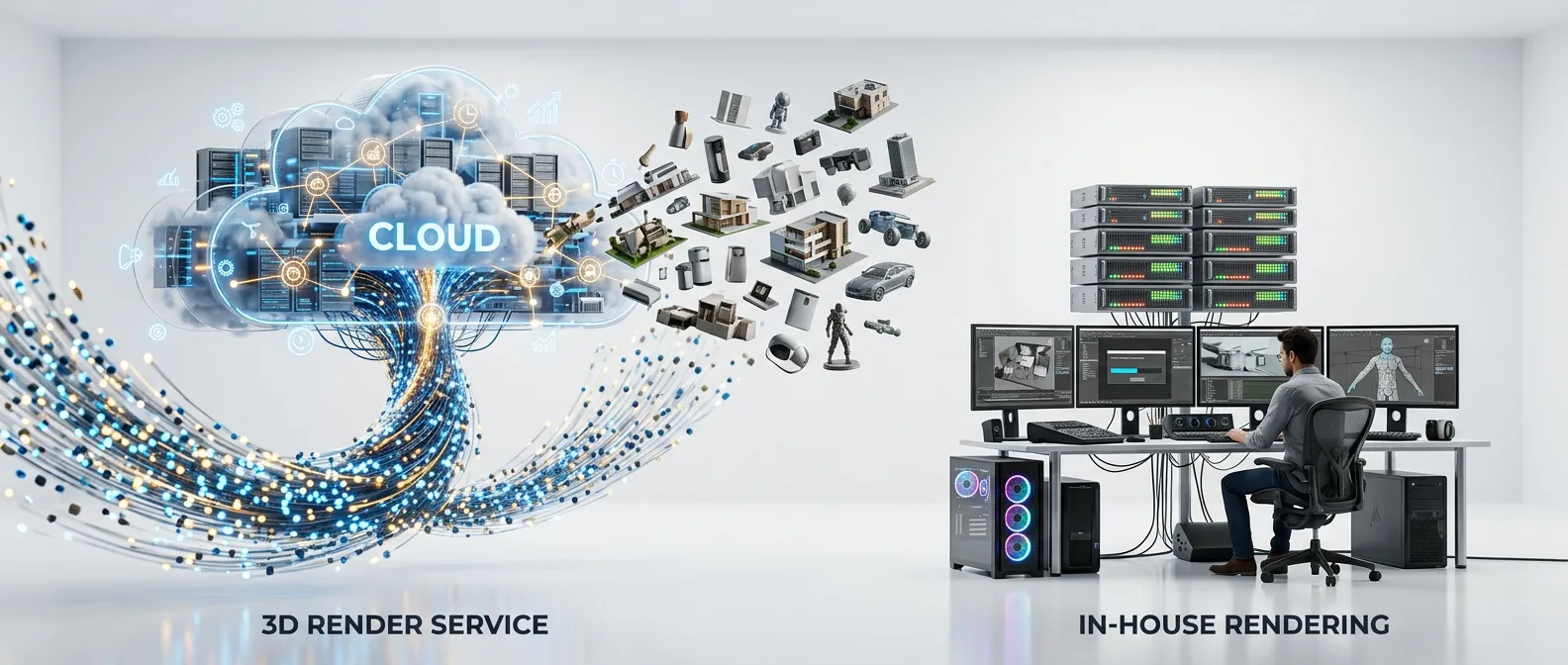
One argument you’ll often hear for in-house rendering is speed. The thinking goes: if your artist is right there in the office, you can get revisions done in hours rather than days. And there’s some truth to that — for quick tweaks and minor changes, having someone on hand is genuinely useful.
But scale is where in-house setups really struggle. Say you land a big development project with 20 individual units, each needing interior and exterior views, plus drone-level aerial perspectives and marketing hero shots. Suddenly, your one or two in-house artists are buried for months. You either miss deadlines, lower your quality bar, or turn away other work.
A professional rendering partner scales with you. Need 50 images in four weeks? A studio with a full team and render farm can handle that without breaking a sweat. Need just three images for a small residential pitch? They can handle that too. That kind of flexibility is genuinely difficult to replicate internally without significant staffing investment.
This scalability is especially valuable for real estate developers and property marketers. If you need compelling real estate rendering services to support a pre-sales campaign, timing is everything — and a studio built around high-volume output is often your best bet.
When In-House Rendering Actually Makes Sense
To be fair, there are real scenarios where building in-house capacity is the smarter move. It’s not always the wrong choice — it just needs to fit your specific situation.
If your business produces a very high volume of relatively straightforward visualizations on a consistent basis, the math can shift. A large interior design firm producing dozens of client presentations every month might find that a dedicated in-house artist pays for themselves relatively quickly compared to ongoing outsourcing costs.
Similarly, if your work requires extremely tight revision cycles and real-time collaboration — think design-build firms where the model is being updated constantly — having someone in-house can streamline that feedback loop significantly.
There’s also the IP and confidentiality angle. Some businesses work on sensitive projects where sharing design files with external vendors is genuinely problematic. In those cases, in-house rendering isn’t just convenient — it’s necessary.
And frankly, some companies just prefer the control. Having a team member who understands your brand, your clients, and your standards deeply can produce more consistent results over time, even if the per-project cost is higher.
A Practical Way to Think About the Decision
Rather than treating this as a binary either/or choice, many businesses find that a hybrid model works best. Use an in-house artist for quick conceptual visuals and minor revisions during the design process. Then bring in a specialized service for the high-stakes, client-facing deliverables that really need to shine.
Here are some practical questions to help guide your thinking:
- How consistent is your rendering workload? Peaks and valleys favor outsourcing. Steady, predictable volume favors in-house.
- What quality level do your clients expect? If photorealism is non-negotiable, experienced studios have a genuine edge.
- What’s your runway? Early-stage businesses rarely have the capital to justify in-house infrastructure. Established firms have more options.
- Do you need specialized output types? Things like 3D animation services, 360-degree virtual tours, or interactive walkthroughs require specialized skills that are hard to maintain in-house unless you do them constantly.
- How fast do you need to scale? If you’re growing quickly, outsourcing gives you flexibility without locking you into overhead commitments.
There’s also the question of what you’re actually trying to render. Product visualization has different requirements than large-scale exterior architecture. Interior design work is different from engineering and industrial visualization. A studio that specializes in your category will almost always outperform a generalist.
Real Examples: How Different Businesses Approach This
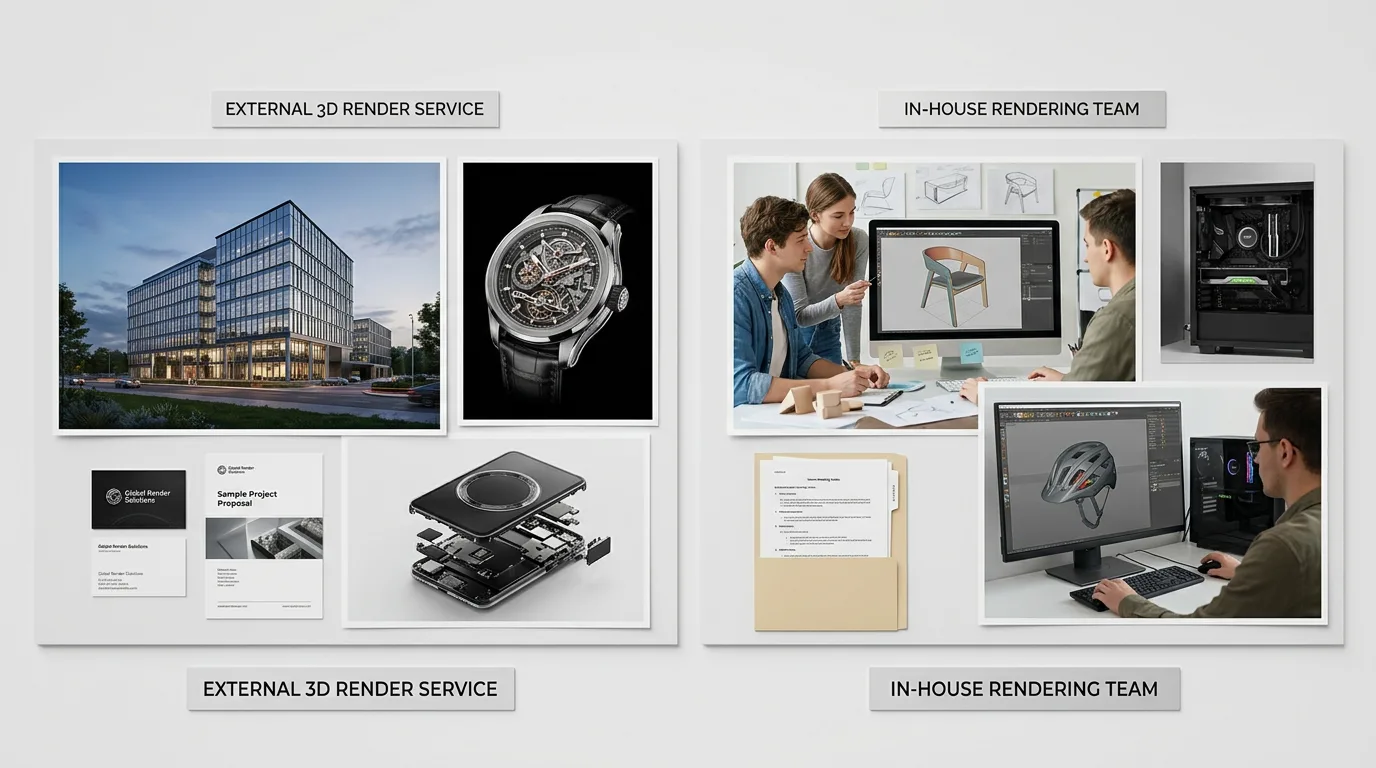
Consider a mid-size real estate development company that was spending around $120,000 per year on one in-house 3D artist — salary, equipment, software, and overhead included. They were getting decent results but struggling with larger projects and specialized outputs like aerial views and animated walkthroughs. After switching to a dedicated rendering partner, they cut their visualization spend by about 40% while actually improving output quality and turnaround time on their biggest campaigns.
On the flip side, a high-volume interior design studio that produces 15–20 client presentations per month built a small in-house team of two artists and found it cost-effective within about 18 months. Because their output type was consistent and their revision process was highly collaborative, having people in-house genuinely made sense for their workflow.
The lesson here? Neither model is universally superior. The right answer depends entirely on your volume, your output needs, your budget, and how much you value flexibility vs. control.
For businesses that handle physical products, the calculus is also different. Companies needing precise product rendering services for e-commerce, packaging, or marketing campaigns often find that specialist studios produce better results faster — especially when photorealism and material accuracy are critical for driving sales conversions.
So, 3D Render Service vs In-House Rendering: Which Makes More Sense for Your Business?
Honestly? For most small-to-mid-size firms, outsourcing to a specialist studio wins on almost every practical measure — lower upfront investment, better access to specialized expertise, easier scaling, and access to the latest techniques without having to retrain your own staff constantly.
But for high-volume operations with consistent, predictable needs — especially when tight revision cycles and brand consistency are top priorities — building in-house capacity can absolutely be justified over the long term.
The key is to do the actual math for your specific situation. Don’t romanticize either option. Look at your real project volume, your real quality requirements, and your real budget constraints — and make the decision that fits those facts.
If you’re not sure where to start, it often makes sense to try outsourcing first. You can always bring things in-house later if the numbers support it. The reverse — dismantling an in-house setup that’s not working — is a lot more painful and expensive.
Ready to See What a Professional Rendering Partner Can Do?
If you’re curious about what working with a specialist studio actually looks like — in terms of process, pricing, and quality — we’d love to show you. At 360render.com, we work with architects, developers, designers, and product companies of all sizes to produce photorealistic visuals that win pitches, drive sales, and make projects come to life before a single brick is laid.
Take a look at our full range of 3D rendering services to see how we can support your next project — or get in touch with our team to talk through your specific needs. No pressure, no fluff — just a straight conversation about whether we’re the right fit for what you’re working on.
Frequently Asked Questions
What is the cost difference between using a 3D render service and building an in-house rendering team?
Hiring a professional 3D render service typically costs between $500 to $5,000 per project depending on complexity, while building an in-house team requires investing $50,000 to $150,000 annually in salaries, software licenses, and high-performance hardware. For businesses with irregular rendering needs, outsourcing is almost always more cost-effective, whereas companies requiring daily high-volume output may find in-house rendering delivers better long-term ROI. A detailed cost-benefit analysis based on your project frequency and complexity is the best way to determine which option saves more money.
How do turnaround times compare between outsourced 3D rendering services and in-house rendering teams?
Professional 3D render services often deliver completed visuals within 24 to 72 hours for standard projects, leveraging dedicated render farms and specialized workflows that most small in-house teams cannot match. In-house teams may have faster communication cycles but can face delays due to hardware bottlenecks, employee availability, and competing internal priorities. If speed-to-market is critical for your business, outsourcing to a service with render farm infrastructure typically provides faster and more predictable delivery timelines.
What types of businesses benefit most from outsourcing to a 3D render service rather than rendering in-house?
Small to mid-sized businesses in real estate, e-commerce, product design, and architecture tend to benefit most from outsourcing because they require high-quality visuals without consistent enough demand to justify a full in-house team. Startups and growing companies especially gain flexibility by paying only for renders they need rather than carrying the overhead of full-time 3D artists and expensive workstations. Businesses with seasonal peaks in rendering demand also benefit greatly from the scalable capacity that professional render services provide.
How does quality and creative control differ when using a 3D render service versus an in-house rendering team?
In-house rendering teams offer greater day-to-day creative control since team members are embedded in your brand culture, can attend internal meetings, and iterate quickly based on direct feedback. However, top-tier 3D render services often employ highly specialized artists with broader industry experience, potentially delivering superior quality for complex or photorealistic projects. The key is choosing a render service that offers a clear revision process and strong communication protocols to ensure your brand standards and creative vision are consistently met.
What are the hidden costs of in-house 3D rendering that businesses often overlook when comparing it to outsourcing?
Beyond salaries, in-house rendering requires ongoing investment in GPU upgrades, rendering software subscriptions like V-Ray or Chaos Cloud, IT support, and training costs that can add tens of thousands of dollars annually to your budget. Employee turnover in creative roles is also costly, with replacement and onboarding expenses often exceeding 50% of an annual salary. These hidden costs frequently make in-house rendering significantly more expensive than it initially appears when compared to the predictable per-project pricing of professional 3D render services.